At the Lithuanian Academy of Music and Theatre, Sonus has delivered a professional-grade AV, acoustics, and stage technology integration across teaching, rehearsal, production, and performance spaces. Anna Mitchell reports.
The Lithuanian Academy of Music and Theatre (LMTA) in Vilnius is not simply upgrading classrooms. In one major phase of a wider, multistage campus development, the academy has created a set of environments that allow students to learn inside the conditions they will encounter in professional theatres, studios, and production facilities.
The project brings together two faculties and equips approximately 30 spaces with AV, acoustics, lighting, rigging, stage technology, and production infrastructure. Future phases will extend the campus with five additional buildings, but this stage already marks a significant shift in how the academy approaches creative education.
Sonus, the Lithuanian integrator appointed to deliver the technological systems, was faced with a brief that demanded more than equipment supply. It required a joined-up approach to learning, performance, acoustics, technical workflow, and long-term operation.

“The core brief was to design and integrate the technological infrastructure for the Theatre and Dance Faculty, and Film Faculty spaces at LMTA,” says Edmundas Žižys, CEO of Sonus. “However, from the earliest stages, Sonus became involved far beyond the AV specification itself.”
That wider role shaped the project. Sonus contributed to venue layout planning, operational logistics, audience and performer flows, acoustic strategy, and the integration of technology into the architecture. The aim was to avoid the familiar problem of systems being added late in the construction process. Instead, the AV and stage technologies were designed as part of the building’s creative purpose.
A defining principle was that the spaces should not feel like simplified educational versions of professional environments. Students studying theatre, dance, film, sound design, lighting, and production needed to work with tools that reflect the standards of the industries they are preparing to enter.
“From the beginning, the goal was to eliminate the gap between educational environments and real-world professional production spaces,” says Žižys. “Rather than creating simplified educational systems, we implemented professional-grade infrastructure throughout the facility.”

That philosophy is evident in the range of rooms delivered. The project includes acting and dance auditoriums, teaching spaces, a Black Box theatre, a cinema hall, a theatrical Dolby Atmos mix studio, recording and post-production studios, film shooting studios, and spaces designed for sound, light, and spatial experimentation.
Many of these rooms are transformable. Acting and dance spaces can shift from daily teaching and rehearsal use into performance environments with lighting, sound, audience layouts, and scenic possibilities. In one auditorium, retractable amphitheatre seating can be withdrawn to create an open, multi-use floor. A wired lectern can be removed, and pre-programmed audio configurations allow the space to support different stage positions rather than forcing every production into a fixed front-facing format.
Sonus describes the principle simply: the stage can be anywhere. Users can select presets for established audio flows or create their own layouts, from stereo to LCR and surround-style configurations. That flexibility is intended to expose students to production thinking beyond traditional stage conventions, supporting performances where audience orientation, scenography, and sound perspective can change within the same room.

The Black Box theatre pushes this idea further. It is used for rehearsals, examinations, public performances, filming, and professional training activity. It has to withstand regular load-ins and load-outs while remaining adaptable enough for live music, contemporary theatre, dance, and technical experimentation.
Audio is central to the whole project. Meyer Sound systems are used extensively, providing a consistent sonic reference across spaces of very different sizes and purposes. In teaching auditoriums, Meyer Sound Ultra-X20 and Ultra-X40 loudspeakers are supported by 750-LFC low-frequency control elements. The Black Box uses a Meyer Sound Galaxy 816 processor, UPQ-D3 loudspeakers, Ultra-X20 infills, MJF-208 stage monitors and flown 900-LFC subwoofers.
The audio infrastructure in the Black Box is designed around flexibility. AVB Milan networking was selected for stage effects, monitoring, and distributed loudspeaker systems, enabling speaker positions and system configurations to change without creating excessive cabling or routing complexity. A DiGiCo S21 console sits at the heart of the live workflow, supported by a D-Rack and A168 Stage racks. Waves SuperRack Performer running through Apple Mac systems adds plugin-based sound design tools.

“The venue hosts live music performances, contemporary theatre productions, and dance shows, requiring a scalable and networked audio infrastructure,” says Henrikas Surplys, technical sales, audio at Sonus.
Cinema and post-production spaces presented a different challenge. These environments had to support professional immersive workflows, not merely demonstrate them. Meyer Sound Acheron, HMS, X series, Amie and associated subwoofer systems are used across the Dolby Atmos cinema and studio environments. Meyer Sound Mapp 3D modelling was used to simulate loudspeaker placement, coverage, and spatial performance before installation.
In the theatrical Dolby Atmos mix studio, Auvitran AudioToolBox AVBx7 devices handle surround format control, routing, Dante-to-analogue conversion, and signal management. Sonus also had to design for future change. One room initially needed to operate as a more conventional cinema-style environment, with left, centre, right, surround, and low-frequency channels, while being prepared for later Dolby Atmos deployment. That meant loudspeaker locations, cable lengths, wall panels, curtains, furniture, and ceiling treatments had to be completed for immediate use without compromising the planned upgrade path.
Some of the hardest work was acoustic rather than electronic. Recording studios were particularly demanding because of their location near an elevator and other building engineering infrastructure. Vibration, noise transfer, and isolation required careful attention alongside room acoustic performance. Dance rooms created another challenge, with glass and mirrored surfaces producing reflective acoustic conditions. In those spaces, directional loudspeakers with controlled coverage were critical to maintaining clarity.
“Consistency across very different acoustic environments was one of the project’s key technical challenges,” says Žižys. “Every space within the facility had unique architectural and functional characteristics, requiring highly tailored acoustic and loudspeaker solutions while still maintaining a unified sonic experience throughout the campus.”
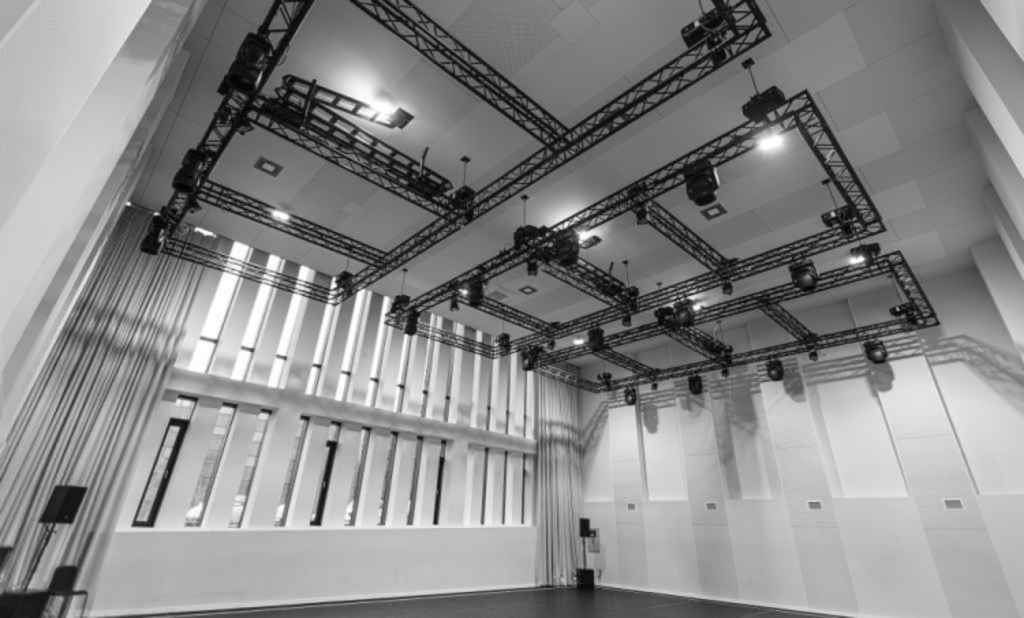
Lighting and stage technology are similarly extensive. ETC fixtures include ColorSource PARs, ColorSource Spot V units and Source Four LED Series 3 Lustr X8 profiles. DTS Lighting Alchemy 5, Synergy 5 Profile and Euphony 3 Ceiling fixtures are joined by Prolights Aria 700 Profile, Fresnel 2KTW, EclCyclorama 050, pendant fixtures, AstraWash7 Pix and Lumipix12 QTour units.
Rigging and stage mechanics combine Protruss structures with Unirig hoists and motor control. Sonus also developed a bespoke rigging structure for the project, designed to allow equipment to be deployed freely across spaces rather than being locked to fixed points.
“One of the project’s major advantages was that the entire technological scope remained within a single design and integration team,” says Žižys. “This significantly reduced coordination challenges, enabled faster decision-making, and ensured consistency across all technical disciplines.”

Consistency became one of the project’s most important design tools. Although the rooms vary from simple rehearsal environments to sophisticated cinema, theatre, and post-production spaces, the operational logic remains familiar. Students moving between spaces encounter similar workflows, compatible infrastructure, and consistent audio characteristics. For the academy’s technical team, that standardisation also simplifies maintenance, training, spare parts, software updates, and future expansion.
The systems were not made deliberately basic because students would use them. Instead, Sonus approached the project as it would a professional theatre or production facility, while ensuring that controls and workflows were intuitive. In some rooms, simple analogue mixers and straightforward playback remain the right choice. In others, advanced consoles, networked audio, and immersive formats are available. The result is not complexity for its own sake, but a graduated ecosystem where each space has the right level of technology.
The academy’s teaching teams have gained new creative options and, as Ilona Balsyte, dean of the Faculty of Theatre and Dance, says, the new facilities have changed what students are able to imagine and create: “Today, new technologies allow them to feel comfortable and open up broader creative possibilities. At the same time, we are aware that Lithuanian theatres are technologically advanced, so it is essential that the study process prepares directors and actors who are proficient in these technologies.”

Sonus’s work also had to align with a live construction programme and a financing model tied closely to the project timeline. Procurement, logistics, integration, and handover had to be coordinated with the main contractor and wider stakeholder team. Because so many systems were embedded in the architecture, timing was critical.
The project demonstrates the value of an integrator that can work across AV, acoustics, lighting, stage machinery, networking, control, curtains, seating, and performance infrastructure. Sonus’s background in theatres, concert venues, and cultural spaces positioned it to understand not only the equipment, but the operational behaviours of the people who would use the building every day.
Now in use, the facility is supporting education, public performance, interdisciplinary work, and professional artistic activity. Students are not waiting until graduation to experience professional systems. They are learning with them, testing them, and using them to shape creative decisions.
“The feedback from LMTA has been extremely positive, particularly regarding how naturally the technology has become part of the creative and educational process,” says Žižys. “Rather than being intimidated by advanced technologies, students actively explore and utilise them as part of their creative workflow.”
That outcome captures the ambition of the project. Technology is present everywhere, but it is not intended to dominate. It gives students access to professional tools while leaving space for performance, experimentation and artistic risk. This phase of the campus development creates a new benchmark for creative education in the region as well as a showcase of how integration can help shape not just rooms, but the way future artists and technicians learn to work.
Tech-Spec
Audio
Auvitran Audio ToolBox platform, ADSP and AxC interface cards
DiGiCo S21 mixing console, D-Rack I/O, A168 Stage I/O expanders
Meyer Sound Ultra series, UPQ-D3, Acheron, HMS, and Amie loudspeakers; MJF-208 stage monitors; 750-LFC, 900-LFC, X-400, X-1100, and Amie subwoofers; Galaxy 816 processor; and MPS-488 power supply
Waves SuperRack Performer
Lighting
DTS Lighting Alchemy 5 LED washes, Synergy 5 Profile moving heads, and Euphony 3 Ceiling- mounted moving heads
ETC ColorSource PARs and Spot Vs, and Source Four LED Series 3 Lustr X8 arrays and zoom lenses
Prolights Aria 700 Profiles, Fresnel 2KTWs, EclCyclorama 050 floodlights, EclPendants, Astra Wash7Pix i moving washes, and LumiPix 12Qtour LED battens
Rigging
Protruss RSP2010 stage trolleys, HQ30 and HQ50 truss
Unirig Divo hoists and digital motor controllers