A live events company in Poland took on several key roles for a media event that fully embraced ST 2110 technology. Paul Milligan finds out how it was done.
The Polish cultural sector is currently facing what has been dubbed a ‘succession tsunami’, with more than 40 key institutions undergoing leadership changes in the last two years. To address this issue one local live events and broadcast company, in the form of Relacje Video, took it upon themselves to not only initiate an event, but organise and look after the technology too.
The aim of the Digital Succession Congress was to create Poland’s first competence centre for cultural succession, providing the country’s media sector with the tools to combat the erosion of institutional knowledge. The project’s aims were to democratise access to expertise, create standards for succession planning, and build awareness of the issue among cultural managers. Not content with just this challenge, Marcin Andrzejewski, founder of Relacje Video, decided the Congress would be hosted in a brand new venue and that he would also run the entire five-day event on a workflow based entirely on SMPTE 2110 infrastructure.

The Congress was hosted inside the new campus of the Academy of Music in the Polish city of Bydgoszcz. It was designed by plus3 Architekci (Warsaw) in collaboration with acoustic designers Ewa Wieckowska-Kosmala, Magdalena Czechowska and Radoslaw Ciszewski, and built on the grounds of a former brickworks. Part of a wider urban revitalisation, the building has been described as “inscribed into the city structure like a musical instrument”. The complex itself includes a 423-seat concert hall, additional halls for chamber music, opera and organ, an orchestra rehearsal room, as well as classrooms and recording studios. Opened in October 2025, it is now one of the most modern educational spaces in Europe, and the entire space was available exclusively to the Congress for five days.
Unlike many projects where AV providers win tenders or are contacted by previous clients for follow-up work, this was created by Relacje Video. “This was our original project, which combines our commitment to technology with an awareness of the challenges facing the Polish cultural sector. We therefore took on two roles in this project: we served as both the organiser and initiator, as well as the technical supervisor,” says Andrzejewski.
Did having the multiple roles extend the scope of Relacje Video’s involvement in the Congress? “We oversaw the entire process,” explains Andrzejewski. “Ultimately, we were responsible for the audio, the 2110 video technology, the live stream, and ensuring a stable internet connection,” he adds. What were the original plans for the Congress, and did that evolve during the planning process? “The brief had been finalised several months earlier and remained unchanged throughout the project. The scope was fixed and dictated by the nature of the project: 14 panel discussions, a five-day production schedule, seven cameras, nine microphones, stage lighting using the venue’s existing infrastructure, full internet connection redundancy, a YouTube stream, and AI transcription during post-production. There were no major changes in this regard during the event.”
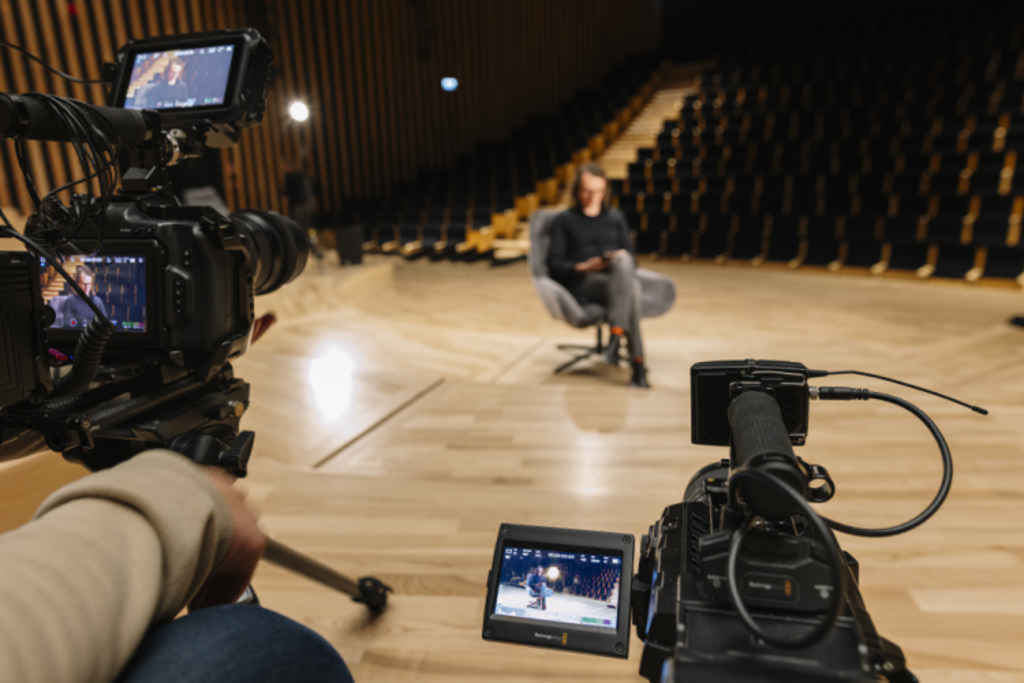
The entire event took place in the concert hall and featured fully configurable acoustics with a stage area. Apart from minor adjustments during the event, Andrzejewski didn’t make any major changes to the settings: “The only difference was on the last day of the Congress, when the number of people on stage changed from 3+1 to 2+1. This required a slight adjustment to the video and lighting settings.”
Designed to be a “systematic transfer of knowledge between generations”, the Congress included 14 expert panels to cover the entire succession spectrum: from explicit knowledge (procedures, contacts) to tacit knowledge (relationships with donors, organisational culture, informal cooperation networks). The Congress offered live and direct access to all cultural institutions in Poland via a YouTube channel, and recordings were archived for long-term access to that knowledge. The idea is that this will help to eventually build a comprehensive digital library, with all Congress material processed into 14 audio podcasts, videocasts, analytical content and case studies available free of charge to the sector. To help preserve the knowledge gained, a website has been created to provide complete access to the knowledge in a “natural, fast, and effective way,” says Andrzejewski. “You’ll find not only comprehensive information and a record of the Congress proceedings, but also a digital avatar - me, actually,” he adds.

“You can talk to him in your native language about the topics covered at the Congress and he has all the knowledge gathered at the Congress stored in his database and can talk about it for a very long time,” he says with a smile.
The entire event was streamed live on YouTube. We used four Blackmagic Design Studio Pro 6K cameras and three Micro Camera G2 cameras. The whole thing was connected using IP 2110 technology with a 2110 4x12g PWR converter and two 3x3 iP 2110 converters.
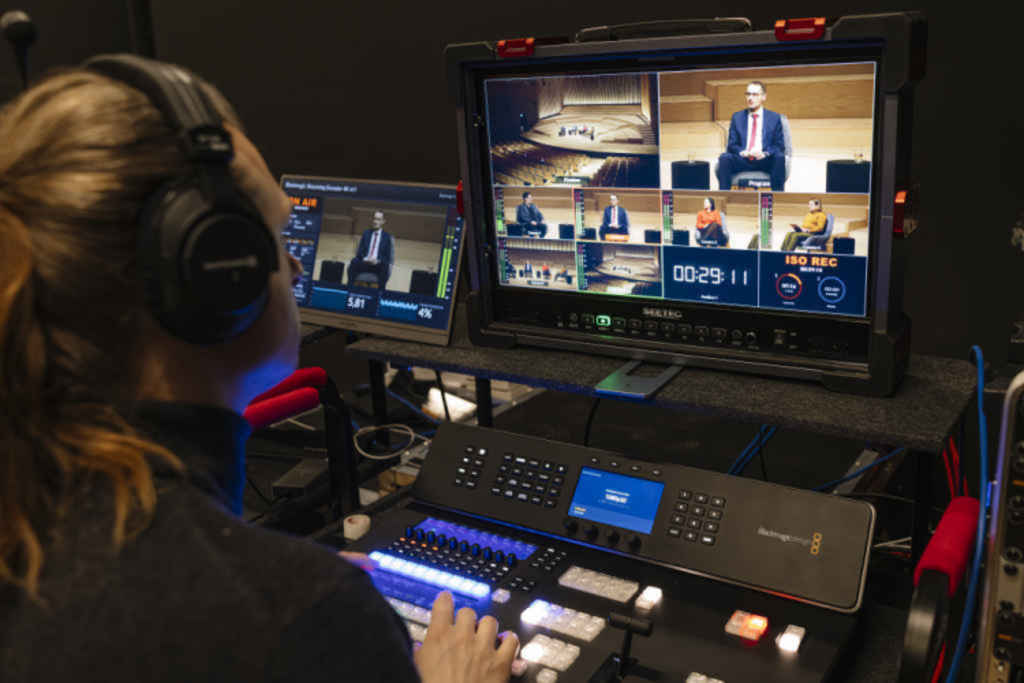
All the material was assembled on Blackmagic’s Atem Television Studio HD ISO and independently recorded in 4K quality on the hard drives of each camera. After the event, we delivered the material in 4K quality, based on the mix made and recorded on the mixer during the event. “We introduced [Blackmagic Design] HyperDeck Pro 4K into the workflow, from which we displayed bars and graphic elements using keying and full transparency. The whole thing
was controlled only from the mixer and predefined Macros.

No Streamdeck or similar solutions along the way. We also used Hyperdeck to control the animations that started and ended each stream. In addition, we used the built-in timer to count down the time for the panel discussion participants. They had a separate screen that first displayed the countdown and introductory animation operated by HyperDeck, and when the broadcast started, it automatically switched to the countdown mechanism available in Atem Studio HT ISO. Again, 100% operated by a macro made only in Atem.”
The streaming of 14 panels across five days is built on a workflow based on 2110 products. “We’ve been working with 2110 technology for a year, but this is the first time we’ve implemented it on this scale,” says Andrzejewski. Why did he choose 2110 for this project? “It allows for very quick setup on location, reducing both time and costs. The entire setup was managed from a mixer that recorded all tracks and signals independently (ISO), which makes post-production very easy for us. Thanks to the IP 2110 hardware and the mixer we were able to fully control the cameras from the control room. This meant we didn’t need camera operators on set, which gave us a clean shot of an empty hall, a key requirement for this project as the entire Congress was recorded without an audience and was only available online.”
For audio at the Congress, Relacje Video used Sennheiser microphones, including both transmitters and receivers from the AVX series, to ensure reliable transmission in what was a challenging radio wave environment. The MKH 416 shotgun microphone was used to capture the atmosphere and spatiality of the hall.
Relacje Video chose the MADI protocol for the Congress, “because this solution allows us to record and process 32 channels simultaneously, which is sufficient for our needs. Thanks to the integration of MADI with the mixer and the rest of the system, we have a setup that is highly resistant to interference.”
Other technology choices included Canon CN-E series lenses (18-80 and 70-200), “which allowed us to fully control the frame from the mixing console and control room, without the need for camera operators at the Congress,” explains Andrzejewski. “The entire storage workflow was based on Samsung SSD hard drives, which allowed us to work with 6K and 4K footage in post-production, depending on the cameras we were using at the time. The entire network infrastructure was connected and managed by a Ubiquiti Dream Machine Pro router, using both 1G RJ45 and 10G networks via SFP+ ports. All files and footage from the event are securely stored in a private cloud on NAS Pro from the same manufacturer.”
Relacje Video also used Blackmagic Design hardware players for overlays, lower thirds, and similar animations and graphics. “The entire system was based on hardware solutions and SSD drives, but the operation and triggering were based on scripts we created specifically for the Congress,” explains Andrzejewski. “Since we were working with people unfamiliar with the stage and broadcast technologies, we also developed scripts with appropriate animations and countdown timers for the panellists before and during the event. The entire setup was managed via the mixer, and there was no need for additional control or auxiliary devices.”
What were the most difficult parts of the install for Relacje Video? Thanks to the 2110 and its single-cable technology for both signal and power, the setup was greatly simplified says Andrzejewski. “However, the network infrastructure and ensuring full redundancy of the internet connection posed a huge challenge. The building of the Academy of Music in Bydgoszcz is a modern structure, designed to minimise the impact of external signals as much as possible. It’s a great solution for artists, but not so much for technicians. Since it is a new facility, the internet connection in the building had not been sufficiently tested. We had to have a backup router with bonding across three SIM cards to be prepared for any issues.”
Which was just as well because during the last day of the Congress, during the final live broadcast, the internet at the venue stopped working. “If it weren’t for our backup and a very powerful router set up in one of the few spots in the building’s basement where it could perform effectively and, thanks to its power, provide us with a constant backup connection, the broadcast would have been interrupted. Fortunately, we were able to stream continuously without any interruptions. Our tests showed that we could send two independent backup streams in 4K at 60 frames per second if necessary, so we had plenty of headroom.”
Andrzejewski acknowledges the support and guidance he received from Cyfrowa Republika, a local AV distributor in Poland. “We installed most of the hardware components - including players, routers, network management devices, recorders, and encoders - in racks and tested them at our facility before arriving at the conference. Once there, all that was left was to connect the cameras to the equipment and add the audio.” The event lasted a total of five days, with the entire setup and takedown process taking a total of eight days (two days for setup before the Congress and one day for takedown).
How did Relacje Video get buy-in from the on-site IT team to what it was doing during the Congress? “Working with the local office went smoothly. In addition to providing physical access to the infrastructure, they set up virtual networks tailored to our needs and configured the internet traffic exactly as we wanted,” says Andrzejewski.
The premise behind the Digital Succession Congress was to preserve the knowledge with one particular industry. The team at Relacje Video must be commended for recognising that, to do this, you have to democratise the information that is created, making it accessible to as many people as possible and removing barriers so nothing is lost.
TECH-SPEC
Blackmagic Studio Camera 6K Pro, Micro Studio Camera 4K G2, 2110 IP Converter 4x12G PWR, 2110 IP Converter 3x3G, Atem Television Studio HD8 ISO, HyperDeck Studio 4K Pro
Canon CN-E series lenses (18-80 and 70-200)
MineMedia C3 5G bonding router
Samsung SSD hard drives
Sennheiser AVX series microphones, MKH 416 shotgun microphones
Ubiquiti Dream Machine Pro router