Cyviz has delivered a new Global Security Operations Center for Aker Security in Oslo, combining large-scale visualisation and AV-over-IP infrastructure to support real-time monitoring and decision-making. Anna Mitchell reports.
Security operations today are defined by the ability to make sense of enormous volumes of information. For organisations responsible for monitoring global operations, the challenge is rarely gathering data. Instead, it lies in bringing disparate systems, dashboards, alerts, and communications together in a way that allows teams to understand situations quickly and respond effectively.
For Aker Security, the organisation responsible for security and preparedness across the wider Aker Group, that challenge prompted the development of a new Global Security Operations Center (GSOC) in Oslo. The facility acts as a central hub for monitoring incidents, travel security, global events, and building systems across dozens of companies and thousands of employees.
To support this role, the company approached Cyviz to design and deliver a control room environment capable of presenting large volumes of information while enabling seamless collaboration between operators.
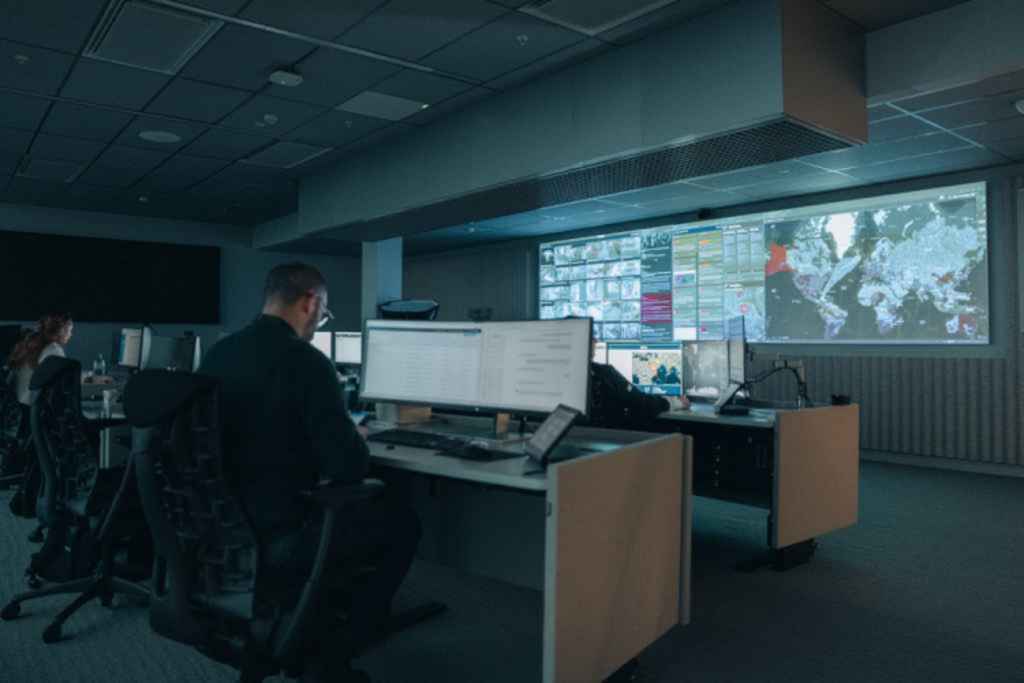
Although the project replaced an earlier facility, the GSOC was not simply an upgrade. Instead, Aker Security relocated to a new building and used the opportunity to rethink how its operations centre should function.
Matt Smith, customer success manager at Cyviz, says: “There wasn’t anything retained from the previous system, in practice it was a completely new build.”
Rather than recreating the previous environment, Cyviz worked with Aker Security to define how operators needed to interact with information and with each other. In a modern security operations centre, operators typically work across multiple individual dashboards while sharing critical information with colleagues during incidents or emerging events. The design therefore needed to support both focused individual work and collective situational awareness.
One of the most significant design challenges was uncertainty about how the centre might evolve.
“The biggest challenge is that customers often don’t know exactly what they want at the start,” says Smith. “What they do know is that the system needs to evolve. As more companies become customers of Aker Security, the amount of information they need to monitor increases.”
This requirement drove the overall architecture of the system. Rather than a fixed infrastructure designed around a small number of sources, the GSOC would be built around an AV-over-IP environment capable of scaling as operational demands changed.
The visual centrepiece of the room is a projection-based display wall spanning the front of the GSOC. Cyviz implemented its F311 display configuration using three CP1 single-chip DLP projectors arranged in a blended 3 x 1 array. The system delivers a seamless display surface with a resolution of 6,848 by 1,600 pixels, allowing operators to visualise multiple dashboards simultaneously.
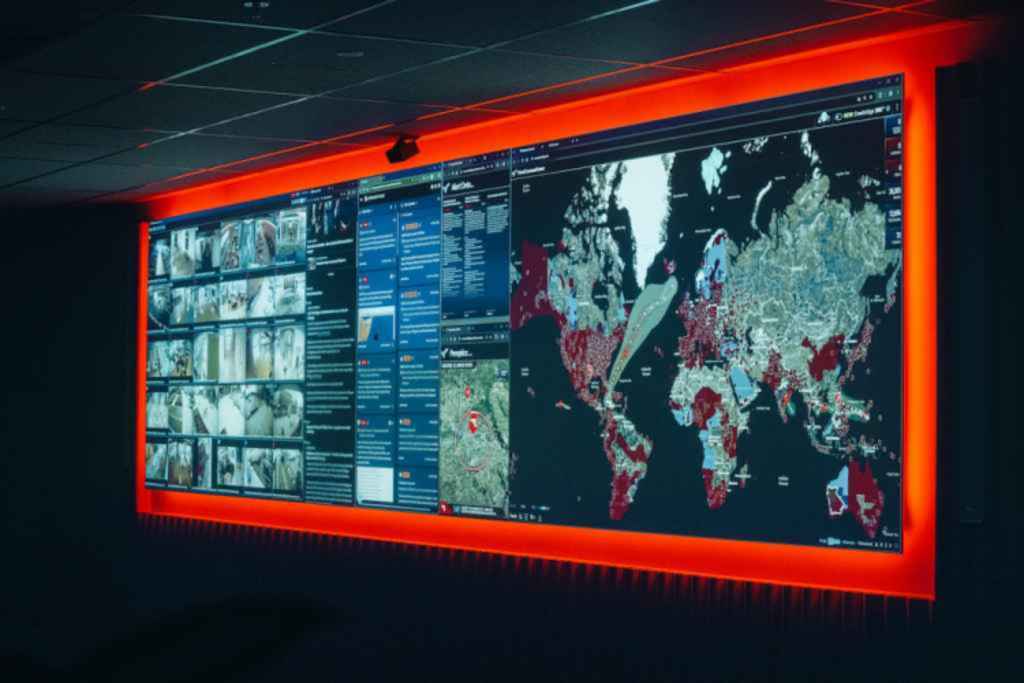
“For Aker in general, and in Europe, we use a lot of projectors for videowalls,” says Gøran Hansen, CTO at Cyviz. “We see good results with that and have good experience building very effective videowalls for customers.”
For Cyviz, that decision is influenced by operator ergonomics. Security operations centres often run continuously, meaning staff may spend long shifts monitoring large displays.
“In these environments we actually prefer projection-based systems,” says Smith. “The indirect light from projection tends to be easier on the eyes for operators working long shifts in front of large dashboards.”
The display system allows a primary source to occupy the full resolution of the wall while additional inputs appear as picture-in-picture (PiP) windows. This flexibility allows operators to maintain a persistent overview while bringing in additional information when incidents occur.
Behind the display wall sits a signal infrastructure designed to manage a large number of potential sources. At its core is a Guntermann & Drunck (G&D) ControlCenter-IP 2.0 KVM matrix forming the backbone of the system’s AV-over-IP routing.
Source computers connect to the system using G&D VisionXS-IP transmitters, while operator desks are equipped with VisionXS-IP console receivers. This configuration allows signals to be routed dynamically between centralised compute resources, local workstations and the visualisation wall.
The approach reflects the changing nature of control room workflows. Rather than dedicating specific sources to specific displays, operators can bring any signal into their own workspace or push it to the shared display surface when collaboration is required.
“If you imagine a hundred different signals coming from dashboards, cameras, or other systems, they all feed into a matrix,” Smith explains. “From your desk you can bring those signals onto your own monitors, but you can also push them to the big screen so the rest of the team can see them.”
Video signals are transported across the room using Lightware’s TPS signal extension technology. The installation includes multiple HDMI-TPS-TX96 transmitters and HDMI-TPS-RX96 receivers, enabling HDMI signals to be distributed over structured cabling while maintaining high bandwidth and low latency.
Signal processing is handled by Extron DSC 401 A scalers, ensuring compatibility between different source formats and the visualisation system.
The primary visualisation source is provided by an HP Z2 Gen5 workstation equipped with an NVIDIA T2000 graphics card. This system feeds the Cyviz XPO.5 video processor, which aggregates multiple DisplayPort inputs and distributes them across the blended projection surface.

Control of the room is handled by the Cyviz Easy platform, implemented through Cyviz 1U controller appliances and touch monitor interfaces. The platform provides equipment control, signal routing and system automation while also enabling remote monitoring and management.
The Cyviz Easy architecture is designed to standardise control across different installations, allowing systems to be configured and updated without extensive custom programming. This approach allows systems to be modified or expanded more easily as operational requirements change. The platform also integrates with the building management system via KNX, enabling control of lighting, blinds and environmental settings alongside the AV system.
The Cyviz touch panels act as the primary user interface for the room, integrating control of the Microsoft Teams Room system directly into the same interface. Rather than using a separate Teams controller, operators can manage meetings, audio, and video sources, and the videowall layout from a single panel.
“We try to work with hardware that is very fit for the use case and where we have a good relationship with the manufacturer,” says Hansen. “That allows us to collaborate closely on customer projects.”
While the GSOC’s primary function is operational monitoring, communication tools also play a critical role in enabling collaboration during incidents. The room is therefore equipped with a Microsoft Teams-based video conferencing system featuring a Huddly L1 collaboration camera positioned at the front of the space.
The conferencing system also benefits from the flexibility of the videowall processor. Rather than presenting the Microsoft Teams interface within a single window, the system can span the meeting layout across a wider section of the display by stitching together multiple PiP windows.
“We can present Microsoft Teams in a wide 21:9 layout,” says Hansen. “We achieve that by stitching two PiP windows together across the wall.”
Wireless presentation is supported through two Barco ClickShare C-10 systems, allowing users to share content from laptops directly to the videowall without connecting physical cables.
Audio within the room is delivered through a distributed loudspeaker system combining Biamp and Bose components. Two Biamp Desono P6-SM loudspeakers and two Bose DesignMax DM6SE units provide coverage within the operations centre, while a Biamp Desono Sublime subwoofer supports the adjacent training room.
A Shure IntelliMix P300 DSP handles audio processing and echo cancellation, while a Bose PowerShare PS604D amplifier drives the loudspeaker system. A Shure MXA920 ceiling array microphone provides beamforming audio capture for conferencing.
Although the technology infrastructure is complex, the success of the GSOC ultimately depends on how effectively it supports the people using it.
Operators typically work at individual workstations equipped with multiple monitors, allowing them to focus on specific data streams or dashboards. When an incident requires team coordination, relevant information can be pushed to the visualisation wall, creating a shared operational picture for the entire room.
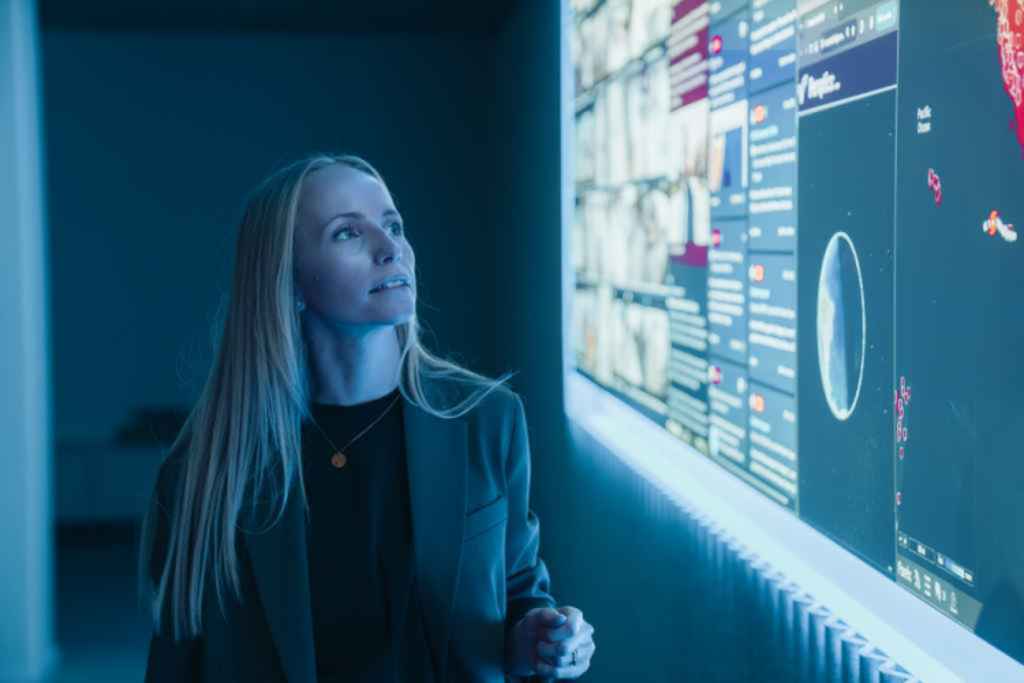
“There’s always a balance between what an operator needs on their own screens and what needs to be visible to the whole team,” Smith says. “The videowall becomes the shared overview that everyone in the room can follow.”
Lighting and environmental controls were also designed with operator comfort in mind. Integration with the building’s KNX system allows lighting levels, blinds and accent lighting to be adjusted depending on operational needs.
For Aker Security, the GSOC represents more than a technology upgrade. The facility is intended to function as a strategic asset supporting both day-to-day monitoring and crisis response across the organisation.
Equally important is the flexibility of the underlying architecture. As new data sources, monitoring systems and operational workflows emerge, the AV-over-IP infrastructure allows the control room to evolve without requiring major reconstruction. The GSOC provides Aker Security with a platform capable not only of supporting today’s security operations but of adapting to whatever challenges emerge next.
Tech Spec
Audio
Audinate Dante Avio adaptors
Biamp Desono COLW101 column speakers and Sublime subwoofer
Bose DesignMax DM6C ceiling speakers and PowerShare amplifiers
Shure MXA920 ceiling array mic and IntelliMix P300 DSP
Infrastructure
APC metered rack PDUs
Barco ClickShare C-10 units
Brainboxes ED-008 Ethernet to DIO device
Cyviz V3 controllers and 10.1-in touch monitors
Extron STP20 cables
G&D ControlCenter-IP 2.0; and VisionXS-IP-DP-HR series KVM-over-IP consoles and computer modules
Lightware HDMI-TPS-RX96 extension kits and HDMI-4K de-embedders
Lindy HDMI to DisplayPort converters and HDMI 2.0 EDID emulator, HDMI to DisplayPort cable, USB to Ethernet network adapters
Magewell USB Capture HDMI 4K Plus
Video
Chief LSM1U Fusion wall mount
Cyviz CP1 projectors and XPO 5 videowall processor
Extron DSC 401 A scalers
Huddly L1 and S1 cameras
NEC 65-in MultiSync display