Rebuilt after fire, Notre Dame demanded wireless coverage on a scale traditional RF architectures struggled to deliver. The solution came in the form of a newly developed platform, and the world’s first installation of Sennheiser Spectera. The project, delivered by Groupe Novelty, went on to win the 2026 Inavation Award for Best House of Worship.
When Groupe Novelty began designing the wireless system for Notre-Dame de Paris, the solution they would ultimately deploy did not yet exist. They started with established RF architectures and quickly discovered their limits.
The rebuilt cathedral presented a challenge that conventional RF could technically solve, but not elegantly. Coverage had to extend across more than 100m of nave, nearly 50m across the transept, and into side chapels. Priests and the archbishop needed to move freely during services. Dropouts were unacceptable. The building would be open 12 hours a day, seven days a week, hosting five daily services while visitors circulated continuously.
The previous system, an analogue Sennheiser 3000 series receiver with centrally placed directional antennas, had proven reliable for decades. But the specification for the restored cathedral was different. The coverage envelope was broader, the operational expectations higher, and the infrastructure philosophy had shifted decisively toward fibre and networked transport.
David Créteur, project lead at Groupe Novelty, quickly recognised the implications. Using familiar digital wireless systems, full coverage could be achieved, but only by multiplying antennas.
At least eight would be required, distributed throughout the building. Those antennas would need long coaxial runs, with inevitable line losses. Fibre extensions would likely be required to mitigate those losses. Antenna combining and zoning would add another layer of system management. Zones would need to be activated and deactivated depending on where clergy were positioned.

Image credit: ©Julio Piatti-Notre Dame
In a cathedral that operates autonomously for much of the day, that level of complexity was not an option for Créteur.
There were no ideal routes forward until, during a presentation from Sennheiser, Créteur encountered something different: Spectera, Sennheiser’s implementation of WMAS (Wireless Multichannel Audio Systems). At that point, Spectera was still in pre-production, but the architecture was compelling.
Unlike traditional narrowband RF systems, Spectera does not employ antenna diversity in the conventional sense. That single design decision had immediate consequences. Instead of eight antennas, the projected requirement dropped to four. In a protected heritage building where mounting positions are tightly controlled and cable paths scrutinised by conservation authorities, halving the antenna count is not a minor optimisation, it is structural simplification.
The transport layer was equally important. Rather than relying on long copper coaxial runs, Spectera antennas connect via Ethernet. Notre Dame’s rebuilt AV infrastructure had already committed to fibre as its backbone medium. When Sennheiser confirmed that fibre extension could be achieved simply by inserting media converters, Spectera aligned cleanly with the cathedral’s wider systems philosophy.
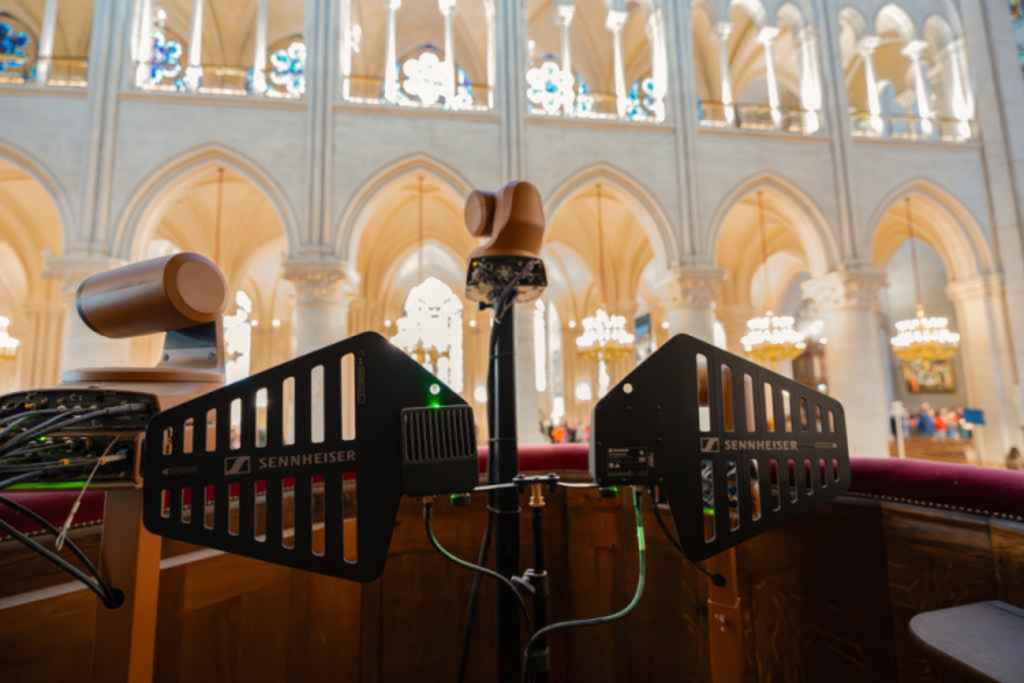
Image credit: Olivier Allard
There was still a question of confidence. Notre Dame is not a proving ground. It is a globally visible landmark operating under constant scrutiny. Deploying a newly introduced wireless platform as its primary RF system required technical assurance on both sides.
A full-scale onsite test was organised in early 2024, while the cathedral remained under construction. In protective overalls, the Groupe Novelty and Sennheiser teams deployed Spectera within scaffolding and incomplete interiors to validate RF stability and real-world behaviour.
Coverage proved consistent. Stability held. Just as importantly, the system behaved predictably under movement, obstruction and changing physical conditions, a critical factor in a space defined by stone, height and constant public flow.
As renovation timelines tightened, and with onsite testing confirming that the RF architecture could meet coverage and reliability targets, Spectera was selected for deployment at Notre Dame. In autumn 2024, Sennheiser supplied a temporary pre-production configuration comprising one Spectera Base Station and three SEK bidirectional bodypacks. While the Spectera handheld transmitter was still in development, a Digital 6000 two-channel receiver with handheld microphones was deployed alongside it to fulfil handheld requirements.
From that point, Spectera moved from evaluation into live operation inside the cathedral. This marked the world’s first installation of the platform, implemented not in a demo facility or controlled test venue, but within the operational environment of Notre-Dame de Paris.
From a systems perspective, the deployment simplified almost every layer of the RF design.
Four antennas replaced eight. No diversity pairing reduced hardware complexity. Ethernet connectivity eliminated heavy, loss-prone coaxial infrastructure. Antennas combined automatically without manual zoning intervention. The operational burden dropped.
The Spectera Base Station occupies a single rack unit while supporting up to 32 microphone channels and 16 stereo IEMs. In a building where technical racks must remain compact and discreet, that density matters. A conventional narrowband configuration offering equivalent channel capacity would have required significantly more rack space and higher power consumption.
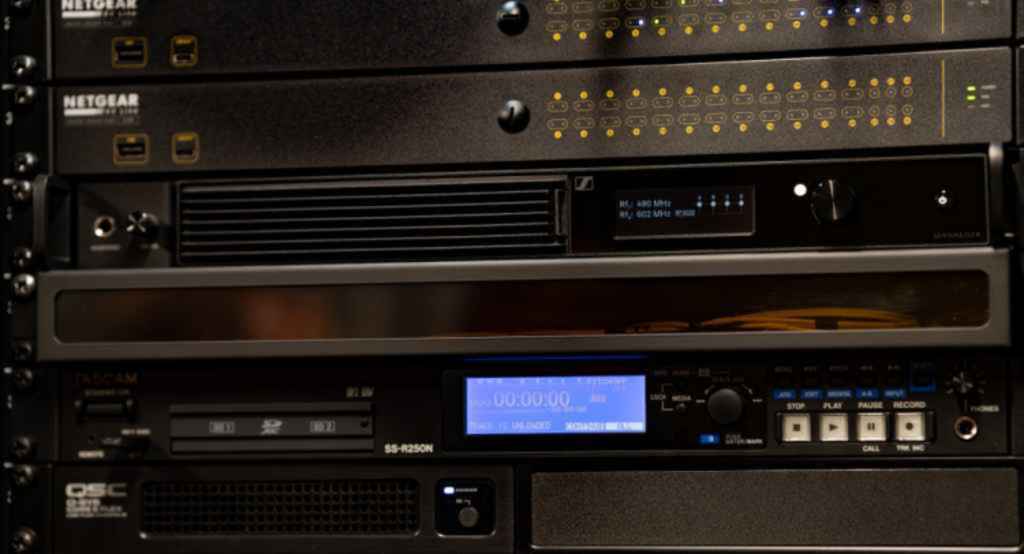
Image credit: Olivier Allard
Integration into the cathedral’s digital audio network was equally direct. Spectera connects to the DiGiCo console via Dante, routed through a 4REA4 matrix. Channels move cleanly between wireless layer and console without unnecessary conversion stages.
Initially, antenna placement was planned high in the gallery at approximately 10m above the floor. During commissioning, antennas were repositioned lower, delivering stable and uniform coverage across the nave, transept and chapels. Even with massive stone pillars and constant human movement, the RF footprint remained consistent. In daily operation since reopening, coverage has remained stable across five services a day.
Notre Dame’s liturgical life is fluid. Some priests prefer handheld microphones; others use bodypacks with MKE 40 clip-ons. The cathedral also hosts concerts and daily television broadcasts via television channel KTO. Wireless channels must transition between use cases without reconfiguration complexity. The system now runs as part of the cathedral’s daily rhythm, without manual zoning adjustments or technical supervision between services.
Bidirectionality adds another layer. Engineers moving through the building can monitor PFL (Pre Fader Listening) directly through headphones connected to an SEK bodypack. This effectively decentralises aspects of console monitoring, a powerful advantage in a space of this scale.
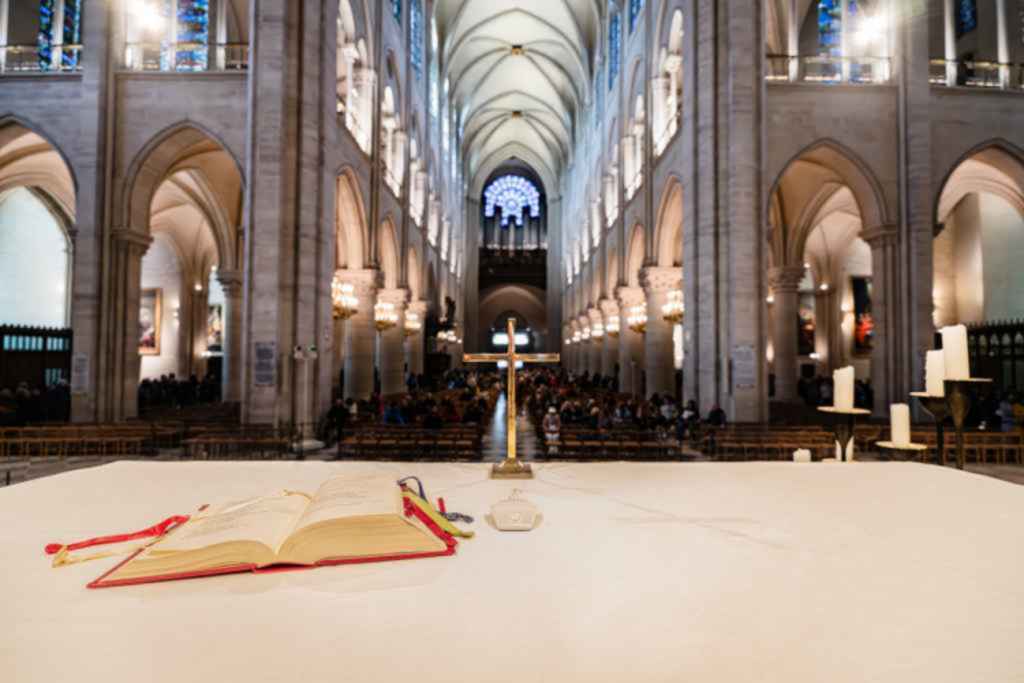
Image credit: Olivier Allard
Scalability was tested early. In live trials, one antenna was relocated outside the cathedral during operation to simulate future exterior speaking scenarios. The system continued running without restart. Additional antennas can be added if required, and more bodypacks introduced permanently or for major events. Channels can be routed externally to support broadcast partners such as KTO or Radio-France. The architecture leaves headroom for expansion without redesigning the RF topology, an important consideration in a building expected to evolve over decades, not years.
In short, Spectera aligned with the cathedral’s new digital backbone in a way traditional RF could not.
Groupe Novelty did not set out to deploy a first-of-its-kind wireless system. They were searching for a solution to a complex RF geometry problem. Spectera emerged during that search and proved capable of reducing hardware, simplifying architecture and integrating cleanly with a fibre-first philosophy.
That a project of Notre Dame’s profile placed its trust in a newly introduced platform speaks to more than technical specification. It reflects confidence in Sennheiser’s engineering maturity and support structure. A system debuting on a project of this visibility must perform without hesitation. At Notre Dame, it did. And in doing so, it moved from promising new technology to proven infrastructure in one of the most demanding environments imaginable.
Top image credit: ©Julio Piatti-Notre Dame