Signal Space – Echoes of Tomorrow took the Arts & Experience trophy at the 2026 Inavation Awards. But the winning exhibition is only one chapter in the story of a flexible digital arts venue designed to continually reinvent itself. Anna Mitchell explores the technology behind the project.
Signal Space – Echoes of Tomorrow was named winner of the Arts & Experience project category at the 2026 Inavation Awards, recognising an installation that combines large-scale projection, spatial audio, interactive systems, kinetics, and light inside one of Prague’s historic landmarks.
Yet there is an important distinction between the award-winning project and the space that houses it. Echoes of Tomorrow was the opening exhibition when Signal Space welcomed the public in September 2025; Signal Space itself is a 2,500 sq m technology platform built to accommodate changing artists, exhibitions, events, and other programming. The approximately €2.4 million project occupies Prague’s heritage-protected Old Town Market Hall and incorporates the largest 360-degree projection environment of its kind in the Czech Republic.
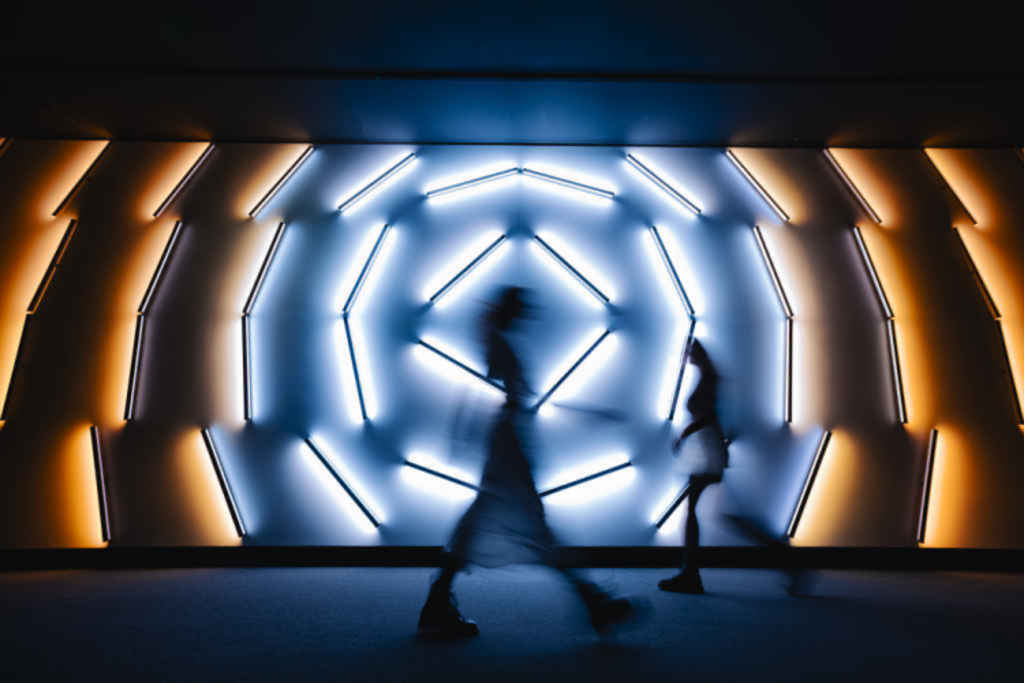
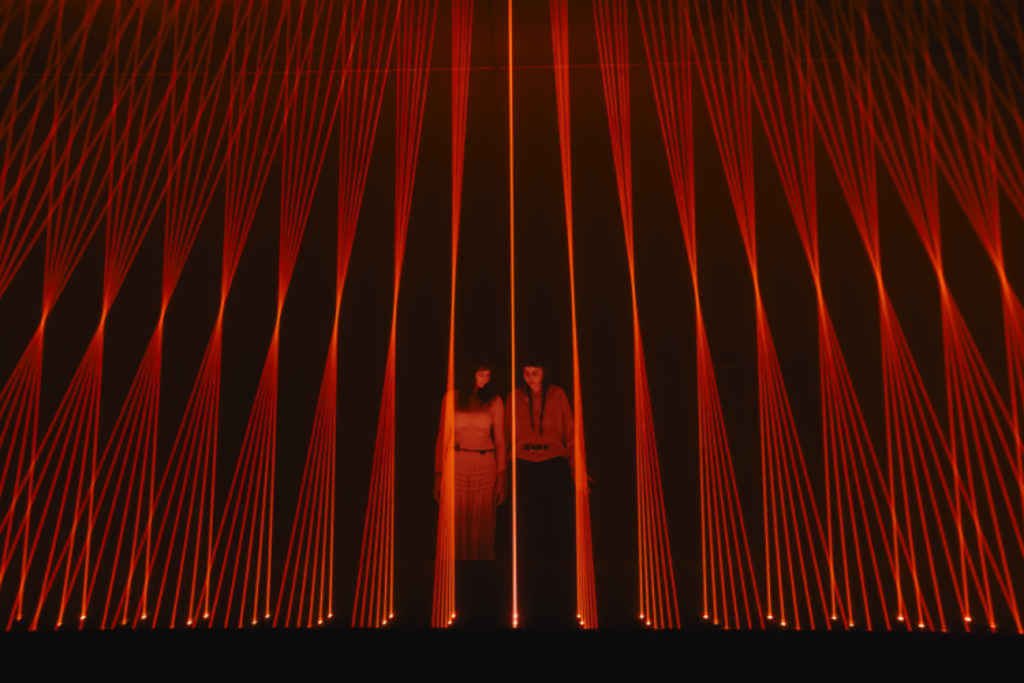
Echoes of Tomorrow brought together work from artists and studios including Nohlab, Playmodes, Shohei Fujimoto, onformative, Zach Lieberman, Ondrej Zunka and Preciosa. Its installations span immersive projection, kinetic and laser works, interactive exhibits, and an Infinity Room. But Signal Space was always intended to go further.
“We tried to build the venue as universally as possible,” says Martin Pošta, founder and CEO of Signal Space. “We wanted to create a place that enabled us to present different rooms where each can become one artwork. That could be anything from kinetic works and laser-based works to an Infinity Room, interactive works, or projection.”
Building around history
Signal Space is an evolution of more than a decade of work in digital art. Pošta co-founded Signal Festival in 2013, growing the Prague event into a four-night celebration of digital art and public-space installations attracting around 500,000 visitors. Signal Space takes that experience indoors and gives it a year-round home.
The choice of building, however, made creating that home considerably more complicated.
Completed in 1896 and inspired by Parisian market halls, the Old Town Market Hall is a cast-iron, wood, and glass structure. Later modifications, including a false ceiling installed during the 1980s to improve thermal performance, sit alongside the protected fabric. Signal Space could not simply strip those interventions away or attach new infrastructure wherever convenient. With the present occupation of the building limited, modifications also had to be reversible.
“We had to work with both the historical elements of the building and the structures that had been added later,” says Pošta. “We had severe restrictions on what we could do.”
AV integrator AV Media joined the project in December 2024. “We helped with the AV and technology design, installation, and now support the maintenance,” says David Lesch, CEO of AV Media. “The installation had to be very flexible and creative because a lot of challenges occurred as we opened up the different spaces.”
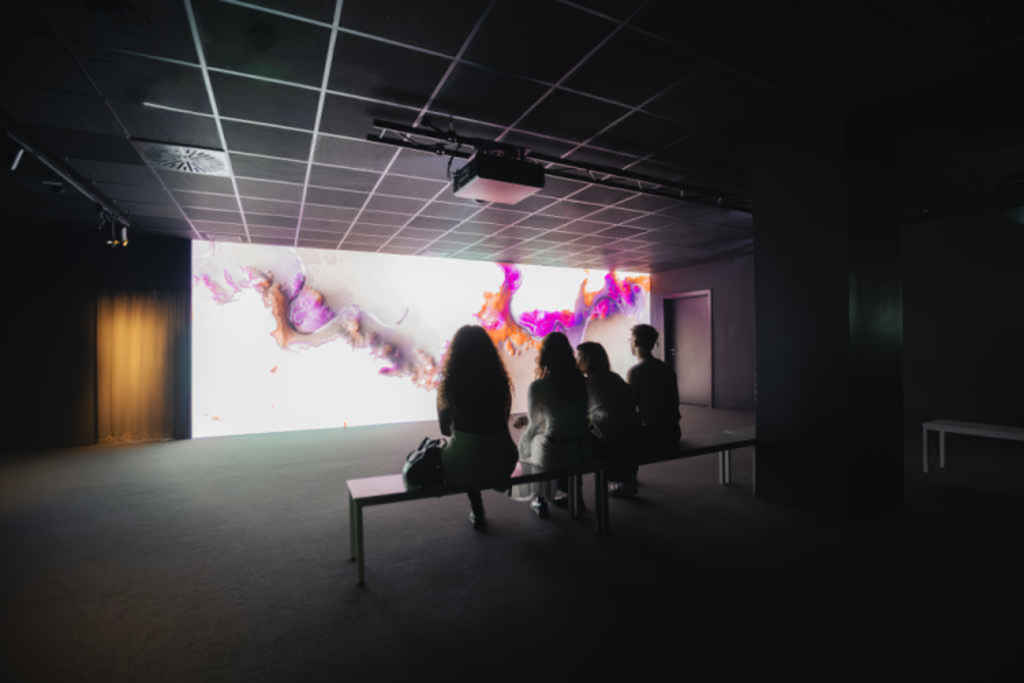
Few places demonstrated that more clearly than the main Immersive Space.
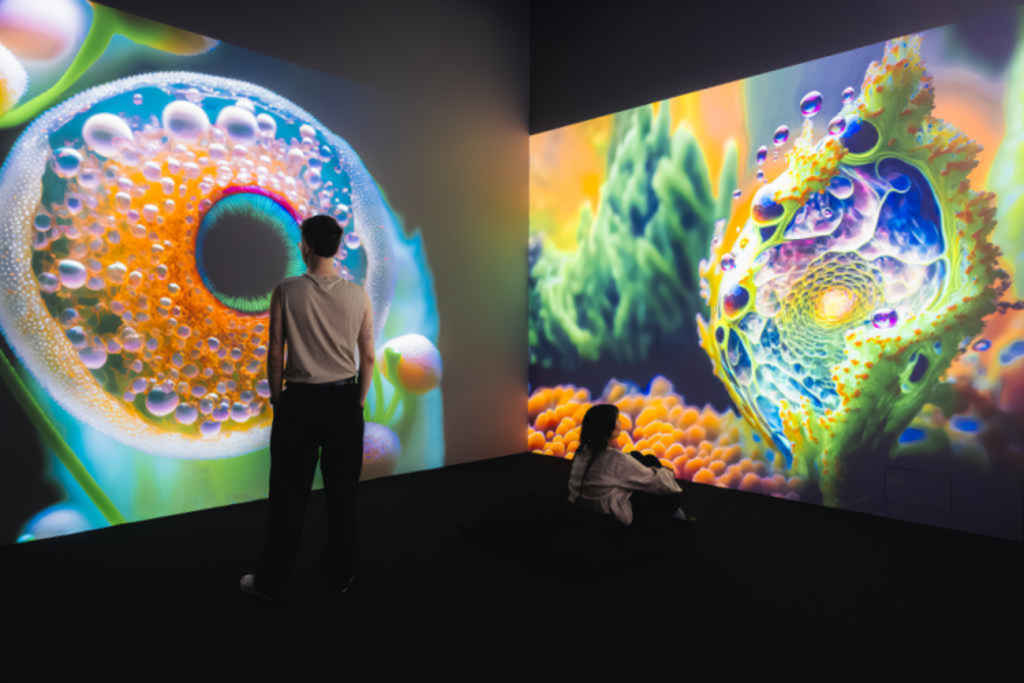
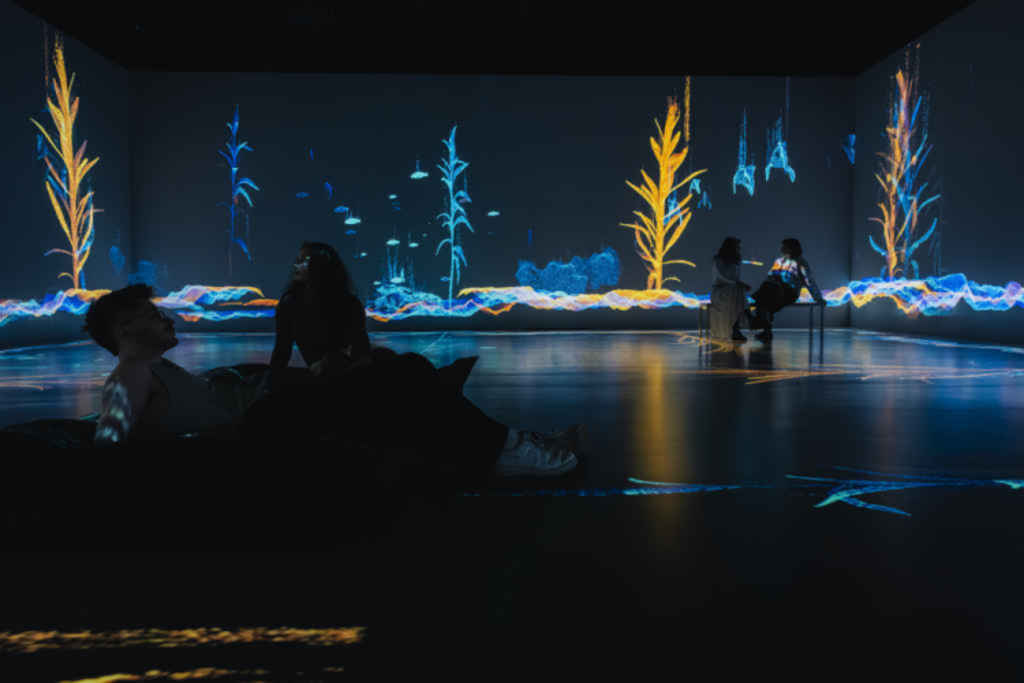
The 300 sq m room wraps imagery around its walls and floor. Nineteen Panasonic 4K laser projectors create a combined 22.7K canvas, with the final installation using a combination of 14 PT-REQ12 and five PT-REQ15 units. Four Virtuality.one PixelBox media-server nodes running AV Stumpfl Pixera drive the 19-projector immersive canvas, with hardware synchronisation maintaining the multi-projector output.
The building immediately introduced an unusual projection-mapping problem: the floor was never intended to be level.
“The floor slopes quite heavily because it was a marketplace,” says Pošta. “If there was blood, vegetables, or anything else on the floor, it needed to wash away. From one side to the other it falls by 25cm.
“When you have to be precise in terms of levelling the projection, that became quite challenging. How do you make it so the audience doesn’t notice? We managed to overcome it by adjusting the projection so it doesn’t show.”
A platform for pixels
Projection dominates Signal Space with 38 projectors operating across the venue and further reserve equipment available. Panasonic models vary according to the requirements of each environment: PT-REQ12 and PT-REQ15 projectors serve the main room, PT-RQ7 units are deployed in the Cinema Studio, with PT-MZ882, PT-VMZ6ST and PT-MZ11KL models used elsewhere. A substantial inventory of Panasonic lenses allows the projection geometry to be adapted to individual spaces.
Eight Virtuality.one PixelBox media servers form the core of the visual playback infrastructure. In addition to the four nodes serving the main immersive environment, servers are allocated to the Studio, Cinema, Infinity, and other projection spaces. Framelock and genlock hardware keeps multi-output systems aligned, while long-run Vivolink optical HDMI cabling carries signals to projectors throughout much of the venue.
Despite early plans involving more LED, the finished venue remains overwhelmingly projection-led. A proposed large-format LED wall was removed from the design on cost grounds, while an LED solution considered for the Infinity Room would have reduced usable space through the need for rear maintenance access and introduced additional cooling requirements. The permanent LED display element is instead P6 transparent LED film fitted across the entrance doors and gate.
Audio is equally distributed. The system incorporates JBL 9300, Control, and Eon loudspeakers alongside Bose EdgeMax models and JBL subwoofers. Eleven LEA Connect amplifiers, including 354D, 168D, 88D, and 64D models, feed the system over Dante, with two BSS Soundweb BLU-160 processors equipped with BLU-DAN providing DSP and matrixing. In the main immersive hall, JBL 9300 and Control 65P/T loudspeakers are combined with SB2210 subwoofers and Dante-networked LEA amplification.
The venue is also equipped for programming outside gallery hours, with Sennheiser EW-D wireless systems available for events.
One venue, many systems
For technical director Martin Vronský, one of the defining characteristics of Signal Space is that there is no single playback technology ideally suited to every work.
“Signal Space is made up of independent installations, and each installation uses a different technical solution,” he explains. “Pixera drives the main immersive hall. Because that room is also used for events, we chose Pixera as the primary solution: it gives us the scalability and node-to-node synchronisation we need across a large-format projection.”
Resolume provides playback and overlay capabilities for smaller edge-blended projections, while QLab handles audio cues for events, elements of lighting control, and everyday ambient audio. Unity forms the backbone of the interactive Playground, while TouchDesigner is also employed for one of its installations.
Above those individual applications sits Universe Control, a commercially available gallery and installation management platform.
“Everything is tied together by Universe Control,” says Vronský. “It acts as the scheduler for switching the exposition on and off, reports device status, and supports more than 200 protocols. Its simple interface means we can edit and add devices or new scenes without programming skills as events or temporary installations demand.”
Underneath that control layer, the core infrastructure is divided into three physically segregated network planes: a Pixera/video network based around a Netgear XSM4316 switch, a primary and secondary Dante audio network using two GSM4352PA switches, and a control network operating across three GSM4352S switches. Public wireless connectivity is handled separately through Ubiquiti infrastructure.
That separation gives Signal Space a permanent technical backbone without forcing every artist into the same workflow.
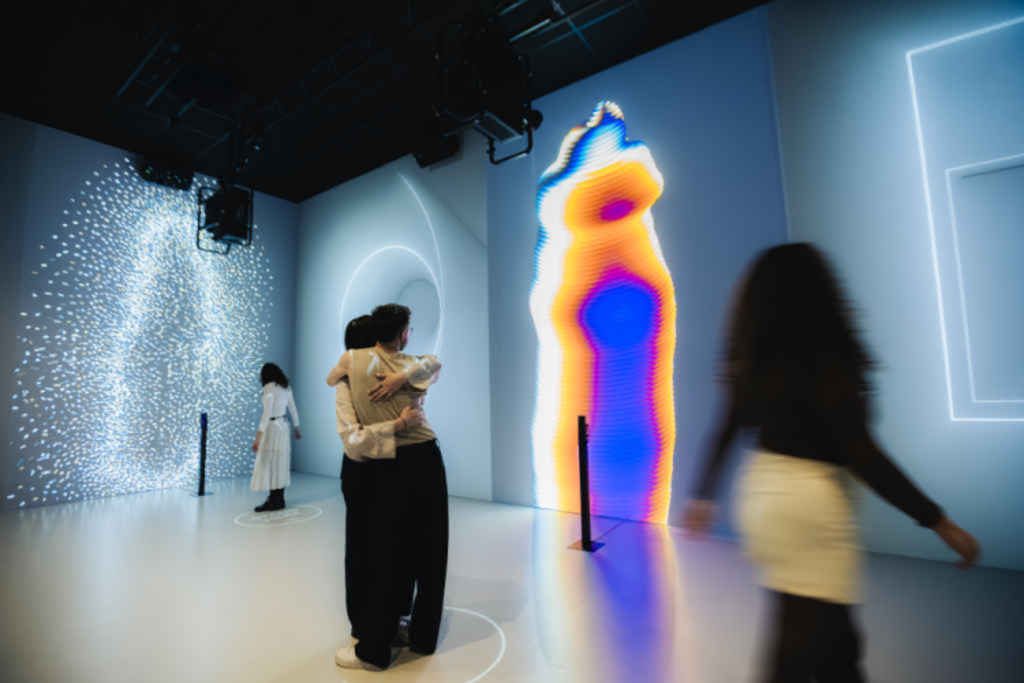
The Playground demonstrates the approach on a smaller scale. One exhibit uses an AVMatrix Eagle T10 camera feeding TouchDesigner to turn objects arranged on a light table into projected content. Another connects a rotary encoder through a Revolution Pi controller to a Unity application, allowing physical rotation to manipulate real-time AV. An interactive wall uses an Orbbec Femto Bolt depth camera to transform visitors’ movements into a digital shadow, while a digital pinball installation combines 14 capacitive buttons, a Revolution Pi, Unity, three projectors, and an Enttec S-Play controlling chandelier effects. HDBaseT carries video from the interactive PCs to the projectors.
Lighting adds another layer. More than 500 Halla luminaires were specified across the wider space, including Lina60, Vali80-T, Rundo62, and Shift models, with high-CRI LED sources and DALI control. Spectoda technology is used for more dynamic artistic lighting, allowing behaviours to respond to inputs including movement, music, and ambient light.
Expect the unexpected
Building a complex AV environment in a historic property also delivered some less predictable tests.
Two weeks before opening, a water pipe above Signal Playground failed. “It got completely flooded,” recalls Pošta. “The water came through the projectors. You could literally shower underneath them.”
Fortunately the projectors were powered down. AV Media removed the affected units, checked them in its workshop and returned them to site. They remained operational and Signal Space still opened on schedule.
Once open, the challenge moved from installation to running a collection of artworks that include mechanical and interactive elements.
“The Kinetic works can break, and the laser works can break,” says Pošta. “We have a constant maintenance team there every day doing the upkeep so everything runs smoothly.” At the time of the interview, Signal Space had operated for ten months without losing a full day to a technical shutdown. Spare parts are held for kinetic works and laser systems, while reserve projection hardware is also available.
Two UPS systems rated at 10kW and 6kW protect the central racks, and the projector estate can be monitored remotely using Panasonic Multi Monitoring, with AV Media connected as service partner. Universe Control provides wider device status information.
But Vronský points out that automation is only part of operating an experience-led venue. “The most reliable monitoring is with our own eyes,” he says. “Technicians have access to cameras in every room and custodians walk the spaces. Over radio they hear about any fault and can respond immediately.”
Designed to change
Perhaps the most important technical feature of Signal Space is not any individual projector, server or network switch, but what happens when Echoes of Tomorrow leaves.
The curatorial process for the next exhibition begins with a theme and narrative before artworks are mapped onto individual rooms. Technical specifications, shipping, budgets, ceiling loads, and installation requirements all become part of deciding whether a piece can be accommodated.
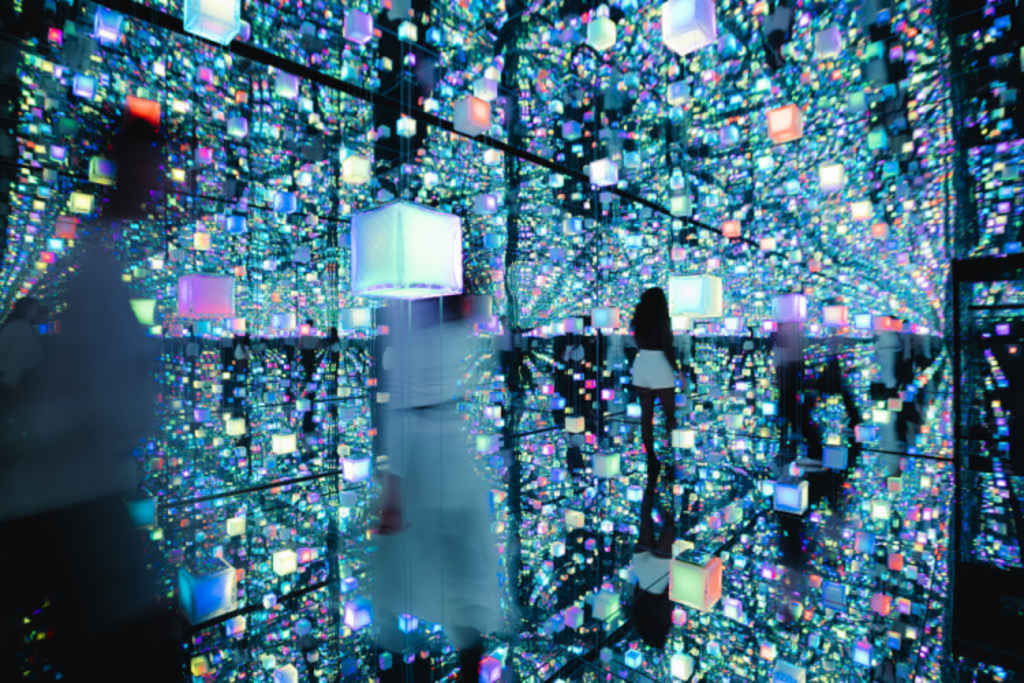
Some spaces are deliberately more fixed. The 19-projector immersive room is a substantial calibrated system and is not something the team intends to regularly rebuild. The Infinity Room, which currently uses 180 polished crystal mirrors and a Preciosa-created installation, is semi-flexible: it can accommodate physical pieces and has also been prepared to accept screens and projection. Elsewhere, rigging, sockets, and cabling have been designed around adaptation.
“If it is a matter of deploying video into the existing setup, it is simple,” says Vronský. “Otherwise the space is prepared for relocating sockets and cabling, adjusting the support structure, or installing a new piece on the rigging. The control system then needs an adjustment to the on/off logic or new devices added.”
That flexibility is already taking Signal Space beyond the conventional gallery day. It has hosted one-off audiovisual performances, while the main immersive environment is used for events and even morning yoga sessions under a programme branded Signal Movement. Pošta is considering educational content, workshops around creative software, breathwork sessions, and programming the immersive room more like a cinema or planetarium, with different content aimed at different audiences during the day.
For Pošta, experimentation is integral to a sector that is still working out what a permanent immersive cultural venue can be.
“We’re still taming this beast,” he says. “We want to have fun with it, but we’re responsible as well. Everybody in this world is experimenting because it is such a new industry.”
Echoes of Tomorrow earned the Inavation Award, but its greater legacy may prove to be the infrastructure left behind. Signal Space has been engineered not around one exhibition, but around the expectation that the art, the audience, and even the uses of the building will continue to change. For an AV system, that is arguably the more difficult brief.
All photos credited to Katerina Fialova
Tech Spec
Audio
Audinate Dante Avio analogue output and Dante virtual soundcards
Bose Edgemax and F1 loudspeakers
BSS Soundweb Blu-160 signal processors
JBL Control, 9300, and Eon loudspeakers
König & Meyer loudspeaker mounts
LEA Connect amplifiers
Sennheiser Evolution Wireless Digital microphone system
Tasker loudspeaker cables
Control & Interactivity
Elgato Stream Deck XL key control pads
Interspace MC3-L2 MicroCue3 cueing system
QLab show control software
Revolution Pi controllers
TouchDesigner visual programming software
Unity real-time development platform
Universe Control gallery management system
Infrastructure
APC UPS
Aten UE3310 USB cable
Brainstorm DXD-8 universal clock
Hikvision cameras
Milos Systems trussing
Netgear managed switches and cables
PremiumCord 8K DisplayPort to HDMI adapters and KVM switches
Thomann safety cables
Triton racks
Ubiquiti switches, transceivers, and access points
Lighting
Halla Lina60, Vali80-T, Rundo62 and Shift LED luminaires
Spectoda Custom System wireless lighting control
Stairville Gobo projectors and LED spotlights
Varytec LED Theatre spots
Video
AV Stumpfl Pixera media server system
Blackmagic Design UltraStudio 4K Mini and SDI/HDMI convertors
Euromet projector mounts
Kiloview N60 converters
Klotz coaxial cables
Kramer coaxial cables
Panasonic PT-REQ12, PT-RQ7, PT-REQ15, PT-MZ882, PT-VMZ6ST and PT-MZ11KL projectors; and lenses
Resolume Arena media software
Virtuality.one media servers