Systems integrator GVAV working with technology consultants Hewshott have delivered a unified AV strategy around a scalable, network-based design at the Schwarzman Centre for the Humanities at University of Oxford in the UK.
The Stephen A. Schwarzman Centre for the Humanities unites the University of Oxford’s humanities faculties into a single, purpose-built campus bringing together multiple faculties alongside the Institute for Ethics in AI, the Oxford Internet Institute and the Bodleian Humanities Library.
As well as converging around 2,500 staff from 22 separate buildings into one, the Schwarzman Centre is also open to the general public, meaning its spaces need to serve not just academics and researchers, but also visitors and community members. Teaching, performance, public engagement and research all happen under one roof, often simultaneously.
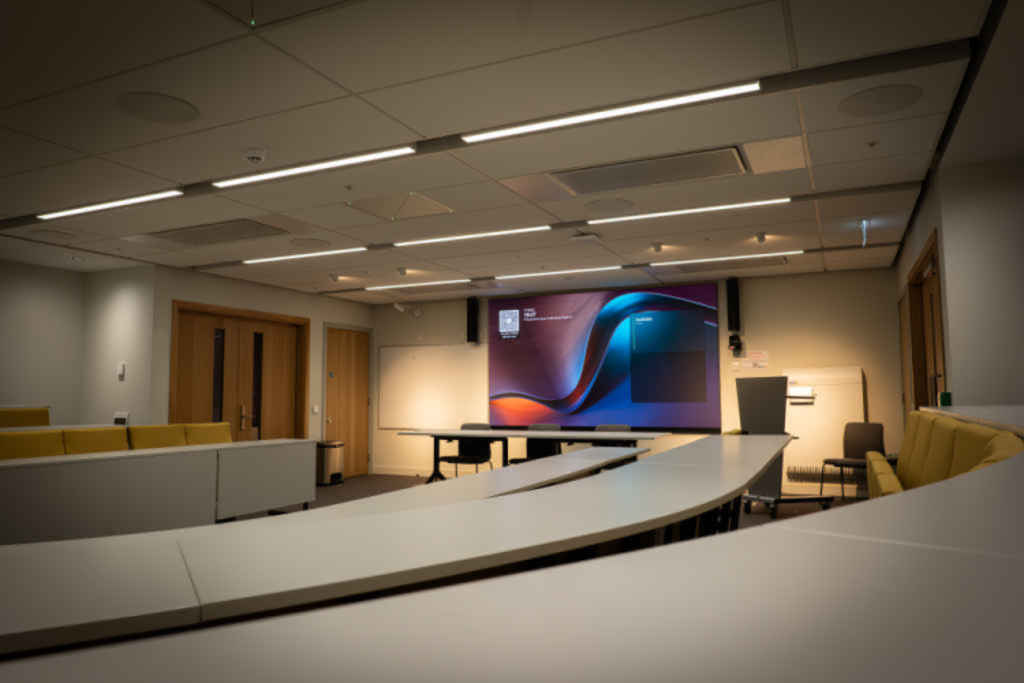
GVAV was brought into the project at the planning stage by consultants Hewshott in 2022 to deliver a unified AV strategy around a scalable, network-based solution. A complete proof-of-concept teaching room was mocked up in full with ceiling microphones, speakers, cameras and displays all installed and tested together to address questions around airflow, heat and acoustic performance before a single product was committed to at scale.
The finished installation covers over 100 AV-enabled spaces across the building, including 39 fully equipped teaching and seminar rooms, 85 meeting spaces, a Harvard-style lecture theatre, a boardroom, an atrium LED installation, and a building-wide digital signage network.

Each space was designed by Hewshott from the outset as a hybrid environment, capable of supporting in-person teaching, remote collaboration and events without reconfiguration. Hybrid capability was an important requirement from day one, shaped in the design phase by Hewshott and built into the AV architecture at every level.
The entire AV infrastructure at the Schwarzman Centre is built on a fully converged AV-over-IP architecture. Rather than traditional point-to-point cabling, audio, video and control signals travel across the University's IP network, managed and distributed by a centralised platform.

At the heart of the system are eight Q-SYS Core 610 processors, each licensed with Capacity Scaling, Scripting Engine and UCI Deployment software, forming a resilient, building-wide backbone to handle all audio processing, video routing and room control.
Video is distributed via Q-SYS NV-21-HU AVoIP endpoints throughout the building, eliminating the need for traditional matrix switching infrastructure. Audio travels across a full Dante network, delivering high-channel-count, low-latency audio distribution to every space.
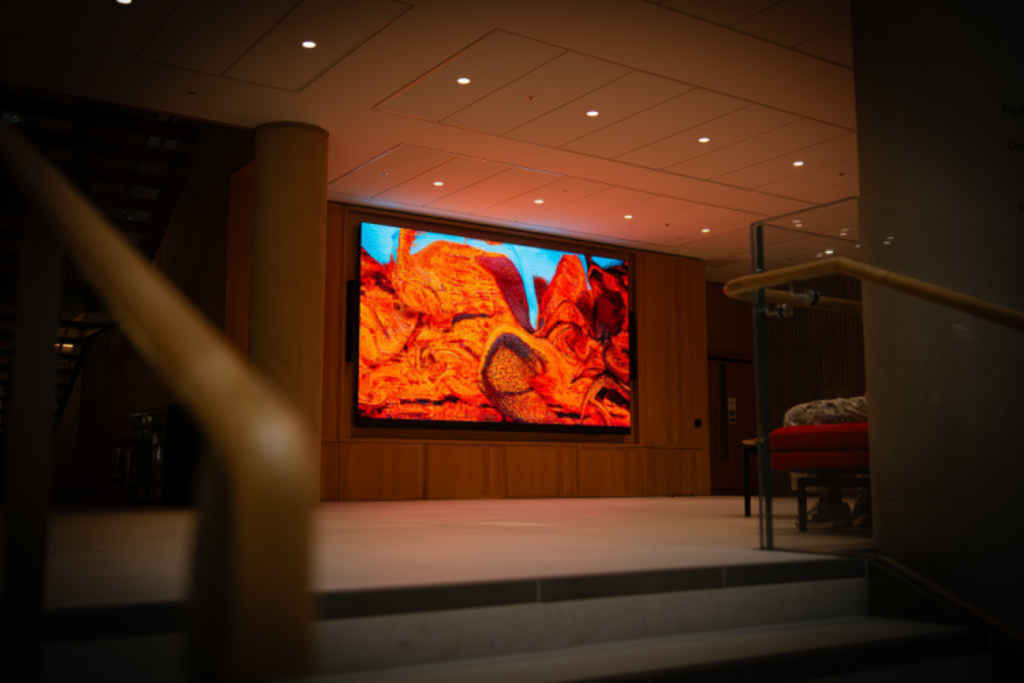
The Centre's atrium is the social and cultural heart of the building. This public space serves as the focal point for everyday life within the centre, as well as events and performances. The digital centrepiece is a 165" Sharp FE Series direct-view LED wall, comprising 36 modules assembled into a seamless bezel-free canvas.
With a 0.95mm pixel pitch and a 5000:1 contrast ratio, the display delivers UHD image quality for signage or digital art installations within the atrium. Reliability of the display was an important consideration for a high-profile public space such as this. Each module is independently front-serviceable, meaning that in the unlikely event of a module failure, a single section can be attended to quickly and without any visible disruption to the rest of the display. Mounted either side of the LED wall are Yamaha VX-L16P speakers, providing a slim solution for the space.

Away from the atrium, an LED wall also serves as the main display within the building’s Harvard-style lecture theatre. A high-resolution 135" Sharp 1.5mm pixel pitch LED wall delivers a high definition presentation surface that remains vivid and legible from every seat. Either side of the display, QSC loudspeakers have been installed, delivering clear audio.
For lecture capture, Q-SYS PTZ cameras ensuring remote participants have full visibility of sessions, while a Sennheiser TeamConnect Ceiling Mic captures speech from anywhere in the room without the need for handheld microphones, supporting a natural, free-flowing teaching environment. An Epiphan Pearl device handles lecture capture, sending recordings directly to the University's Panopto cloud platform.

Throughout the building’s 39 teaching and seminar rooms, the AV has been designed with the user experience in mind. Freedom of movement was an important consideration for those presenting, with no fixed lecterns and no racks of visible equipment. Instead, each room features a bespoke wall-mounted TOP-TEC Slimline Active Learning Console (SALC), a compact credenza housing all the AV equipment for that space, keeping the room uncluttered and flexible for different uses and different faculties.
Academics can walk into any teaching room in the building to a familiar user experience, with Sharp M-Series large format displays providing bright 4K visuals, QSC ceiling speakers, surface-mount loudspeakers, and amplifiers, delivering a consistent experience and output from room to room.

Like in the lecture theatre, audio is captured by Sennheiser TCC2 mic arrays, which pick up speech clearly from anywhere in the room without the need for handheld or lectern-mounted mics, while Q-SYS PTZ cameras track the presenter and frame the room for remote participants. Each space is controlled via a Logitech Tap touch controller integrated within the SALC, and paired with a Lenovo ThinkSmart Core compute unit running Microsoft Teams Rooms. Mounted above the teaching rooms’ whiteboards is a Logitech Scribe, capturing written content for the benefit of those joining remotely.
Lecture capture is again managed via an Epiphan Pearl device, which combines camera video and room audio before sending the feed automatically to the University's Panopto cloud platform.