Absen has supplied KLCOB1.5 PRO V2 LED technology for the Swinburne Virtual Universe, a 3D immersive environment at Swinburne University of Technology in Melbourne, Australia.
The installation spans more than 106 sq m and is described as the largest truly wraparound LED screen built for public education. The space surrounds visitors with 3D imagery and interactive animations designed to explore the solar system and deep space environments
The Swinburne Virtual Universe uses Nvidia GPU technology and real-time rendering engines, with content generated from Swinburne’s OzStar and Ngarrgu Tindebeek supercomputers. The system allows audiences to experience planetary close-ups, virtual space travel and astrophysics simulations based on real scientific data.
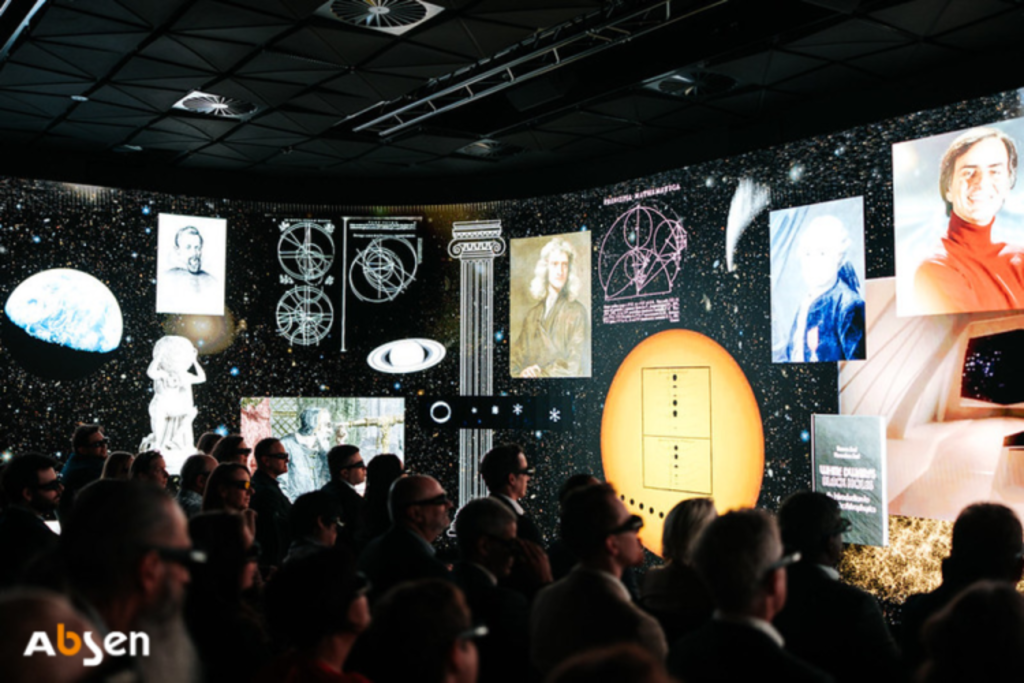
Absen’s KLCOB1.5 PRO V2 was selected to meet the demands of close-viewing 3D content, long operating periods and a high-traffic public environment. The product features a 1.5mm pixel pitch and uses Chip-on-Board technology, embedding LED chips beneath a continuous protective surface layer to improve durability, contrast and uniformity.
The wraparound geometry required consistent colour, seamless surface uniformity and image clarity across wide viewing angles. According to Absen, the product’s monolithic construction was central to maintaining the visual integrity of the 3D content across the full LED canvas.

Professor Matthew Bailes, project lead at Swinburne University of Technology, said the facility may be the largest truly 3D wraparound LED screen for public education ever built. He added that the first visiting school group “shrieked with joy” when one of Mars’s moons appeared in front of them.
The facility will support undergraduate students, school groups, families and the wider public, while also acting as a resource for Swinburne’s Film, Games and Animation programmes. It forms part of the university’s wider astronomy activity, which includes its partnership with the W. M. Keck Observatory.
Ruben Rengel, vice president at Absen, said the project demonstrates the role of COB LED in large-format immersive environments requiring image quality, reliability and precision.