Choosing the right projector sounds straightforward until you’re faced with hundreds of models, evolving technologies, and a long list of specifications that don’t always translate clearly into real-world performance. For AV professionals, consultants, and integrators, the challenge isn’t just picking a projector, it’s selecting the right one for a specific environment, audience, and experience.
So where do you start?
Begin with the outcome, not the hardware
The most common mistake in projector selection is starting with specs rather than objectives. Before comparing brightness, resolution, or light sources, step back and ask a simpler question: What is this system meant to achieve?
A corporate boardroom presentation has very different requirements than a projection-mapped façade, a planetarium dome, or a theme park dark ride. The more clearly you define the intended experience or use —whether it’s for sharing information, creating an immersive experience, or producing a large-scale visual spectacle—the easier it becomes to narrow your options. There is no universal “best” projector. There is only the best fit for your application.
Understand your environment
Once your goals are clear, the physical environment becomes your next critical filter. Even the highest-performing projector can underdeliver if it’s mismatched to its surroundings.
Ambient light is often the biggest factor. A bright lobby or outdoor installation demands significantly more brightness than a controlled, darkened theatre. But brightness alone isn’t enough. You also need to consider screen size, surface type, and viewing distance.
A few practical questions help shape your requirements:
- - How much ambient light is present (natural or artificial)?
- - What surface are you projecting onto and how large is it?
- - How far is the projector from the screen?
- - How close is the audience to the image?
-
These variables directly influence brightness, resolution, and lens selection. For example, audiences seated close to large visuals will quickly notice insufficient resolution, because images will appear soft or pixelated, while limited installation space may require ultra short throw lensing.
Environmental conditions also matter more than many expect. Dust, heat, humidity, or outdoor exposure can all affect long-term performance, making features such as sealed optical engines or protective enclosures essential in certain applications.
Let your content guide your choices
Not all content is created equal and neither are the projectors that display it.
If your primary use case is static presentations or data-heavy visuals, your requirements will differ significantly from applications involving high-motion video, 3D content, or visually rich storytelling.
Color fidelity becomes especially important as content complexity increases. Applications that rely on lifelike imagery, brand accuracy, or immersive storytelling benefit from wider color gamuts and more advanced illumination technologies.
Frame rate is another often-overlooked factor. For motion-heavy content such as simulation, live events, or attractions, higher frame rates reduce motion blur and improve clarity. In contrast, lower frame rates may suffice for static or slow-moving visuals.
In short, the more dynamic and visually demanding your content, the more critical performance factors like color accuracy, contrast, and frame rate become.
For permanent installations, it’s also worth thinking beyond day one. A long-term content strategy that allows for updates and refreshes can keep experiences relevant—and give audiences a reason to return.
When one projector isn’t enough

Festa da Luz, Belo Horizonte, Brazil.
Installation by ON. Photo credit: Cadu Passos & Isis Medeiros
As projects scale up, so does complexity. Large venues, unconventional surfaces, and immersive environments often require multi-projector systems to achieve the desired brightness, resolution, and coverage.
But adding more projectors introduces new considerations:
- - Alignment and calibration
- - Ease of setup and operation
- - Ongoing system management
-
Modern solutions can simplify these challenges by automating warping, blending, and calibration. The system's usability, especially for teams that may not be highly technical, should be a factor in your decision-making process.
A system that looks impressive on paper but is difficult to maintain or recalibrate in practice can quickly become a liability.
Think beyond purchase price
Budget is always part of the conversation but focusing solely on upfront costs can be misleading.
Total cost of ownership tells a more complete story. This includes:
- - Maintenance requirements
- - Ease of service and access
-
For example, laser-based projection has largely replaced traditional lamp systems, offering longer operational life and reduced maintenance. While initial costs may be higher, the long-term savings, in both time and operational expenses, can be significant.
It’s also worth considering how easily a projector can be serviced. Can filters or components be accessed without removing the unit from its installation? Is the light source replaceable in the field? These practical details often have a bigger impact over time than spec sheet comparisons.
Technology matters - but context matters more
Projection technology has advanced rapidly, offering a wide range of options across brightness levels, resolutions, and illumination types. From compact, cost-effective solutions to high-performance systems designed for large-scale experiences, the spectrum is broader than ever.
But technology alone doesn’t determine success. A high-end system deployed in the wrong environment, or for the wrong application, won’t deliver the intended results.
Instead of chasing the highest specifications, focus on alignment: between the technology, the environment, and the experience you’re trying to create.
Don’t overlook support and service
Finally, consider the long-term relationship, not just the product. A reliable support structure can make the difference between a smooth deployment and ongoing operational challenges. Look for partners and manufacturers who understand your application, offer responsive technical support, and provide tools that simplify monitoring and maintenance. Projection systems are rarely static. They evolve with content, usage, and audience expectations. Having the right support in place ensures your investment continues to perform over time.
Bringing it all together
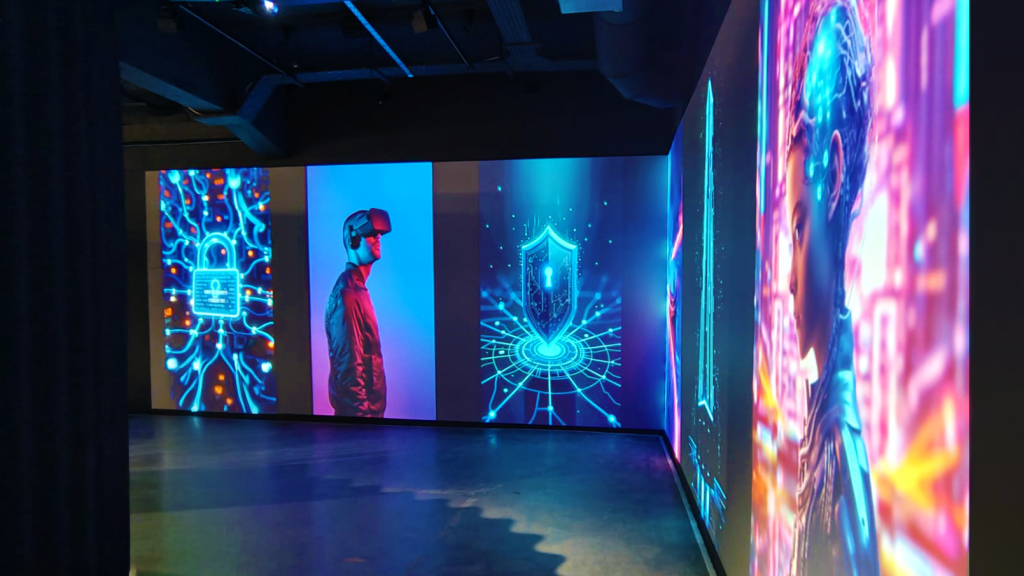
The Building Centre event space, London, UK.
Installation by AVM and ARC.
Choosing the right projector isn’t about finding a single perfect model; it’s about making informed choices based on your specific needs.
When you take the time to evaluate your environment, understand your content, and consider both performance and operational factors, the decision becomes clearer. The “right” projector is the one that delivers the intended experience reliably, efficiently, and within your constraints.
If you’re looking to go deeper, exploring technologies, specifications, and practical selection frameworks in more detail, download this comprehensive projection selection guide from Christie as your next step. It expands on these considerations and helps translate them into actionable decisions for real-world projects.
Because in the end, great projection isn’t just about what’s on the spec sheet—it’s about what your audience sees, feels, and remembers.
Learn about topics such as pixel shifting, color fidelity, and types of laser projectors, and get more details on the top considerations you need to factor in when selecting a new projector.
Read the projection selection guide.
