Projection has always occupied a unique position in Pro AV. Unlike many display technologies, projection systems are deeply tied to architecture, geometry, optics, and physical space. Every installation is different. Every venue introduces variables. And despite huge advances in media servers, calibration, and rendering technology, much of the planning process still relies on approximation.
For many AV professionals, projection design remains a fragmented workflow. CAD drawings are created in one application. Lens calculations happen somewhere else. Coverage checks are manual. Brightness estimations often rely on experience rather than simulation. Problems only become visible once projectors arrive on site, when time, budgets, and access windows are already under pressure.
That reality becomes even more challenging as immersive environments grow in scale and complexity. Multi-projector experiences, curved architecture, dome environments, interactive spaces, hybrid LED/projection systems, and simulation environments all increase the number of variables that integrators and designers must manage before installation begins.
This is the problem VIOSO is addressing with the launch of Experience Designer, a new cloud-based platform that brings projection planning, simulation, and validation into a connected workflow.
Rather than treating projection design as a collection of disconnected stages, Experience Designer introduces what VIOSO describes as a “virtual site survey” for projection systems.
The idea is simple: before entering the venue, AV teams should be able to simulate the installation, validate feasibility, identify problems, optimise layouts, and communicate visual outcomes to stakeholders.
Learn more about Experience Designer or start using the platform.
Why projection planning still creates risk
In many large AV projects, the most expensive problems are not caused by hardware failure. They come from assumptions made too early in the design phase.
A projector position that looked acceptable on a drawing may produce unexpected occlusions once architectural details are considered. A lens choice may technically achieve coverage but create brightness inconsistencies across a surface. A projector array may fit geometrically but generate edge-blending challenges that only appear during calibration.
These issues are rarely impossible to solve, but solving them during installation is costly.
Venue access extensions, additional labour, re-rigging, revised mounting structures, last-minute projector swaps, and extended commissioning schedules can quickly transform a profitable project into a stressful one.
Historically, projection professionals have compensated through experience. Skilled designers build intuition around optics, geometry, and deployment constraints. But as projects scale up, even experienced teams benefit from tools that allow decisions to be tested before deployment begins.
Experience Designer aims to shift projection planning away from approximation and toward simulation-driven validation.
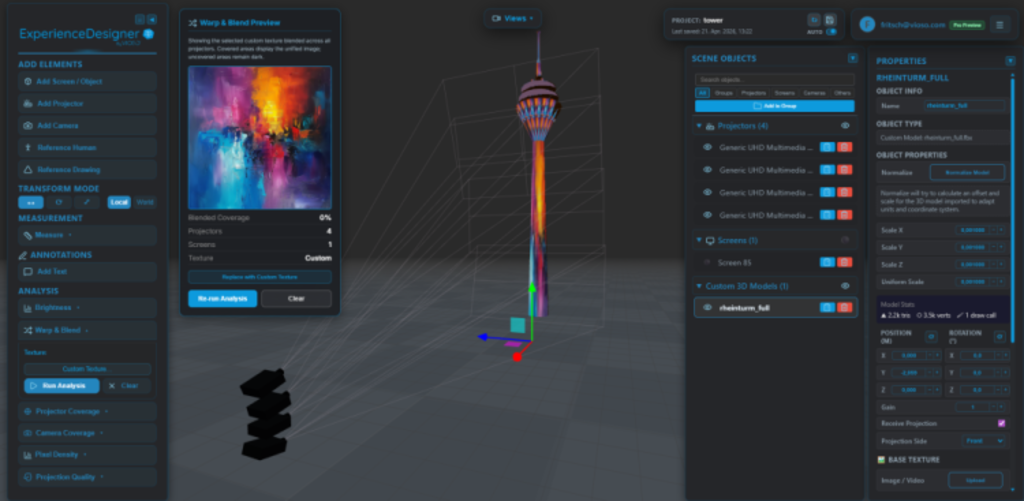
Using GPU-based rendering and photometric analysis, the platform allows users to evaluate projection coverage, brightness distribution, pixel density, frustum geometry, and line-of-sight constraints inside a browser-based environment.
The platform supports importing real venue geometry, positioning projectors from manufacturer libraries, and simulating real-world optical behaviour — including lens characteristics and brightness falloff.
In practical terms, this means AV teams can identify problems while they are still inexpensive to fix.
A browser-based workflow for modern AV teams
One of the more interesting aspects of Experience Designer is its positioning as an open, vendor-neutral platform.
While VIOSO is well known for camera-based auto-calibration and media playback technologies, the company is deliberately positioning Experience Designer as something broader than a proprietary ecosystem tool.
The platform is designed to integrate flexibly into existing workflows used by consultants, integrators, creative studios, simulation providers, and immersive experience designers.
That matters because the AV industry increasingly operates through collaboration across multiple disciplines.
A projection mapping project today may involve AV integrators, Unreal Engine artists, architects, content creators, lighting designers, and simulation specialists — often working across different locations and timelines.

Static PDFs and screenshots are increasingly inadequate for communicating complex projection systems between stakeholders.
Experience Designer addresses this with interactive 3D visualisation and shareable project links, allowing clients and collaborators to explore layouts, coverage, and visual outcomes directly within the scene.
The platform also includes automated reporting tools for projector analysis, equipment specifications, photometric validation, and extended PDF generation.
For consultants and integrators, that potentially changes how proposals and approvals are handled. Instead of presenting abstract technical drawings, teams can communicate visually and interactively.
Beyond projection mapping
Although projection mapping is an obvious application, the broader opportunity may be within simulation, immersive spaces, museums, visitor attractions, and hybrid visual environments.
Many modern immersive installations now combine projection with LED walls, tracking systems, camera-based calibration, and real-time rendering engines.
These systems introduce a level of complexity where planning tools become increasingly important.
Experience Designer includes support for LED wall integration, hybrid projection/LED workflows, camera simulation (including fisheye systems), and GPU-accelerated occlusion detection.
The platform also supports importing OBJ, FBX, and GLTF geometry, enabling accurate digital representations of real environments.
For simulation environments, where projector alignment and sightline accuracy can directly affect training outcomes, the ability to simulate systems before deployment could provide substantial operational advantages.
Likewise, for museums and visitor attractions, where installation windows are often short, and venue downtime is expensive, pre-validation becomes particularly valuable.
The shift from calibration to workflow
VIOSO’s launch of Experience Designer also reflects a broader trend happening across Pro AV.
Historically, many AV manufacturers focused on individual technologies: calibration, playback, displays, switching, control, or rendering.
Increasingly, the competitive advantage is shifting toward workflow integration.
The AV industry is becoming more software-driven, more collaborative, and more dependent on previsualisation. Tools that reduce uncertainty, improve communication, and accelerate deployment are becoming just as important as the underlying hardware itself.
In that context, Experience Designer represents an expansion of VIOSO’s role beyond calibration and playback into the earliest stages of projection system planning.
Benjamin Fritsch, CEO of VIOSO, describes the goal as creating a more connected workflow for projection professionals:
“Projection projects have traditionally relied on a fragmented workflow of separate tools for design, calibration and playback. With Experience Designer, we’re introducing a more connected approach — enabling AV professionals to perform a virtual site survey before entering the venue and validate their system design in advance.”
Importantly, the company is not positioning the platform as a closed ecosystem.
Instead, the emphasis is on adaptability and interoperability — allowing AV professionals to integrate the platform into existing workflows regardless of playback or rendering choices.
That positioning may resonate strongly within an industry where mixed-tool workflows remain the norm.
A broader industry direction
Projection technology itself is evolving rapidly.
Higher-brightness laser projectors, increasingly affordable real-time rendering, Unreal Engine-driven experiences, and growing demand for immersive environments are pushing projection systems into more ambitious applications.
At the same time, clients increasingly expect predictability. They want to know what the space will look like before installation begins. They expect visual validation, and they expect fewer surprises during deployment.
That creates demand for planning tools that operate more like modern architectural visualisation workflows than traditional AV design processes.
Experience Designer is part of that shift.
Rather than replacing calibration or playback technologies, it attempts to connect the stages around them, moving from concept and simulation through to calibration and final playback.
For projection professionals working on increasingly complex immersive environments, that may prove just as important as the hardware itself.
Learn more about Experience Designer or start using the platform.