In Sohar, Oman, a vast tented structure and a 32m immersive dome engaged visitors in the most ambitious AI-driven environment yet attempted in the interactive experience sector. Anna Mitchell finds out more from Vivid Studios.
Omnia is a new breed of immersive and fully interactive exhibition that uses AI not only as a subject, but also as the operational backbone of the entire installation. Content is generated by AI, interactions mediated by AI agents, and lighting cues triggered by AI decision-making. Even the narrative arc of the experience evolves through data captured from its visitors.
Created by Vivid Studios, Omnia is a modular concept that can be localised and deployed for clients across the world. Sohar was its first full-scale implementation when it became reality as part of a government-backed cultural installation.
“This is the first fully responsive, AI-driven experience,” says Moe Tarakomyi, co-founder and chief creative officer at Vivid Studios. “It’s a close encounter between human and machine where the environment listens, responds, and evolves. The AI isn’t just performing for people; it’s learning from them and collaborating with them in real time.”
For Mohamad Haroun, co-founder of Vivid Studios, the defining characteristic of Omnia is integration. “From end to end, it’s using AI,” he says. “Not just for visuals. Not just for content. In the software, the registration, the lighting control, the interaction logic. Everywhere.”

Every visitor begins their journey with a personalised QR code. This unlocks a digital passport, built as a Progressive Web App (PWA) designed to function without internet connectivity. The value is immediately obvious: seamlessly lowering friction and simplifying throughput, while leveraging the technology that drives the whole experience.
From the moment of onboarding, the system learns context. Each zone either stamps the visitor’s passport or writes data back to it. Images created in photo booths, preferences expressed in interactive modules, and final “wishes” all contribute to the user's personal digital archive.
The collective expressions and engagements of the visitors are used to build what Vivid calls “The Archive of the Future”, a living view of visitor aspirations, designed to inform future AI understanding of human intent.
The dataset additionally enables contextual awareness for the exhibition’s central AI character and what each visitor experiences, which has considerable operational benefits.
It is important to note that personal identifiers are stripped from analytical data. “The personal information is not even transmitted into our dataset,” Haroun explains.
Walking through Omnia
Omnia occupies approximately 1,200 sq m of exhibition space, followed by a 32m diameter immersive dome and a hospitality zone beyond.
Visitors move first through an immersive pre-show environment where floating calligraphy, generated from previous guests’ wishes, fills the space. It sets the narrative arc from the start: Omnia begins with what others have imagined, then gradually widens its lens from personal life to collective society as the exhibition unfolds across themed zones: Future Home, Space, Health, Education, Energy, Nation, Environment & Planet, Community & Connection, and Identity & Digital Self.

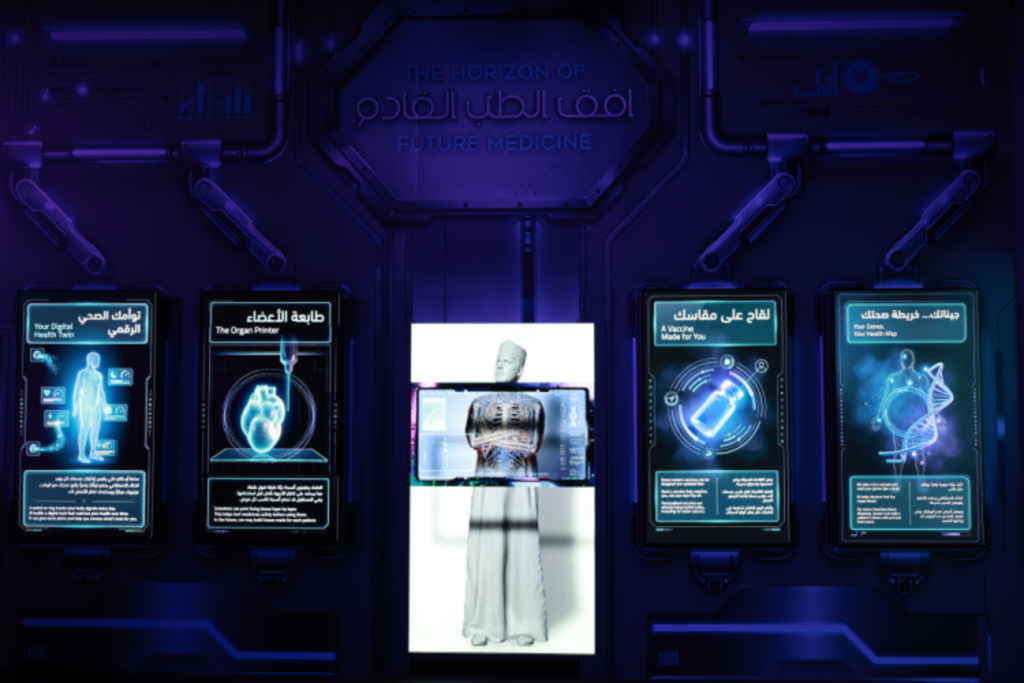
Within those zones, the future is treated as a set of plausible trajectories rather than pure speculation, with scenarios informed by a sweep of scientific literature and emerging research. In Health, this translates into themes like AI-assisted organ bioprinting and personalised medicine, visualised through interactive displays. In Education, kinetic ceilings and mirrored rooms illustrate AI-driven personalised learning ecosystems. The Home environment explores predictive systems, robotics and automated safety, while the Energy and Space zones draw directly from Oman’s national ambitions and its Vision 2040 strategy.
At the centre of the museum section sits Amani, a multilingual digital human presented on a large LED canvas. For Sohar, she appears in traditional Omani dress. Visitors approach her and speak naturally in Arabic or English. She responds conversationally, referencing infrastructure projects, energy initiatives and national development plans.
As she speaks about a marina development, relevant video content appears dynamically. When she shifts topic to energy, lighting tones adjust and the visual environment changes in response.
“In real time, lighting will change based on what she’s talking about,” Haroun says. “Videos also play in response to the topic. We believe this is the first real-time AI agentic orchestration of video, lighting, and conversation.”

The journey culminates inside the immersive dome at the Well of Wishes.
Visitors submit a final aspiration via their app. The wishes are classified, transformed into poetry and, depending on configuration, generate imagery or music.
In Sohar, poetry is prioritised in alignment with the local cultural context. The poem reappears in the opening Oasis space, feeding the ecosystem of floating calligraphy that greets subsequent visitors.
“We can translate a wish into music, poetry, and imagery,” Tarakomyi says. “And it all becomes collectible in the app”
The wish also triggers volumetric LED animation and environmental changes within the dome, completing the feedback loop between individual input and collective atmosphere.
Beyond the dome, Omnia extends the interaction model seamlessly into the café area, which features integrated seating arranged around interactive tables. Each table reacts to QR-triggered interaction, LED flower sculptures and synchronised scent emitters. Visitors scan their passport, trigger digital blooms, and watch as lighting, visuals, and fragrance respond in unison.
Architecture of a ‘brain’
At the core of Omnia sits what the team refer to simply as “the brain”: a custom framework designed to connect visitor data, AI agents, real-time graphics engines, hardware control systems, and media servers into a single responsive environment.
The software stack combines TouchDesigner for real-time graphics and sensor integration, Node.js Middleware, Unreal Engine for photorealistic 3D environments, and a Python/FastAPI backend orchestrating AI service. The system uses a combination of protocols: WebSockets, message queues, Art-Net, DMX, OSC and HTTP allowing AI agents to directly influence lighting states, media playback and environmental conditions.
One of the clearest departures from conventional show control lies in the lighting architecture. Rather than building pre-programmed cues triggered by timecode or operator input, Vivid created an MCP server for the lighting system itself.
“The AI is actually asking the lighting control to change the colour in real time,” Haroun explains. “Without cues. It’s sending channel values directly. Like a live operator.”
The lighting desk (an MA Lighting grandMA3 console in Sohar) is no longer executing static scenes but responding dynamically to conversational context and AI decisions.
Vivid built an ecosystem of specialised AI agents, each responsible for a discrete operational task and all communicating through the central integration hub.
“To make powerful AI systems, you need context and memory,” says Dany Haroun, head of AI development at Vivid Studios. “We built everything around context. The AI doesn’t just respond to a question. It knows what the visitor has experienced, where they’ve been, and what they’ve interacted with. That context is the underlying magic behind meaningful environment control.”
Custom AI agents handle conversational logic and environmental triggers. They do not simply generate dialogue; they issue structured commands that update lighting parameters, trigger video assets, write data back to the visitor’s profile, and modify the state of the wider experience.
Running alongside them is TAOTF, The Archive of the Future, an LLM-assisted classification pipeline that translates human “wishes” into structured aspiration signals. It aggregates the hopes expressed by visitors into an anonymised map of collective intention, designed to be shared openly as a resource for researchers and future AI systems seeking to understand not just how humans behave, but what they actually want the future to become.
Speech is delivered through custom-trained voice models producing high-quality Arabic and English synthesis aligned to local dialect and tone. This makes Amani not just a rendered avatar but a context-aware digital human capable of altering the physical environment in real time.
The generative layer extends far beyond language.
For generative visuals, Vivid integrated Nilor’s Blossom system, which drives real-time, continuously evolving content across key canvases, allowing the exhibition’s look and tempo to shift without relying on fixed playback loops.
SeeDreamV4 powers portrait transformation in the AI photo booths, dynamically combining passport data with structured prompts to localise outputs. StreamDiffusion handles sketch-to-art transformations, converting line drawings into stylised visuals live on screen.
For body-based interaction, MediaPipe and OpenPose provide real-time pose estimation, while YOLO object detection models interpret gestures and spatial relationships within camera feeds.
In the children’s animation zone, a modified Meta Animated Drawings framework rigs scanned drawings in real time, applying pose retargeting so that a child’s physical movements drive their illustrated character on the LED canvas. Particle systems and collision logic layer on top, creating a feedback loop between body tracking, generative animation and large-format display.

What distinguishes Omnia is not the presence of any single AI model, but the choreography between them. Language models, diffusion models, object detection frameworks and pose estimation libraries are interconnected through the same backend architecture that controls projection, LED content and lighting.
Machine learning is not an add-on feature. It is embedded within the show control logic itself.
All of this runs on a substantial on-site compute backbone. At the core is Carismi, Vivid’s in-house hardware platform built specifically to deliver AI and real-time generative media inside physical environments. Twenty Carismi Quad GPU-accelerated systems handle heavy AI processing and live generative workloads, supported by six Carismi Duo machines dedicated to vision processing, plus seven Carismi Uno Mini PCs distributed for edge computing across the exhibition.
Omnia positions artificial intelligence as its conceptual core, underpinned by a substantial projection, LED and audio deployment that carries the visual and sonic weight of the exhibition.
Projection is delivered site-wide through a combination of 22 Epson EB-PU2216B 16K laser projectors and eight Panasonic 30,000-lumen 4K 3-Chip DLP laser projectors, deployed with multiple lens configurations to accommodate the tented architecture and curved surfaces. Within the dome, multi-projector blending creates a continuous 360-degree canvas for generative animation and reactive content.
LED forms the second major visual layer. Fabulux Alpha Series and FC Series rental LED screens, in 1.9mm and 2.6mm pixel pitches, are deployed throughout the exhibition as fine-pitch walls for AI-generated content and digital human interaction. Amani appears on a large-format LED canvas, providing the clarity and colour depth required for close-range conversational engagement.
Specific LED installations punctuate individual zones. In the Space zone, 1.5m and 0.5m LED spheres transform planetary themes into suspended sculptural display objects. In the Wish Zone, a volumetric LED cube forms a three-dimensional grid of light, responding visually to visitor submissions. Curved LED displays support immersive gaming environments, while interactive LED floors introduce touch-responsive ground planes that extend visual storytelling underfoot.

Beyond conventional flat displays, the project incorporates multiple transparent OLED screens, 3D holographic cylinders and an 86-in Holobox showcase, layering digital content into physical space and reinforcing the exhibition’s exploration of hybrid digital-physical identity.
Audio is distributed across all zones using L-Acoustics X Series loudspeakers, configured to deliver both background atmospheres and clear reinforcement for AI-driven dialogue. Dedicated speaker coverage ensures Amani’s voice remains intelligible even within the acoustically challenging tented structure. In the immersive dome, a 360-degree surround system provides spatial audio that envelops visitors, synchronised with projection and LED outputs to heighten the impact of generative visuals. Mackie SRM450 loudspeakers are deployed for voiceovers and interactive sound effects, particularly within participatory and game-based environments.
The most disruptive aspect of Omnia lies not in what visitors experienced, but in how it was produced.
“Traditionally, you would require an army of people,” Tarakomyi reflects. “Here, we had heads of departments. The rest was a fleet of AI agents.”
Content generation pipelines produce variant visuals dynamically rather than replaying identical loops. The Experience Management System allows on-site modifications without rewriting core code. AI agents support ideation, narrative development, visual generation, and operational control.
For Haroun, this marks a turning point. “AI can be the whole place,” he says. “Not just a corner.”
The concept is functional, modular, and extensible. Zones can be scaled, removed, or expanded. Space modules can localise to national space programmes. Energy narratives can align with regional infrastructure. Digital humans can adopt new dialects and attire.
The hardware footprint can scale from temporary touring format to permanent installation. Sponsorship layers can be integrated without re-engineering the core system. AI interaction volumes can be throttled to manage compute cost.
Omnia doesn’t simply demonstrate what AI can look like in an exhibition. It demonstrates what happens when AI integrates with the infrastructure of the experience itself.
Tech-Spec
Audio
L-Acoustics X Series loudspeakers
Mackie SRM450 speakers
Computing & AI Core
Carismi Quad, Duo and and Uno Mini PC
Nilor Studio Blossom system
Lighting
Avolites consoles
MA Lighting grandMA3 console
Martin MAC Viper Performance fixtures
Stellar Wash770 LED fixture, LED Q5 City Colour units, UV LED Parcans, Tornado X5 beams, and Storm 990 hybrid fixtures
Additional high powered lasers, haze machines, and fog machines
Video
Elo 55-in touchscreens
Epson EB-PU2216B 16K laser projectors
FabuluxLed Alpha Series and FC Series P1.9 walls, P2.9 floors, kinetic LED cubes, LED spheres
Panasonic 30,000-lumen 4K 3-Chip DLP laser projectors
Holoconnects 86-in Holobox
Additional transparent OLED, transparent LED, 32-in touch PCs, 32-in information kiosks, 55-in touchscreen table, and 3D holographic cylinder
Sensing & interaction
Digital Logic RF readers
Hokuyo UST-10LX LiDAR scanners
Intel RealSense depth cameras
Logitech C920 cameras
MIFARE Ultra Light C NFC tags
Additional interactive 4-button controls