Sennheiser has deployed its largest Spectera system to date at the Eurovision Song Contest 2026, supporting wireless microphones, in-ear monitoring and control data for one of the world’s most technically demanding live music broadcasts.
As official audio supplier to host broadcaster ORF, Sennheiser worked with technical production company Agorà at Vienna’s Stadthalle, where the wideband wireless system supported around 150 live streams. The deployment included four active Spectera base stations, alongside additional units for spectrum scanning and redundancy.
The Eurovision production required full venue coverage, with the system carrying wireless mics, IEMs and control data across a complex arena environment. The setup used Spectera DAD antennas positioned around the venue, with additional antennas added to improve reliability. An RF control centre in the sound room provided real-time monitoring through Spectera WebUI and the Sonoros app.

The event also marked the use of manufacturing samples of Sennheiser’s upcoming Spectera handheld transmitter, paired with Neumann KK 105 A super-cardioid capsules. Artists using hands-free systems were equipped with Spectera bidirectional bodypacks and cardioid Headmic 4 microphones.
Agorà’s ESC project lead Valerio Motta said the system contributed to a production environment where reliability and speed were essential, adding that the ability to simplify complexity “can make a real difference”.
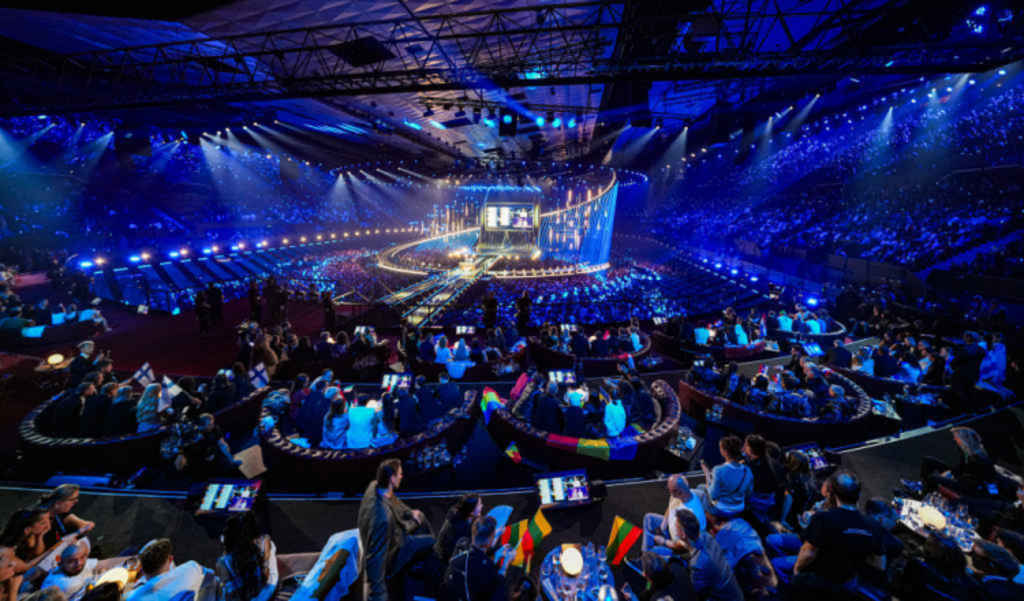
Photo credit: ORF
The audio team managed rapid changeovers between performances, with each Eurovision act limited to three minutes and only 42 seconds available to reset for the next artist. The production used rotating sets of Spectera handhelds, SEK bodypacks for in-ear monitoring, and all-in bodypack configurations combining headset microphones and IEMs.
Sennheiser’s technical application engineering team supported the deployment on site, helping manage the wideband workflow and the additional system monitoring enabled by Spectera. According to the company, the platform allowed engineers to see device and RF health data remotely, reducing the need for physical intervention during rehearsals and performances.
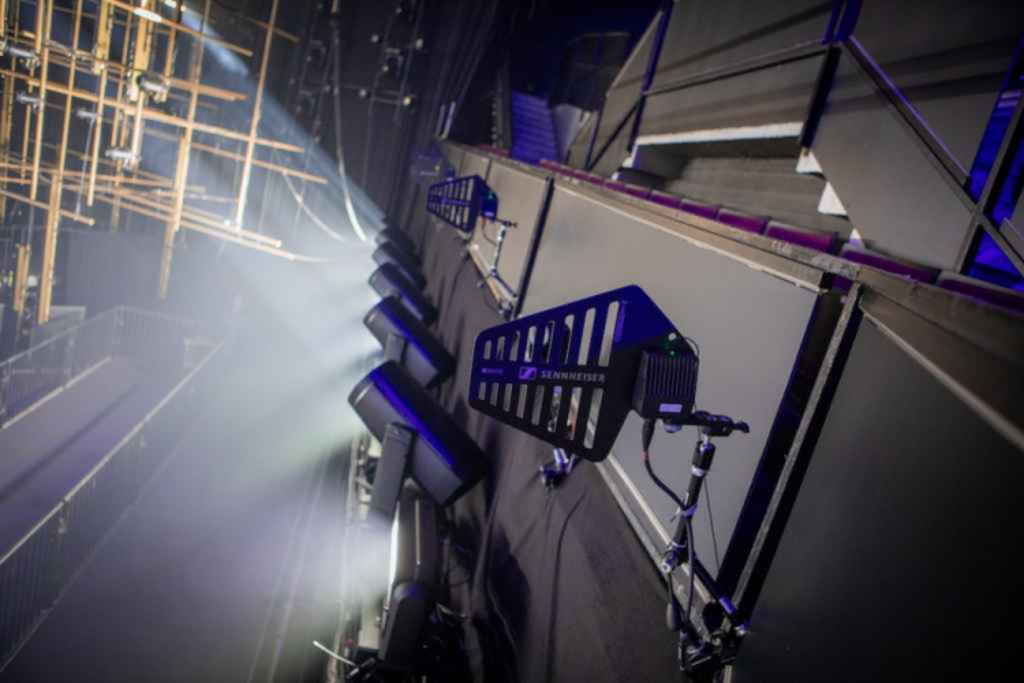
The system architecture used fibre from the sound room to front of house, converted back to copper using standard IT media converters, allowing remote antennas to operate without the compromises associated with conventional RF-over-fibre workflows.
The Eurovision deployment also represented a significant milestone for Spectera’s development story. Sennheiser said the concept for the platform can be traced back to RF challenges encountered at Eurovision 2014 in Copenhagen, where fading issues in a metal-heavy venue prompted engineers to rethink wireless transmission using wideband technology.
For Eurovision 2026, the final Spectera setup included four active base stations, one scanning base station, 46 Spectera SKM handheld microphones with Neumann KK 105 A capsules, 101 Spectera SEK bodypacks, Headmic 4 microphones and Sennheiser in-ear systems for orchestra and dancers.
Top image credit: ORF