The German city of Detmold has recently become home to the KreativInstitut Ostwestfalen-Lippe (KIO), and its the brand new Spatial Audio and Arts Lab facility is powered exclusively by Genelec monitoring.
Situated on the Kreativ Campus Detmold, KIO serves as a centre of science and research and is jointly shared by Paderborn University, Detmold University of Music, and the OWL University of Applied Sciences and Arts. In bringing together creative minds from business and science, the institute is unique in Germany for its huge breadth of expertise.
KIO’s Spatial Audio and Arts Lab (known as S.A.A.L. – an eloquent wordplay on the German word for ‘music hall’) functions as a high-resolution immersive monitoring room with a clear musical focus, allowing the mixing, production and presentation of content by students and researchers alike.
“S.A.A.L. was designed as a high-resolution Ambisonics monitoring space, enabling full-spherical reproduction between the 5th and 6th order. At the same time, the room is fully compatible with channel-based formats and common consumer formats such as Dolby Atmos,” comments Sascha Etezazi, KIO’s Artistic Research Associate in Composition & Sound Design.
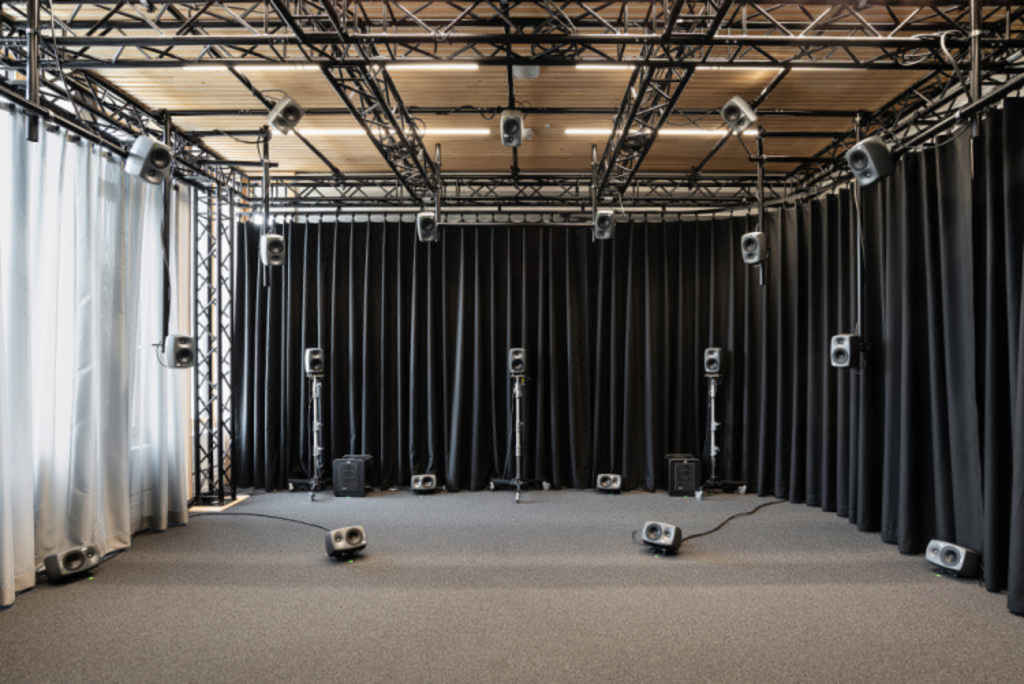
In designing the room, Etezazi worked closely with Jörn Nettingsmeier, consultant for immersive electroacoustics/ambisonics. With Nettingsmeier planning the truss structure, acoustic curtains and electroacoustics, Etezazi and his team defined the precise positioning and setup of the monitoring system.
As a result, Etezazi and the KIO team specified a monitoring system comprising 43 Genelec 8030C two-way monitors – configured as a 360 degree spherical array measuring 7m × 6m × 3.8m – complemented by four 7050C subwoofers. “S.A.A.L. is a relatively large room, so we wanted to provide a wide listening area where several people can also listen comfortably while standing,” says Etezazi.
The system design and concept allow for an easy plug-and-play through the integration of common DAWs and playback systems. With its huge diversity of projects, KIO relies on a highly flexible infrastructure, enabling students to prepare mixes remotely and then set up their workstation directly in S.A.A.L., connect to the playback system, and start working in a wide range of formats. Mixes created in the spatial room can then be experienced and evaluated elsewhere on campus – such as using a 3D headset with headphones, for instance.