AV can save the day when crisis strikes. Paul Milligan gathers an expert panel to give tips on how to maximise efficiency and provide reliability when a serious incident occurs.
all pix: Diversified and Cyviz
There is no greater test for your AV systems than when crisis hits. We all strive for reliable and trustworthy AV, but in the event of a serious incident such as a significant power outage, fire or flood, a concerted strike by hackers, a terrorist attack, or during military operations, resilient AV is not a technical luxury. It can be the difference between mission success and failure, between life and death.
As John van Laerhoven, regional director at Cyviz, puts it: “The mission is not to put more information on more screens. It is to ensure the right people have the right information at the exact moment they need to act.”
We gathered a panel of experts, from integrators and manufacturers active in the command and control room sector, to ask them a series of questions on what to do when crisis strikes. First of all, how can AV help when a serious incident occurs? When something goes wrong, the first challenge is usually getting everyone working from the same information says Brian Blumhardt, vice president, mission critical workspaces, CTI. “AV can bring together camera feeds, maps, operational data, news coverage, field updates, and communications in one place. That gives the people making decisions a clearer picture of what is happening and where attention is needed. The goal is not more technology for the sake of it. It is getting the right information in front of the right people quickly enough for them to act.”

Information is the key in these situations, and the first challenge is achieving a common operational picture across all stakeholders says George Konstantinidis, control room specialist at Telmaco. “Modern command-and-control AV systems enable emergency teams to visualise information in real time, coordinate actions across multiple agencies or departments, and make faster, more informed decisions. During a crisis, effective information sharing is often as important as the response itself.”
When a crisis occurs, the challenge is rarely a lack of information says James Munt, sales director defense, Cyviz. “More often, organisations struggle to consolidate information from multiple systems, establish a common understanding of the situation, and coordinate decisions across teams and locations. This is where modern command-and control platforms play a critical role. They create a shared operational picture that allows decision-makers to visualise information, communicate effectively, and coordinate response efforts in real time. The purpose is not the technology itself but enabling faster and better decisions under pressure.”

The AV system can help to bring together vital information from different networks (fire, police, rescue, etc.) says Rainer Stiehl, vice president of marketing for Europe, Extron. “These networks are usually isolated from each other, but with a good AV system, operators are able to pull information side-by-side without physically connecting or bridging the networks. That’s where a hardware-based videowall processor shows its advantage over a pure IT-type of system.
Videowall processors and large displays make it possible to view multiple information sources at once, while switching and distribution systems ensure content reaches the right displays throughout the facility. A control system ties everything together. The result is a unified view of maps, dashboards, live video, news feeds, videoconferencing sessions, and field updates that helps teams maintain situational awareness and respond more effectively.”
If an incident occurs - how long should it be before a temporary command is up and running? And is that period of time decreasing as technology progresses? A basic setup should be running within minutes if the organisation has planned for it says Blumhardt. “That might start with laptops, displays, secure connectivity, and video collaboration while a larger temporary command centre is being put together. A more complex operation involving several agencies, systems, and operator positions may take a few hours to become fully functional.”

How quickly a temporary command centre can be operational depends largely on its architecture explains Stiehl. “Mobile command centres integrated into a truck or vehicle can often be deployed at a moment's notice and become operational very quickly. More temporary field-based command centres, such as those established in tents or portable shelters, require additional setup time.”
It depends on the nature of the incident and how well prepared the organisation is says Giles Adams, CEO of VQ Communications. “Any significant organisation, whether in government, finance, pharmaceuticals, aviation, or another critical sector, should maintain a risk register and have a prepared set of responses for likely scenarios. When those processes have been properly established and rehearsed, the incident management team can be activated very quickly.” To help this VG has developed tools to allow organisations to configure these scenarios in advance, so the appropriate people can be brought together with a single click rather than teams having to decide who to contact after an incident has already begun. “Technology can certainly accelerate the response, but the greatest advantage comes from combining that tech with planning and preparation,” he adds.
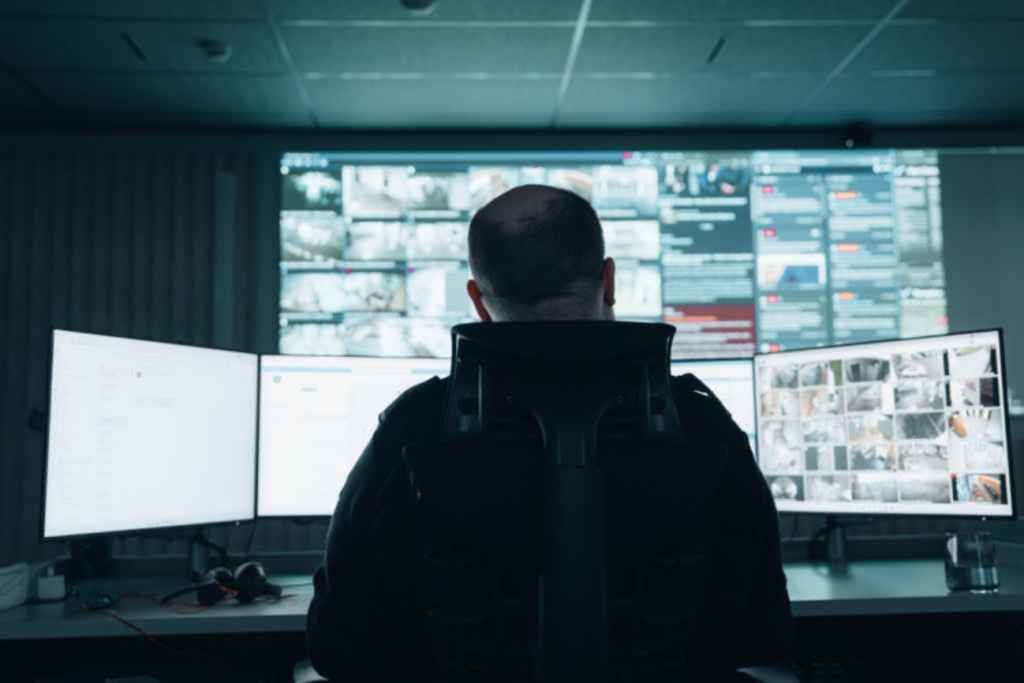
The speed of response is definitely improving as time goes on says Matt Tibbitt, senior growth product manager at Datapath: “In any critical situation, time is of the essence. Advances in networking and visualisation technologies have significantly reduced deployment times compared with traditional control room infrastructures.”
Rather than focusing on how fast a room can be built, organisations should increasingly focus on how quickly they can establish command-and-control functionality thinks van Laerhoven. “As technology continues to evolve, we expect
deployment times to decrease further. Ultimately, success should not be measured by how quickly screens are installed, but by how quickly an organisation can establish a shared operational picture and begin making informed decisions.”
The next question we posed to our panel was what is the minimum AV kit needed to get an emergency command and control centre up and running? The minimum is not necessarily a large videowall or a sophisticated control room
explains Konstantinidis. “A practical minimum deployment would include a secure display environment (large displays or projection), video conferencing and collaboration, audio reinforcement and speech intelligibility systems, a reliable network connection, access to critical data sources and situational awareness feeds, portable workstations for key decision-makers, and backup power capability.”
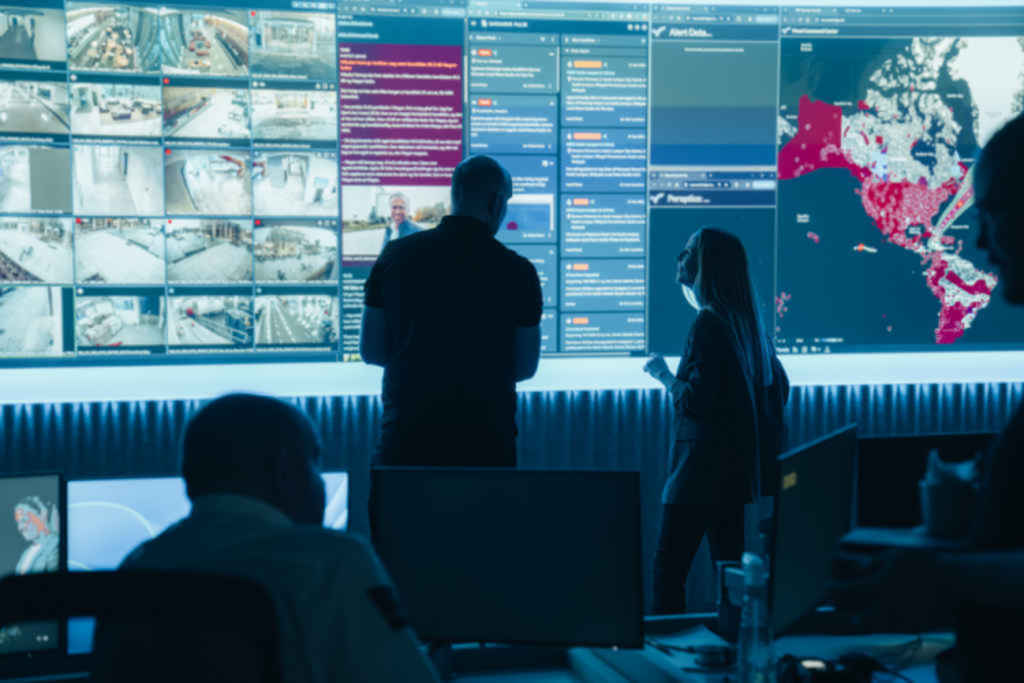
Time is clearly of the essence when crisis strikes, but the emergency systems being installed have to be the right ones. Is this an example where interoperability and easy-to-install products speed up the process significantly? Organisations may need to communicate with people using different video conferencing platforms during a crisis, as well as participants joining through less controlled channels such as FaceTime or WhatsApp. Adams explains: “Teams shouldn’t lose valuable time dealing with compatibility issues or forcing every participant onto the same platform.”
Having different platforms, devices, and communication systems during a crisis means if those systems cannot work together, time gets lost very quickly says Blumhardt. “Products that support open standards and common protocols
make the setup much easier.”
Ease of use matters too, he adds: “A system that is quick to install but difficult to operate is still going to slow people down. The technology has to be simple enough for the team to use under pressure.” The quicker you can get everything aligned, the better. But speed must be balanced with security, says Tibbitt: “Solutions that can integrate quickly with existing data sources, communication platforms, and AV systems allow teams to become operational faster. However, organisations must balance speed of deployment with cybersecurity, data sovereignty, and operational governance requirements.”
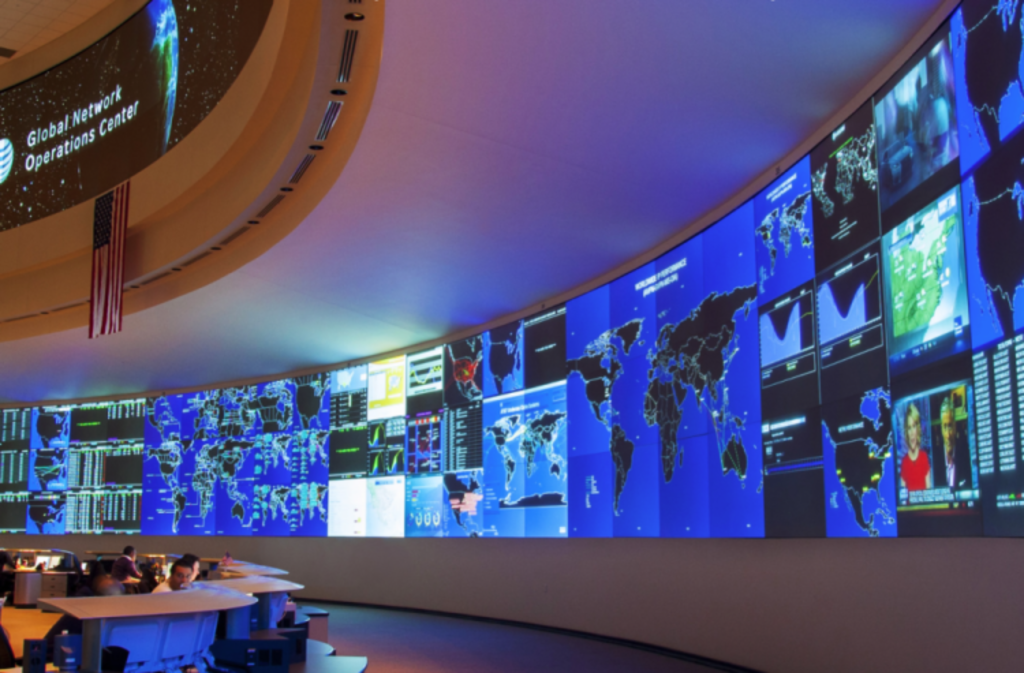
Users need AV that works intuitively and reliably so their focus remains on resolving the situation rather than managing technology says Munt, and that’s one of the reasons why Cyviz has seen increasing demand for standardised, software-driven platforms. “Standardisation reduces complexity, accelerates deployment, and improves resilience by enabling organisations to deploy consistent environments across multiple locations,” he adds.
Our next question was put to the manufacturers to ask how can they help integrators who design and install AV systems for crisis situations. The first step is understanding the application says Extron’s Stiehl. “When a manufacturer has experience in critical environments, whether a fixed command centre or a mobile deployment, they understand the unique demands these systems face and can recommend solutions that are better suited to the mission.”
Rather than requiring every project to be designed and engineered from scratch, manufacturers should provide standardised products and systems that support interoperability, remote management, software updates, and lifecycle flexibility adds Cyviz’s van Laerhoven. “Equally important is ensuring consistency across environments. Operators may need to move between headquarters, regional operations centres, emergency response environments, or temporary command facilities. Maintaining a familiar and intuitive user experience across these locations can significantly improve operational effectiveness.”

AV products and platforms for crisis scenarios have to be easy to integrate, manage, and support says CTI’s Blumhardt. “Open standards, clear documentation, and better compatibility with third-party systems give integrators more options when they are building these environments. Remote monitoring and management are also valuable. When something fails, the integrator needs to identify the problem and fix or replace it quickly.” Support is another major element, he adds: “When a system is being used for emergency operations, waiting in a general support queue is not good enough. Integrators need quick access to people who understand the product and can help solve the problem.”
The list of ways manufacturers can support integrators from Telmaco is similar to CTI's - open architecture, strong cybersecurity, product redundancy and so on - but comes with a vital addition, as Konstantinidis explains: “Most importantly, manufacturers should collaborate with integrators early in the design phase to understand operational requirements rather than focusing solely on technical specifications. Crisis-response environments require solutions that perform reliably under pressure, not just in ideal laboratory conditions.”
Next, we moved onto the topic of location for a crisis AV situation room. Is finding the right location becoming less important than having infrastructure that can be pulled together quickly? In other words, can you set up almost
anywhere if you have the right data and power connections? The location remains important, but the level of importance is changing says Konstantinidis. “Historically, command centres were highly specialised physical spaces.
Today, the availability of connectivity, power, cybersecurity, and data access is often more critical than the building itself. The focus is shifting from ‘Where can we build a command centre?’ to ‘Where can we rapidly establish secure access to information and communications?'".
Advances in networking, cloud infrastructure, collaboration technologies, and software defined control environments mean organisations can establish operational capabilities from a much broader range of locations than before. What matters most says Cyviz’s Munt is “whether teams can securely access information, collaborate effectively, visualise operational data, and maintain situational awareness.”
VQ’s Adams would be cautious about the reliance of everything being assembled temporarily or ‘on the fly’. “The agencies and organisations I have worked with over many years generally maintain one or two established
command centres that are properly equipped and managed by experienced teams.”
If the location of your crisis centre is becoming less important as time goes on, does our panel think we will eventually move from physical command centres to digital command centres? Yes, says Konstantinidis, “but it is more accurate to describe this as an evolution toward hybrid command centres rather than a complete replacement of physical facilities.” Critical infrastructure operators, utilities, transport organisations, public safety agencies, and large enterprises
still require dedicated physical command centres he adds.
“However, they increasingly complement these facilities with digital capabilities that enable decision-makers, subject-matter experts, and field personnel to participate remotely.” Blumhardt agrees we are moving toward a hybrid model.
“Secure video platforms make it possible for leaders, specialists, and partner agencies to take part from different locations. That gives the team access to more expertise and reduces the risk if relying on one physical room. But I do not think physical command centres are going away. When an incident is moving quickly, there is still value in having the core team together, looking at the same information, and making decisions in real time. The difference is that the physical command centre is no longer operating on its own. It is becoming the hub of a much wider digital environment.”
The most effective environments combine centralised management, shared visualisation, and secure information access concludes Tibbit, “enabling organisations to support both co-located teams and remote decision-makers from a common operational picture.