Winner of the 2026 Inavation Award for House of Worship Project of the Year, Groupe Novelty’s work at Notre-Dame combined precision AV integration with large-scale live production inside one of the world’s most demanding heritage environments.
The reopening of Notre-Dame de Paris in December 2024, five years after the fire that destroyed its spire and roof, was more than a ceremonial milestone. It marked the completion of one of the most complex permanent AV integrations ever undertaken inside a protected heritage structure. And, simultaneously, the delivery of a globally broadcast live event layered onto that infrastructure. Groupe Novelty, through Novelty Paris and its sister companies, was responsible for both.
The scale of responsibility was unusual: design and deploy a discreet, futureproof AV backbone for daily liturgical use and international broadcast, then design and operate the entire audiovisual ecosystem for the reopening ceremony itself.
The constraints were structural, acoustic, environmental and political. No visible cabling, no intrusive fixings, strict heritage oversight. Lead contamination protocols limited access, schedules were compressed, and severe weather had to be contended with during the reopening period. The solution had to be technically advanced but visually absent, as David Créteur, project manager at Groupe Novelty and one of the project leads, says: “nothing should be seen, yet everything must be perfectly heard”.
Signal and sound
From the outset, Groupe Novelty pushed for infrastructure that would not simply replace what had been lost but extend it.
To futureproof the integration, Novelty Paris advocated for significantly increased fibre capacity within the cabling infrastructure. The result was a full-fibre deployment across the cathedral, built around a dual spine-leaf topology supporting Milan-AVB, Dante and NDI for synchronised, low-latency transmission.
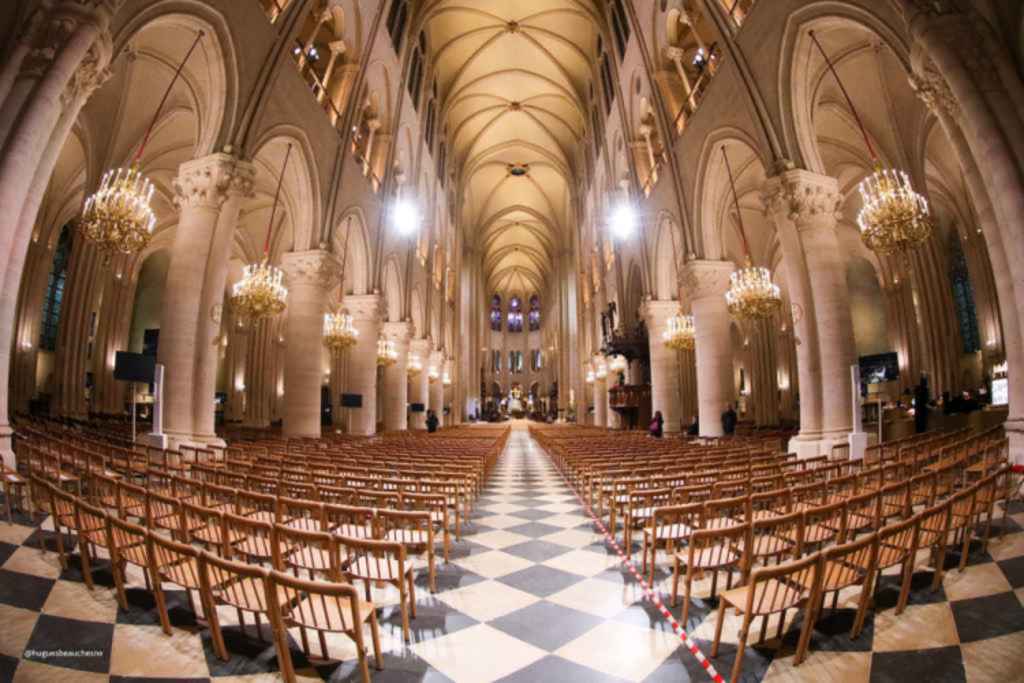
In a building of this scale and acoustic complexity, transport resilience and protocol coexistence were essential. Milan-AVB provided deterministic audio transport to the L-Acoustics amplification network. Dante supported additional digital routing requirements. NDI enabled flexible video distribution, particularly to secondary monitors and ancillary areas. The architecture allowed each workflow to coexist without compromising timing or bandwidth.
Créteur explains that part of his role was “pushing for a significant reassessment of the fibre-optic requirements, ensuring the building would be extensively and properly cabled for the future”.
The audio system comprises 128 colour-matched L-Acoustics loudspeakers distributed throughout the cathedral, including Kiva arrays, Syva and Soka columns, and compact 5XT and X4i units. Placement was governed by detailed acoustic modelling and physical constraints imposed by Gothic architecture. Speaker positioning relied on precise altimetry, angling and rotation to achieve intelligibility in a highly reverberant volume without visual intrusion. Amplification is distributed across seven racks of LA7.16i and LA2Xi units positioned around the grandstands, all running on the Milan protocol over a Netgear-based network infrastructure.
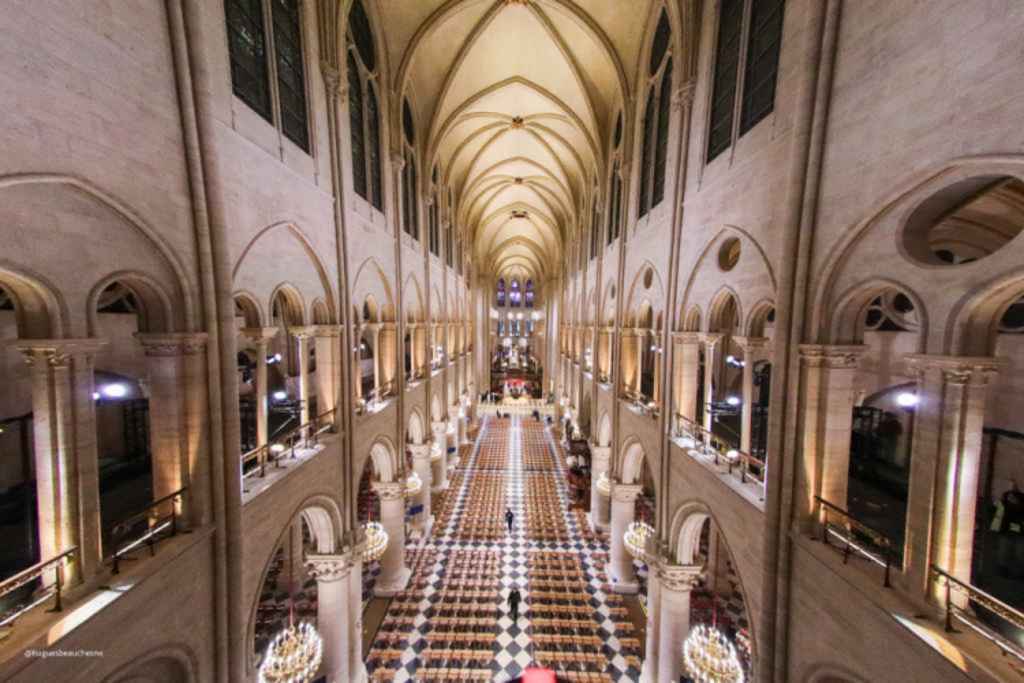
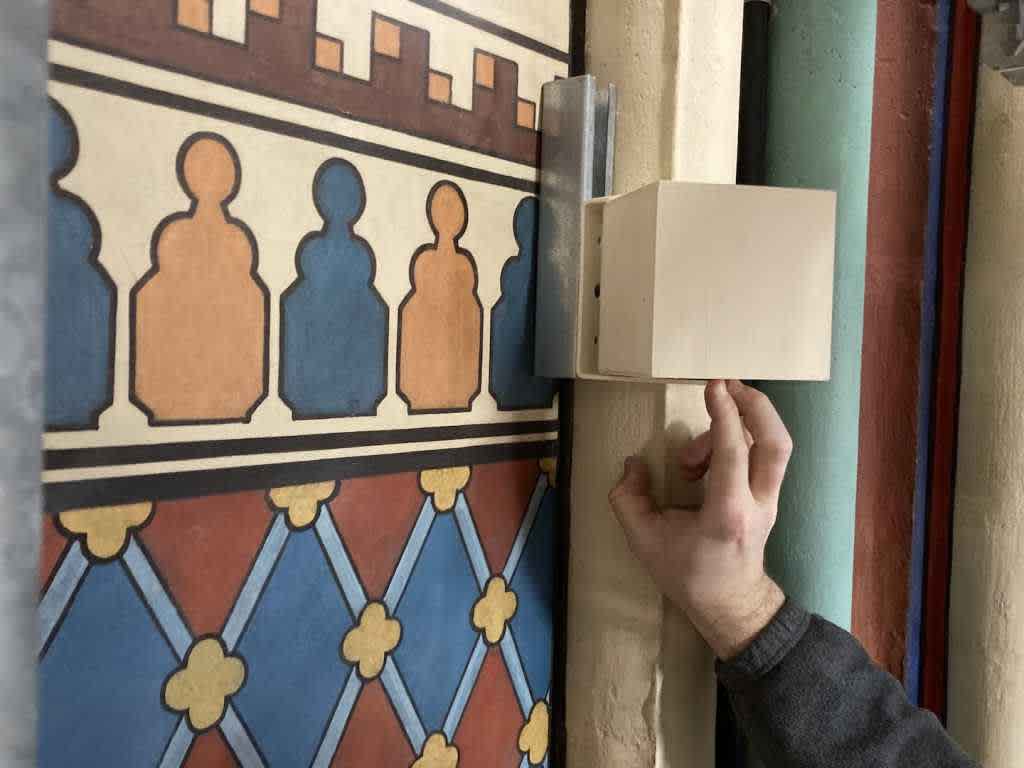
Mechanically, mounting was as critical as signal flow. Drilling into stone was rarely permitted. Créteur describes the workaround: “We therefore used a sliding primary support system, which offered two key advantages: it allowed us to have it installed in coordination with the masonry company - the only party authorised to drill - and it enabled us to slide the final loudspeaker mounts into the exact height position required.”
For loudspeakers positioned in overhang above the capitals, custom metalwork allowed units to rest on stone while routing cabling discreetly through mortar joints in pillars. “For the two Kiva clusters in the grandstands covering the crossing, we used a more traditional but discreet lifting method set back from view,” adds Créteur.
Signal architecture
Beyond loudspeaker deployment, the signal architecture was designed to support daily operation by a small in-house team while enabling full broadcast production.
Mixing and processing are handled via DiGiCo SD9 consoles and 4REA4 processors, supported by remote preamps positioned close to sources in the choir. An Optocore loop runs around the building, capturing ambience and organ signals and distributing programmes. For digital network isolation, a DirectOut Prodigy matrix ensures that each audio network remains fully segregated during external or remote events, a critical design choice when interfacing house systems with broadcast infrastructure.
Microphone deployment includes Schoeps CCM units for lecterns and choir, alongside a Sennheiser MEB 114 at the altar. Wireless transmission marked a world first: the installation of Sennheiser Spectera for unified RF management, significantly reducing setup time and bandwidth use.
Spectera allowed unified management of microphones, IEM/IFB signals and control data over a single RF channel. In a heritage building where antenna placement and RF cabling are constrained, reducing combiners and fibre-based RF extensions simplified deployment and improved coverage.
Video integration is equally deliberate. Eight Panasonic AW-UE150 PTZ cameras form the backbone of the UHD broadcast system, complemented by additional units for monitoring. Camera feeds route to two switchers: a Panasonic 4K AV-UHS500 for local production and a Blackmagic ATEM 4 M/E Constellation 4K for remote production by KTO TV, the French language Catholic television channel.
Video transport to ten NEC displays in the nave runs over custom fibre solutions from LanSee, while secondary monitor distribution in annex areas uses NDI over dedicated copper links. The design separates broadcast, monitoring and house display functions without compromising operational clarity.
Live on the world stage
Once the permanent systems were signed off, attention turned to the reopening itself, a live production of national and international significance, delivered on top of the newly installed AV backbone.
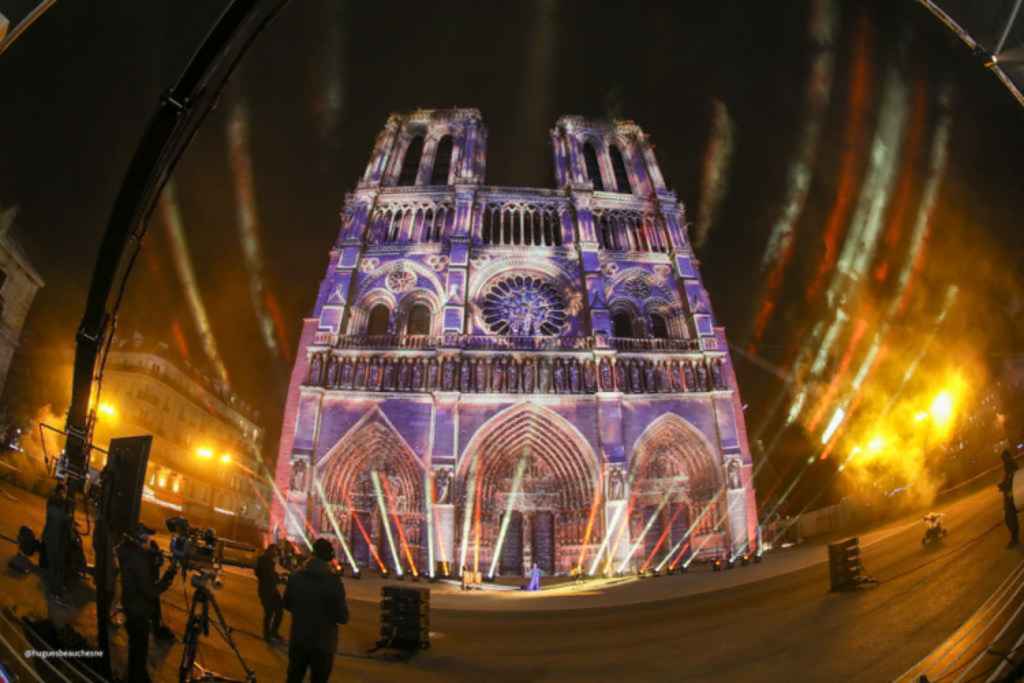
The ceremony followed an intensive build schedule: three weeks of installation, a substantial equipment load-in, and two days of live operation. When the moment arrived, the cathedral’s bells rang publicly for the first time in five years. Outside, the archbishop of Paris marked the reopening by striking the cathedral doors three times with a crosier fashioned from salvaged timber, each strike triggering a gold illumination across the façade. The choir responded from within, and as the doors opened, French president Emmanuel Macron entered the nave to join assembled dignitaries and guests.
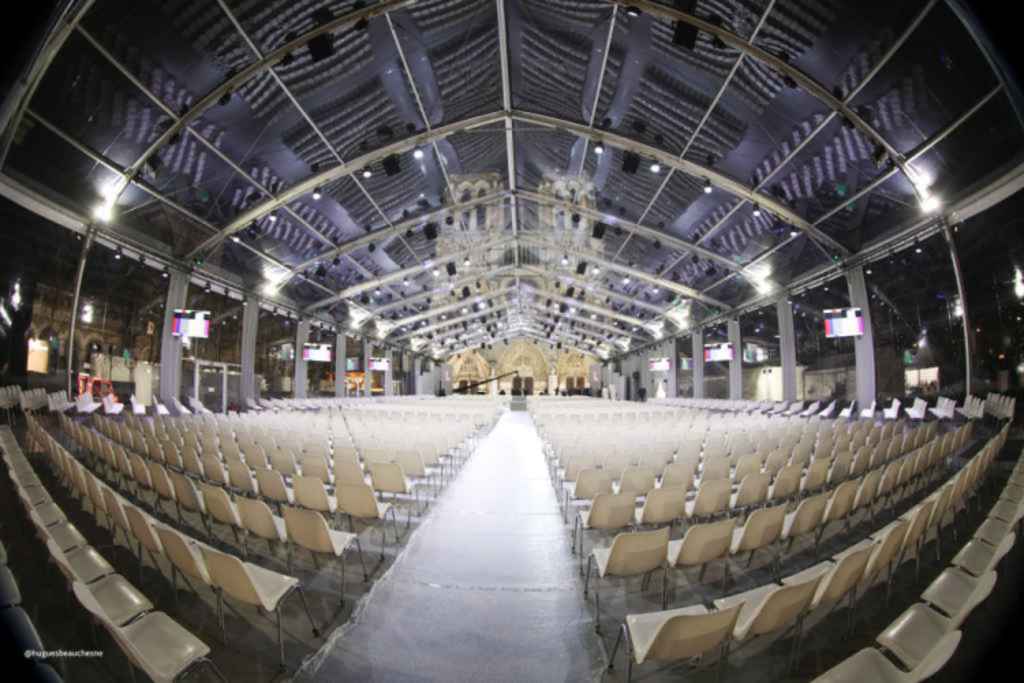
Technically, that sequence was the visible surface of a far more complex deployment. The reopening required a temporary production system at exceptional scale, engineered to integrate with the permanent infrastructure where advantageous, yet capable of operating independently to meet the demands of global broadcast, exterior projection, large-format reinforcement and distributed viewing environments.
Projection mapping on the façade used 30 Panasonic 3-Chip DLP 4K projectors positioned on four towers. The content was divided into three sequences, each produced by a different studio. The system was designed as a modular setup, allowing daily recalibration in severe weather conditions, a practical necessity during winter deployment.
Lighting included more than 400 fixtures from multiple manufacturers, controlled via MA Lighting grandMA3 consoles. Atmospheric effects and distributed lighting were deployed across both the cathedral interior and the 1,400 sq m marquee installed in the forecourt that housed six 75-in Panasonic screens for guest viewing.
For exterior reinforcement, L-Acoustics Kara II and X12 systems powered by LA-Rak II AVB racks were deployed, while interior event support incorporated additional Syva systems and displays.
Power distribution posed its own challenge. Magnum and Magnum Power positioned seven power generators on a barge on the river Seine, which runs next to the cathedral, providing uninterrupted electricity for all equipment during the reopening show.

This strategy reduced on-site cabling congestion and freed the forecourt for media operations. In total, 24 articulated lorries delivered equipment over a three-week installation period, supported by a 100-person team.
Operationally, the reopening required coordination across Groupe Novelty companies Alabama Média, De Préférence, Dushow TV, Magnum, Magnum Power, Novelty and On Stage. As Gérald Bouché, operational sales director at Novelty and Groupe Novelty’s project lead for the reopening project, put it: “We knew that an event of this scale would require an extremely varied number of expertise, and that collaboration would be paramount to the effective management and overall success of this project.”
Award-winning infrastructure
The reopening ceremony was delivered without incident. More importantly, the permanent system remains in daily operation, maintained by Novelty Paris through ongoing calibration, firmware updates and fibre network monitoring.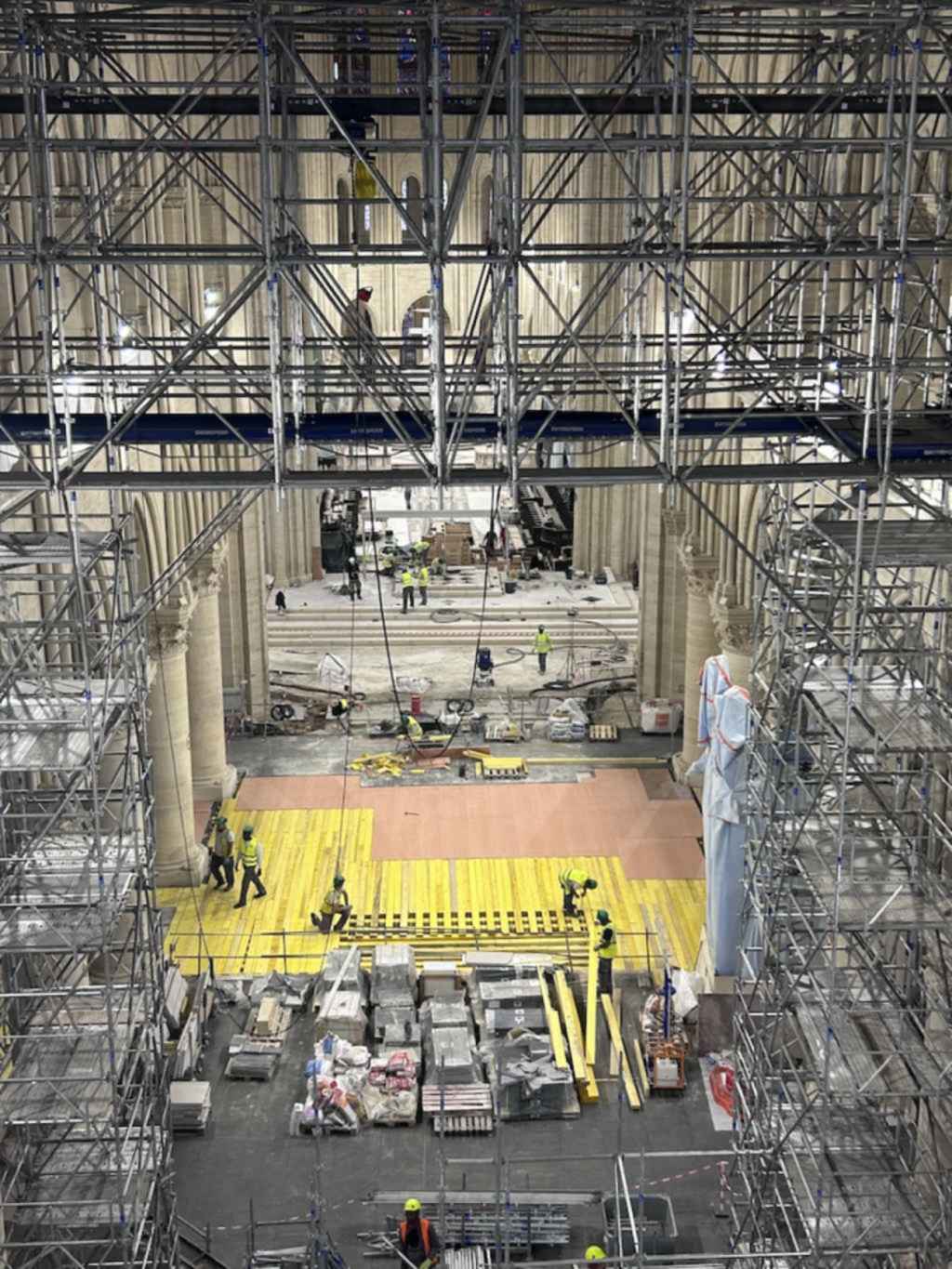
The project demanded two installation teams due to restricted zones and lead protocols, extensive stakeholder justification of technical choices, and coordination with heritage architects and conservation bodies.
It is this combination of permanent systems engineering and live event execution that defines the achievement. As Groupe Novelty president and founder Jacques de La Guillonnière reflected: “Every decision had to balance technical excellence with discretion, sensitivity and preservation.”
The industry recognised that balance. The project won the 2026 Inavation Award for House of Worship Project of the Year, acknowledgement not only of spectacle, but of the technical rigour underpinning it.
At Notre-Dame, Groupe Novelty did not simply install equipment or stage a ceremony. It engineered a resilient, networked, broadcast-capable infrastructure inside one of the most constrained buildings in the world, then proved it under global scrutiny.
Photo credits: Hugues de Beauschesne and Marc Pioger
Tech Spec
Audio
DiGiCo mic preamps, SD9 mixing consoles and 4REA4 system processors
DirectOut Prodigy matrix
L-Acoustics Kara II, Kiva, Syva, Soka, 5XT, X12 and X4i speakers; and LA2Xi and LA7.16i amplifiers
Schoeps CCM4 microphones
Sennheiser MEB-114 SW microphones and Spectera wireless system
Lighting
ARRI fixtures
Astera fixtures
Elation fixtures
MA Lighting grandMA3 consoles
Martin fixtures
Robe fixtures
Video
Blackmagic ATEM 4 M/E Constellation 4K switchers
NEC 43-in displays
Panasonic AW-UE150 PTZ cameras, 4K AV-UHS500 switchers, TP-RQ35K projectors and 75-in displays