When a University in Germany wanted to transform an old warehouse into a multi-purpose virtual production stage it turned to integrator ICT. Paul Milligan reports.
Founded in 2009, the Hamm-Lippstadt University of Applied Sciences is located in North Rhine-Westphalia, 30km east of Dortmund, and is named after its two locations (Hamm and Lippstadt). The University’s primary focus is on STEM and was built as part of an initiative to address the growing shortage of skilled workers in engineering subjects.
As part of this drive to create the next generation of engineers, the University wanted to establish a fully functional virtual production (VP) stage that would serve simultaneously as a research platform, teaching environment, and media production facility.
The University’s desire was to create a practice-based setting in which students could experience authentic production workflows and gain practical experience and build familiarity with professional processes. Tasked with making this vision a reality was system integrator ICT. The client had seen ICT’s previous work on Halostage in Berlin, built in 2021, it was one of the first big VP stages in Germany. ICT won the tender for the Visual Effects Laboratory (VFX Lab), which was written by AV consultant Christian Kimmig. The idea was to transform an old office building, which included a warehouse (now home to the studio), into the VFX Lab, but as you’d expect, that came with a set of building and architectural challenges. Serious structural amendments had to be made to the building to accommodate a huge VP stage, including the demolition of several walls.
In addition, some extra design work had to be completed by ICT on the original tender because “the client wanted to get the maximum they could out of the room,” says Florian Schlecht, ICT’s director of studios. There was also a slight delay after the air conditioning that had been fitted did not allow enough space for the LED to subsequently be installed. The VFX Lab is not just a VP stage for filming says Schlecht, it serves a range of purposes. “It’s not only filming, but also simulation and training with high frequency LED. They wanted to do motion capturing and filming. That’s why we have three different LEDs inside with different specs and with different processors.”
Central to the vision was the integration of real-time rendering, motion capture, and camera tracking technologies to enable both cinematic and industrial applications. The system architecture needed to be flexible and sustainable, capable of adapting to future technological developments and supporting interdisciplinary collaboration. Ultimately, the goal was to build a single, versatile facility that could operate as a film studio, visualisation laboratory, and virtual classroom all in one. The key objective was to deliver a professional-grade VP studio within an academic framework.
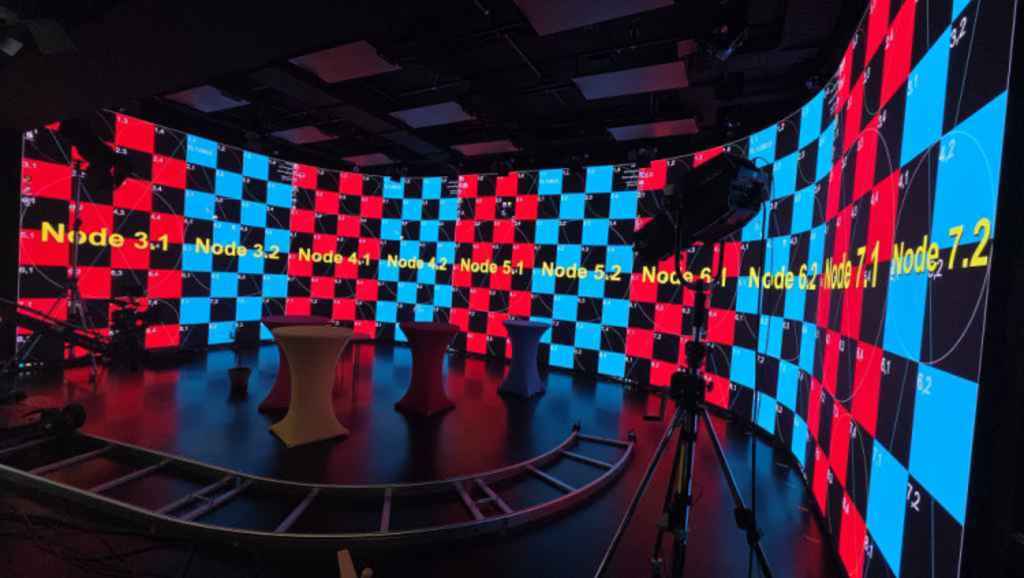
With the VFX Lab now built, students can explore VP workflows using Unreal Engine 5, INFiLED LED walls, Vicon motion tracking, and ARRI camera systems, all synchronised through AV Stumpfl Pixera media servers and custom ICT designs. The installation comprises multiple specialised zones including the Main LED stage, which features an impressive 19m x 4m curved INFiLED LED wall forming an immersive, semicircular stage. The curved wall features
LED with 1.56 mm pixel pitch, and refresh rates up to 240hz, LED processing is via Brompton.

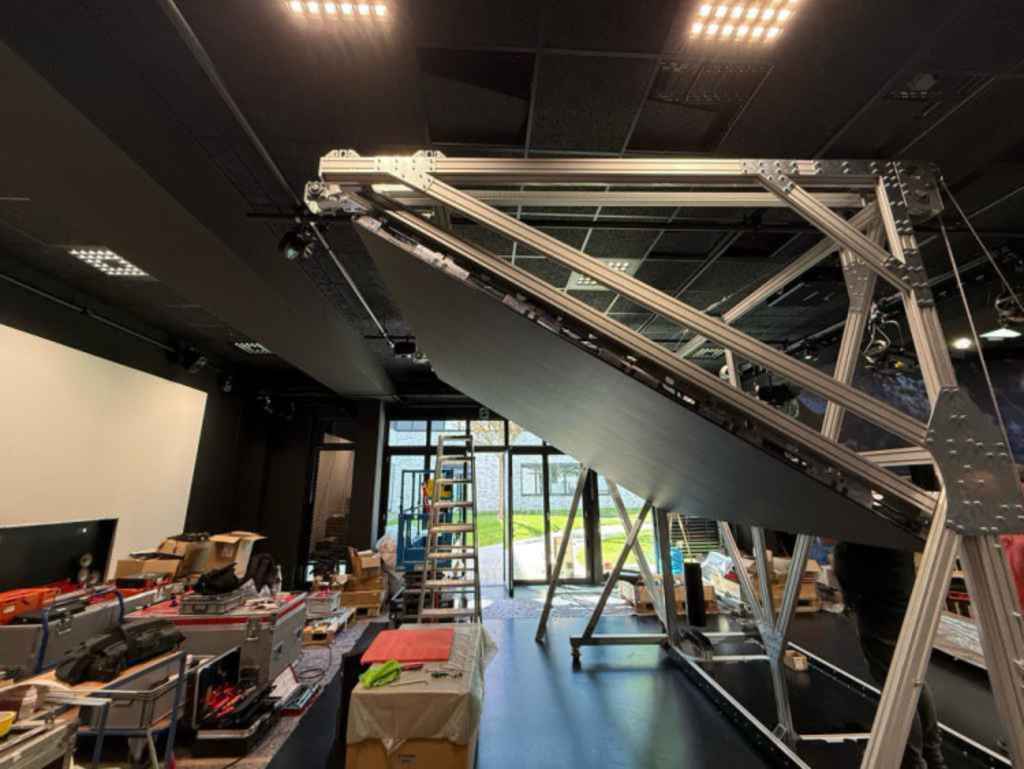
In addition, students and teachers can use a mobile LED 3m x 3m kinetic wall, developed by ICT, capable of vertical movement over large objects such as vehicles. The mobile LED is tiltable by 60-degrees and can be used for different experimental setups such as producing slow motion in 120fps, or dual-stereo content. Processing for the mobile LED wall is via NovaStar.
The third LED-based element in the Virtual Production setup is the ceiling, which is made of nine KinoFlo Mimik video lighting tiles. Processing for the ceiling is via a Megapixel Helios processor. How difficult is it to mix lighting with large LED volumes, how did ICT get that right mix? Two products made a big difference says Schlecht. “One is the KinoFlo on the ceiling, it’s a high-powered LED panel with RGBWW, because the LED itself is only RGB and can make you look like Miss Piggy. The other one is Brompton, which has something inside the system to balance the light levels. It’s really interesting how they fix the Magenta problem.” This is an important consideration as some LED light modules have been known to emit an unintended purple hue on human skin tones.
A control room houses AV Stumpfl media servers, real-time rendering systems, and synchronisation equipment, and is fully integrated with Unreal Engine 3D software. A lighting grid features pixel-based fixtures integrated into the Unreal Engine environment, alongside Fresnel and soft light systems. A motion capture zone is equipped with a full-body and facial tracking system from Vicon. A camera platform and grip area includes dollies, cranes, and remote heads for professional camera movement. Audio in the VFX Lab is via a 360° object-based audio system featuring twenty Genelec monitors and two Genelec subwoofers, all running on a Dante network. Other ancillary spaces at the Lab include a pre-production area, render farm, and student training workstation zone. The camera component is provided by Arri 35 Digital Cinema Cameras with prime and zoom lenses, remote access for aperture, focus, and zoom. Sony 6K Venice cameras are also being purchased soon says Schlecht, to give the Lab more versatility and flexibility.
A Vicon motion tracking system optically synchronises camera and object movement to Unreal Engine. The Vicon tracking system uses 18 fixed cameras, including 6 high-speed and 4 mobile cameras; Vicon Shogun software for filming and gaming setups; and Vicon Nexus software for medical applications. Three Faceware Mark IV wireless headcam systems also help provide facial capture, and a Kistler system to capture force and movements with precision in medical simulations completes the tracking package.
“We chose the Vicon system because the client wanted to run medical use cases in this stage. With the Vicon system you can do really exact finger tracking or muscle tracking. For a normal motion capture system, if you move a finger, it’s only one point [of tracking], maybe two. With the Vicon system you have 10 points on one finger, that’s the reason we went for it,” explains Schlecht.

The primary focus of the VFX Lab is on Virtual Production, and this is where camera tracking comes in, but secondary applications in the Lab include motion capture devices for game design and VFX/3D animation. There is also the ability to create real-time avatars for broadcast applications and usage for biomechanics in teaching and research is also available. An acoustic curtain has been installed to separate the rear part of the room form the rest, where a
Dolby Atmos 10.4.2 setup is on offer for teaching and audio studio applications.
To implement all the hardware took three weeks, with another three to four weeks for fine tuning the systems and the programming, with the complex IT implementation taking a further three to four weeks says Schlecht.
What were the most difficult parts of the project for ICT? The biggest challenge was in synchronising three different LED types with three different processing types together says Schlecht. “This was challenging, having different LED types makes it tough.”
The synchronisation process was demanding and required ICT to develop a bespoke integration of Genlock, Timecode, and Dante audio, enabling perfect timing between camera, LED, lighting, and motion tracking components. “I designed it all in my head in the early stage because this is a small stage and I wanted to have an LED ceiling and a movable LED totem. We could not realise both because of the size of the room, so we designed this mobile arm so you can use it in any position. You can throw it over a car, with front and back lighting. This makes it really special and was all done in-house at ICT,” adds Schlecht.

One example of this was the design of a custom motorised structure capable of safely and precisely lifting a two-tonne LED array for the VFX Lab by ICT’s mechanical engineering division.
Testing for the VFX Lab was a mix of off-site and on-site, because ICT had previously worked on the Halostage in Berlin, it could bring a lot of prior knowledge to the fore. “We tested the 240hz LED in our environment because we’d already worked on a 240Hz project for simulation and training for a previous project for BMW in Munich,” adds Schlecht.
How did ICT manage the process with the University’s IT team so that everything went smoothly when integrating complex IT systems? “We had to implement our IT into the existing university IT structure, and this was very tricky because there were a lot of rules,” says Schlecht. To support the complex workflows required, hybrid network architecture was implemented. This is even more impressive when you find out some of these systems were relocated to a server room in a separate building. “The render nodes are in a separate building because of the noise,” explains Schlecht. “When we first installed it in the studio, we said it doesn’t work, it’s too loud. We then decided to put it in a building across the street.”
Luckily underground cables were already pre-installed, so ICT just had to “bring the fibre and the rest of the IT stuff through this channel,” adds Schlecht. The entire project used 40km of fibre-optic cabling.
The VFX Lab was conceived and executed with sustainability and social impact in mind. Energy efficiency played a central role in the design, with all LED systems using ColdLED technology that delivers powerful and hyper-realistic images with minimal power consumption. “We call it coldLED because on the surface of the LED it’s 35 degrees and not 75 degrees, so you don’t need to pull the air conditioning up a lot,” says Schlecht. The lab is directly connected to the University’s photovoltaic array, supported by an ICT-developed monitoring system that synchronises energy usage with the availability of solar power, ensuring that the facility operates with renewable resources.
Another sustainability advantage of the VFX Lab is that by replacing physical sets with virtual environments, the project reduces the need for material construction and travel, leading to a decrease in carbon emissions. In addition, its modular design promotes longevity and reuse, allowing components to be upgraded rather than replaced, which minimises waste.
ICT is providing post-installation services to ensure the long-term reliability and performance of the VFX Lab. This includes 24/7 remote system monitoring and diagnostics, along with preventive maintenance and calibration of the LED systems and tracking units. Software updates for Pixera and Unreal Engine integration are regularly implemented to keep the technology current, while on-site technical training is provided for faculty and lab supervisors to maximise effective use of the facility. Additionally, a dedicated support hotline with SLA-backed response times guarantees rapid assistance whenever needed.
User accessibility was prioritised through the development of a modular training concept and easy-to-use control interfaces tailored to both students and instructors. Final word goes to Stefan Albertz, Professor for 3D Animation and Visual Effects at Hamm-Lippstadt University of Applied Sciences, who used his previous experience in the film industry to work alongside ICT throughout the project, and who Schlecht describes as the “most important client” on this project. “We are extremely satisfied with the outcome and are delighted that the laboratory enables us to offer our current and future students high-quality teaching across a wide range of technologies and practical applications."
TECH-SPEC
Audio
Audinate Dante network
Genelec monitors, subwoofers
Video
ARRI Alexa S35 production set
Atomos reference monitors
AV Stumpfl Pixera media servers
Brompton LED processors
Face Mark IV wireless headcam systems
INFiLED LED panels
Kistler piezoelectric force plates
NovaStar LED processors
Megapixel Helios (RGBWW) LED processing platform
Unreal Engine software
Vicon high-speed cameras, mobile cameras, Shogun software, Nexus software
Lighting
Arri SkypanelX LED panel lights, Orbiter LED fixtures
Elation KL FC Fresnel 8 LED fixtures
KinoFlo Mimik 120 LED lighting tiles