The Roland V-80HD reflects how expectations of a video switcher have changed. In 2026, switching is about graphics, automation, remote production and operator confidence, not just I/O.
In today’s fast-paced production environments, a video switcher can no longer afford to be just a box that connects sources and cuts between them. It needs to handle graphics, automate complex workflows, support remote and hybrid production, simplify operation for non-specialists, and sit comfortably inside a wider AV ecosystem.
That changing definition is exactly the problem Roland set out to address with the V-80HD Direct Streaming Video Switcher, not by chasing individual features, but by rethinking what a switcher is expected to do in modern production environments.
“The V-80HD didn’t come from nowhere,” says Nico Suarez, Pro AV product specialist at Roland. “It’s the result of more than 14 years of research into how live production actually works, and how it keeps changing.”
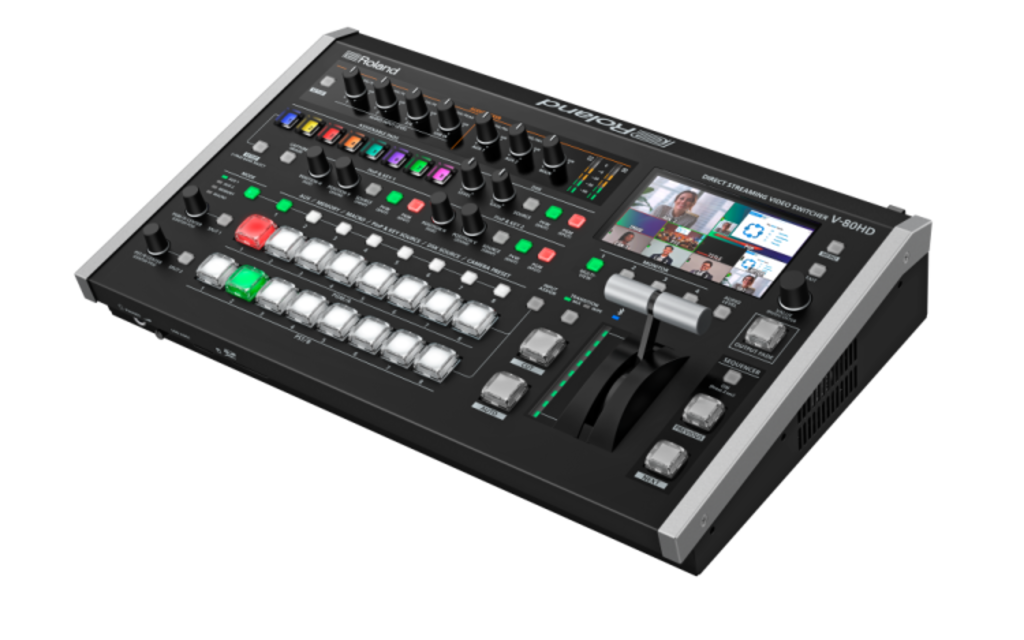
Roland’s approach with the V-80HD reflects a long-running philosophy: simplify live production by consolidating critical tools into a single, reliable hardware platform. For Suarez, this thinking goes back to the company’s earliest all-in-one switchers, designed at a time when streaming setups were sprawling, fragile, and difficult to operate.
“Back in 2010, if you wanted to stream or record an event, you needed a video mixer, an audio mixer, encoders, screens, synchronisation tools - lots of boxes and lots of cables,” he explains. “We asked ourselves: what do people always need, and how can we make that easier?”
Fast forward to today, and the complexity hasn’t gone away, it’s simply changed shape. The V-80HD reflects that shift. It brings together multi-format video switching, audio mixing, streaming, recording, graphics, PTZ control, and automation in a compact, portable chassis designed for live environments.
Beyond I/O
The V-80HD provides eight video inputs via HDMI and 3G SDI, with the ability to bring in additional sources over IP using SRT, and outputs video via HDMI, SDI, USB-C and LAN. But modern production isn’t just about counting connectors.
Corporate events, education spaces, live shows, and hybrid productions increasingly require different mixes for different destinations: a main LED wall, confidence monitors, streaming feeds, recordings, auxiliary displays, and remote audiences.
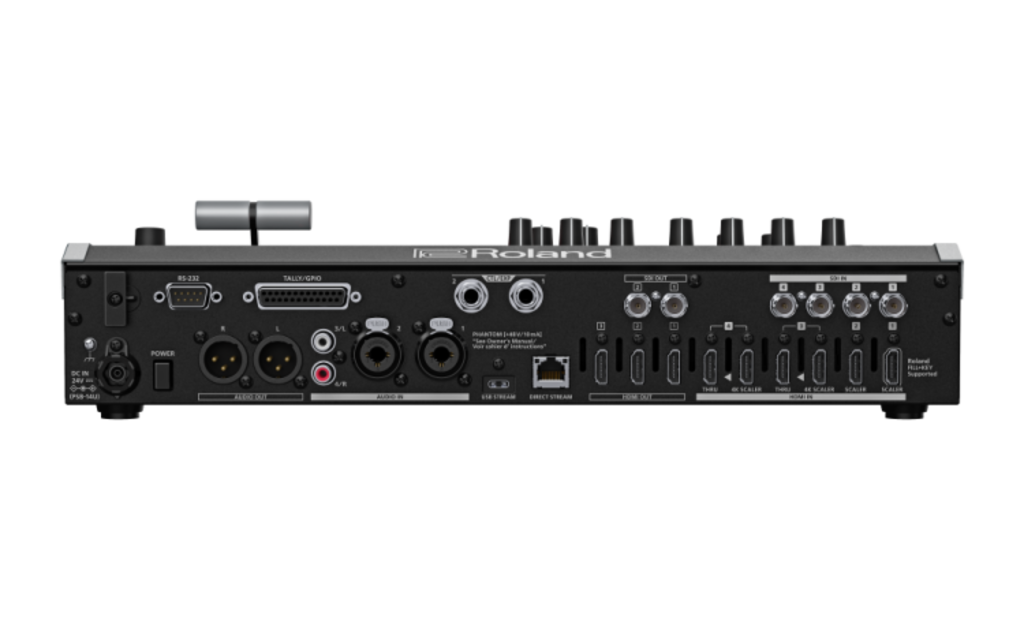
Built-in scalers on HDMI inputs remove common pain points when mixing sources at different resolutions, a frequent issue for integrators and production teams dealing with laptops, cameras, and playback devices in the same production.
“That’s about making the system worry-free,” Suarez says. “You shouldn’t be fighting resolutions during a live event.”
The same philosophy applies to audio. Rather than treating sound as something external that needs to be bolted on, the V-80HD routes audio alongside video from every input, with internal processing and delay tools to maintain lip sync.
“If you separate audio and video across different devices, synchronisation becomes much more complicated,” Suarez says. “Inside one system, it’s easier, faster, and more reliable.”
Reliability is a recurring theme, and one that matters deeply to Roland’s core markets. “We do live events,” Suarez says. “Latency matters. Reliability matters. You cannot afford failure.” The V-80HD operates with just two frames of latency, a critical requirement for live environments where timing is non-negotiable.
Engineered for live
For Dan Taman, European product manager at Roland, that reliability extends beyond technical specifications.
“These products can be used in everything from a low-pressure hybrid meeting to a multi-million-pound live event,” he says. “In both cases, the operator needs the same confidence.”
That confidence, Taman argues, comes from hardware designed to survive real-world use - being transported, installed, and operated under pressure - as well as from predictable, intuitive operation.
“A lot of what makes a system comfortable to use is taken for granted,” he says. “But it’s very deliberately engineered; from how the hardware is built to how the interface behaves when things get stressful.”
One of the clearest signals that the switcher’s role has expanded is the growing expectation around graphics. Titles, lower thirds, motion elements, and branding are now standard even in relatively small productions.
“What we kept seeing was a bottleneck around graphics,” Suarez explains. “Speakers change, names change, agendas change, and suddenly someone has to rebuild slides at the last minute.”
Roland’s response was Graphics Presenter, a software tool designed to work directly with the V-80HD. Using a single HDMI connection, it delivers professional fill-and-key graphics without consuming multiple inputs or requiring expensive third-party systems.
“The key idea was being able to edit graphics on the floor,” Suarez says. “Templates, colours, names, all live, without breaking the workflow.”
Importantly, Graphics Presenter is free for supported Roland switchers, including the V-80HD.
“That’s about removing friction,” Suarez adds. “Graphics stop being a separate department and become part of the production environment.”
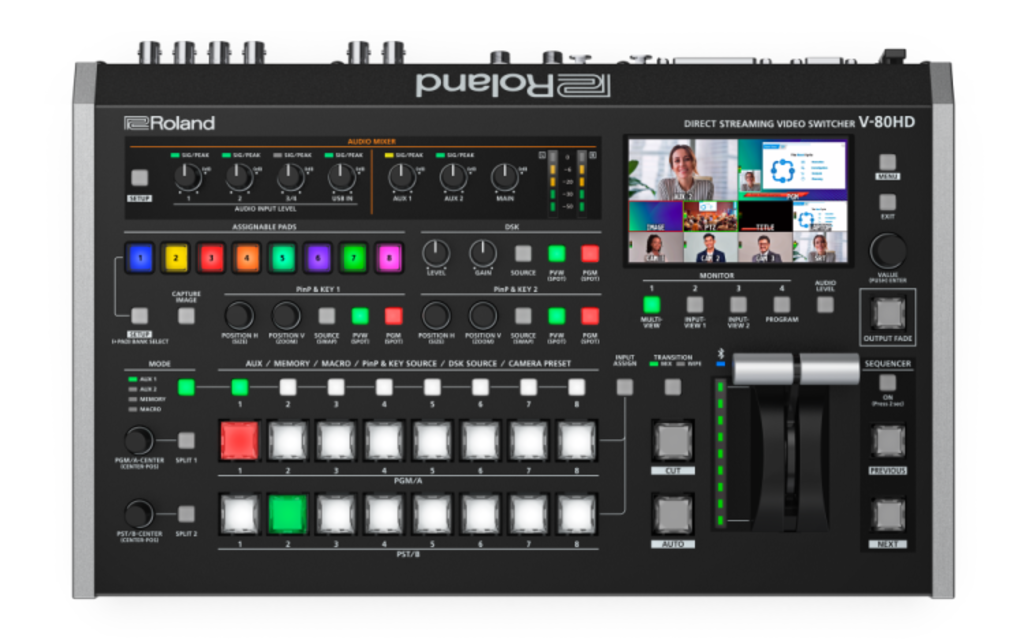
If graphics are now expected, automation has become essential. The V-80HD’s scenes, macros, and sequencing tools are designed to help operators deliver consistent results under pressure, particularly when teams are small.
“Smaller crews are now the norm,” Suarez says. “And many systems are operated by people who are not video specialists.”
Macros allow multiple actions - switching sources, triggering picture-in-picture, adjusting audio, recalling camera positions - to be executed with a single button. Sequencing takes this further, allowing entire event flows to be stepped through using a single ‘Next’ command.
“If someone sets it up properly,” Suarez explains, “the operator doesn’t need to know what’s happening under the hood. They just follow the event.”
Taman sees this as a fundamental responsibility of manufacturers. “Our job is to make professional outcomes easier and more pleasant,” he says. “Not by dumbing things down, but by hiding complexity where it doesn’t belong.”
That thinking extends to operator interfaces. With VenuSet, integrators can design custom control panels for the V-80HD, exposing only the functions an end user needs and locking everything else away.
“You can remove buttons, rename them, add icons, add branding,” Suarez says. “You can make the interface fit the venue, not the other way around.”
For integrators working in education, corporate, and civic spaces, this is increasingly critical.
“The expectation of quality is high,” Suarez notes. “But the operator is often not a professional.”
Ultimately, the V-80HD reflects a broader shift in how switchers are positioned. It’s not a standalone device, but part of an ecosystem that includes PTZ cameras, audio consoles, LED processors, streaming platforms, and IP networks.
Support for RTMP and SRT allows the V-80HD to stream directly to platforms or move video securely across local networks, making hybrid and remote workflows native rather than improvised.
“Five or six years ago, our work was split roughly fifty–fifty between projection and LED,” Suarez adds. “Today, around ninety percent of the projects we see involve LED in some form and that growth is driving demand for more capable switching at the heart of live production.”
So what does a modern switcher need to be in 2026?
The V-80HD suggests an answer: not just a switcher, but a graphics engine, automation hub, remote-production bridge, and operator-friendly control platform, built on hardware that can be trusted when failure isn’t an option.
“If you ask our users what matters most,” Suarez says, “number one will always be reliability.”