SALT in London is a fully immersive audio experience. It's also a hairdressing salon. Paul Milligan speaks to Ben Hayes from the architecture studio behind it.
Spread over three levels of a listed brick building in the Borough area of central London, SALT is a hairdressing salon the likes of which you’ve never seen before.
“The brief for SALT Salon Borough was to bring all the things we already do, hair, sound, music, drinks, and elevate it to a completely new level,” says John Paul Scott, founder of SALT Salon. Alongside its normal usage, the three floors also double as a cultural space for events. Tasked with bringing Scott’s vision to life was architecture studio Unknown Works.
Ben Hayes, director and co-founder of Unknown Works explains how this project fitted the ethos of Unknown Works so well. “We focus on the bold and experimental side of architecture and design. We’re very much cultural focused. Any project we do, we bring cultural-led thinking into it, whether it’s a commercial space, a private space, or specifically for a cultural brief.”

Each space at SALT has a distinct hairdressing function, spatial and acoustic identity. A sound system embedded into the bespoke interior is programmable to support different sonic salon environments, ambient mornings, busier afternoons and immersive evening sessions. A Listening Room doubles as a venue for performances and talks, allowing the space to transition from service to event mode.
Hayes outlines how Unknown Works got involved in this project. “The founder of Salt used to be an electronic music producer. They already have one salon in Dalston [another part of central London], and it was trying to amplify a lot of those passions into a new space. We’ve designed stages for festivals, very technically driven recording studios, jazz clubs, and theatres. We’re big music nuts, as is Salt’s founder, so it was bringing those passions together into the brief. We wanted to do something slightly different with the salon, and there was also a lot of talk about what the culture of a salon can be.”

Because the salon is centrally located in one of the busiest cities in the world, the design had to reflect that adds Hayes. “In the chaos and the hustle and bustle of the city, it’s a nice place for downtime, whether that’s some small talk or having a bit of deep thought for an hour, off your phone, off your laptop, before you enter back. It’s in the centre of Borough Market, to get there you have to go through the market, which is quite a sensory overload. Within that context. we started thinking about how we could do that in terms of sound. We wanted the sound system to be embedded within the interior of the space, rather than just a loudspeaker sat in the corner, we wanted it to feel like the architecture itself was generating the sound, that’s where we started from.
“We then looked at developing that concept as a listening space, which is a fully bespoke loudspeaker system, but it’s also across three storeys. Each of those storeys has a bespoke loudspeaker system within it, and that can be programmed and channelled between the different spaces, but also seasonally too.”
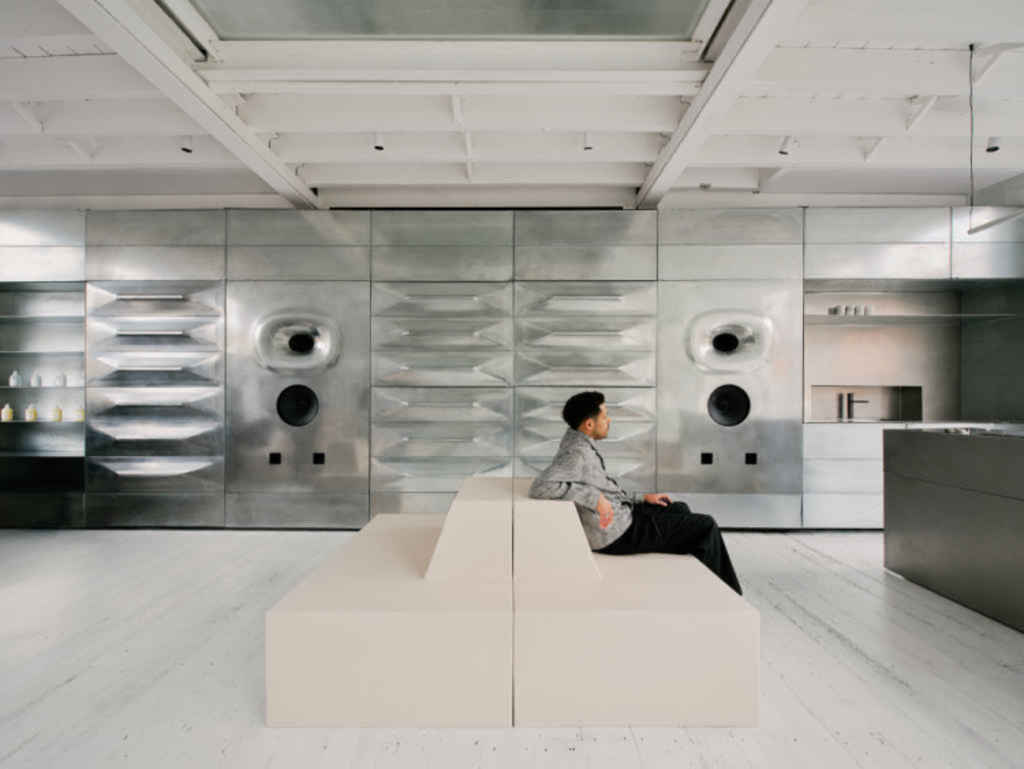
To achieve this, Unknown Works again reached out to regular collaborator and acoustic consultant Charcoal Blue. The bespoke speakers were developed in collaboration with Friendly Pressure, emerging innovative loudspeaker designer led by Shivas Howard Brown, whose designs focus on elements of UK soundsystem culture, and the joy and togetherness of sonic experience. “They’ve got technicians and sound engineers, which were all part of the design development. We worked on some of the prototyping they had done for their bespoke horns and the different drivers they use, we do a lot of experimentation with materiality and fabrication as a studio,” adds Hayes.
The first floor is home to the Listening Room, a row of cutting stations, and a reception area, which becomes a bar at night for events. Together, they create a central gathering space defined by a pair of large-scale, galvanised steel loudspeakers incrementally formed using roboforming (more on that in a minute). The bespoke joinery and specialist metal roboforming for this particular project was designed and developed by Unknown Works and fabricated using salvaged metal and shelves from Blythe House, a storage facility previously used by the V&A, Science Museum and British Museum.
What is roboforming, and why use it here? “You have a robotic arm which is like a big metal stylus which slowly contours and presses the metal. It’s a cold process and doesn’t heat the metal up, so it’s relatively low energy relative to other forming techniques of metals to press them into geometries they don’t necessarily want to go into. We wanted to create something totally unique for SALT in terms of the look and feel of it. Starting with something fully bespoke is a really nice way to begin the conversation,” says Hayes.
The second floor houses an open-plan Cutting Floor. Its cutting station is lined with a continuous stainless-steel mirror, shifting from a buffed, mottled finish for privacy to a mirror-polish for reflection and fidelity. Suspended above, stainless steel Friendly Pressure Pickney loudspeakers fill the room.
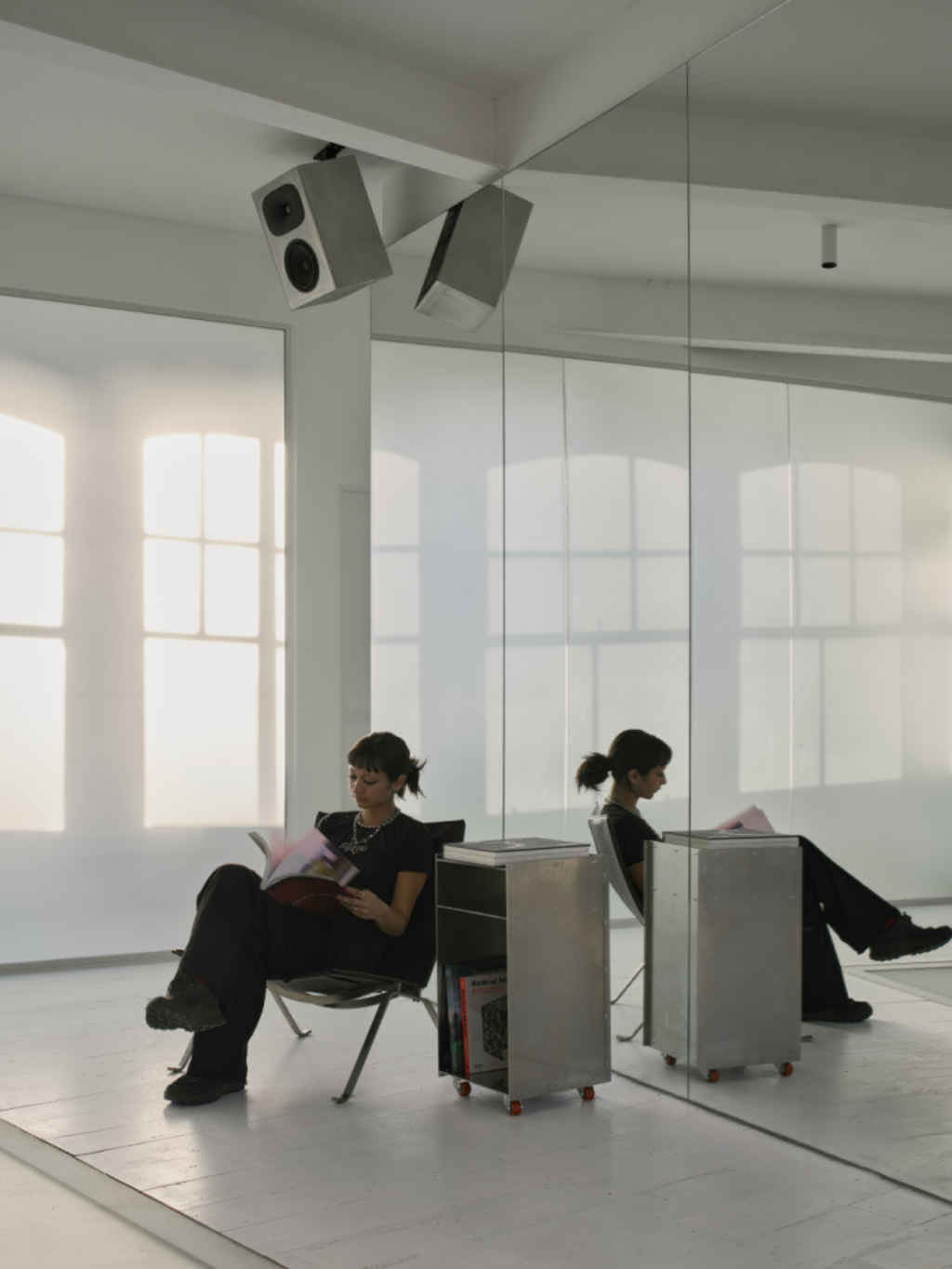
The Colour Floor on the top level features a suspended, half-tonne sculptural mirror workstation hung from the original timber rafters. Crafted from stainless steel, it acts as both a reflective surface and a diffuser. At SALT an old Victorian storehouse has been reimagined as a space where sound operates as both material and medium. The question is: how do you make sound behave that way? It’s totally embedded in the concept says Hayes.
“People have been calling it a sonic salon. Our approach to projects is that, right from the outset, we want something conceptually bold and really ingrain it into the whole idea. With many projects, you can have loads of big concepts, but they often get whittled down through value engineering or just too many ideas. Going quite singular at the beginning is always a challenge, but that’s generally how we like to approach it. While the salon looks really interesting and unusual, you don’t really get the salon experience unless you go there. You can’t replicate it through taking a load of photos. You can write about it, but you’ve got to be there. That's a realm of design and architecture that we’re really fascinated by, not something that’s going to chase lots of clicks.”

SALT is almost exclusively steel or metal surfaces. How has Unknown Works got these surfaces to work sympathetically with what it’s trying to achieve sonically? “The starting point is setting out the correct geometry for the room. There are certain things we’ve also kept, such as the Victorian open joists on the ceiling, which help disperse the sound in a particular way,” says Hayes. Unknown Works has also brought in a series of bespoke, foam modular sofas and chairs to help acoustically, and has dotted white discreet acoustic panels throughout the salon.
Does this project reflect the growing harmony between AV and architects when it comes to incorporating AV and architectural design? “Whether it’s AV, lighting, digital content or screens, you have to bake it in right from the concept. If it’s layered on, or there’s a late client change - ‘we need these screens here’ - then you’re always going to end up with something that doesn't integrate properly and feels slightly at odds with the design vision for the space. The middle ground doesn’t work. Either do it and integrate it, or just don’t do it,” says Hayes.
