Powersoft has introduced a range of technologies to bring new features to passive speakers and beyond. Paul Milligan finds out more.
The pro-AV industry has talked for years about smarter systems which can provide more data, better monitoring, faster fault-finding, and tighter integration between hardware and software. That conversation has focused on active devices and IP-based infrastructure. Passive loudspeakers, meanwhile, have largely remained just that, passive endpoints, disconnected from the wider system intelligence that now defines modern AV.
With the introduction of AnyMATE™ and its first practical implementation, SpeakerMATE™, Powersoft is attempting to readdress that balance. The company’s latest technologies are designed to bring identification, monitoring and data exchange directly to passive speakers, without requiring additional network cabling or external power.
Instead, the amplifier itself becomes a communication hub, using the existing speaker line as both an audio path and a data channel. It's a development that aligns closely with the realities of installed audio, comprises legacy systems, long cable runs, Hi-Z architectures and environments where adding infrastructure is either impractical or expensive.
AnyMATE: intelligence over the speaker line.
At its core, AnyMATE is a communication technology built around a proprietary protocol and a patent-pending physical-layer implementation. Rather than relying on Ethernet or wireless connections, AnyMATE exchanges data directly over an amplifier’s output channels. This enables identification and monitoring of downstream devices without the need for a separate control network.
The concept has been developed over a long period of time. Originating from Powersoft’s R&D department more than a decade ago, the concept explored whether retrievable data could be stored within passive loudspeakers to support a deeper level of systems integration. It was only due to recent extensive internal testing, and the feedback it received from it, that Powersoft decided the technology was ready for realworld deployment.

Caption: SpeakerMATE Application Example
One crucial factor for system designers and integrators is that AnyMATE is not limited to brand-new installations. Provided an amplifier has adequate output measurement and processing capability, the technology can be introduced into existing systems by adding compatible downstream hardware. That makes it a potential retrofit solution rather than a wholescale replacement, which can be a major consideration in sectors such as transport, retail and large venues where audio infrastructure evolves over a period of years.
Although AnyMATE has been developed natively for Powersoft platforms, including the UNICA amplifier range, it’s not a closed ecosystem. The technology can be licensed for integration into third-party systems, which opens the door to wider industry adoption if amplifier manufacturers embrace the technology too.
Bringing IoT to installed audio AnyMATE effectively extends the Internet of Things (IoT) concept to traditional loudspeaker systems, without introducing the overhead normally associated with IoT deployments. By embedding intelligence at the amplifier output, the amplifier becomes capable of monitoring connected devices, storing historical data, and making that information accessible locally or remotely.
In practical terms, this means that system status, changes and anomalies can be tracked over time. Integrated with cloud-based services such as MyPowersoft, accessed via MyUniverso, monitoring can be performed remotely, allowing service teams to diagnose issues without immediately visiting site. For distributed systems spread across large footprints (or across multiple sites), which represents a significant operational shift.
Importantly, AnyMATE is not a single product but a communication technology. Its exact form can vary depending on application needs, and the first representation is SpeakerMATE.
SpeakerMATE: bringing passive speakers into view
SpeakerMATE is a small hardware module designed to establish communication between amplifiers and passiveloudspeakers using AnyMATE technology. It can be integrated in two ways: as an external add-on attached near the speaker, or as a built-in component incorporated by loudspeaker manufacturers.
For retrofit projects, the add-on approach is particularly relevant. SpeakerMATE connects in parallel with the speaker line via quicksplice connectors and does not require a dedicated power supply. This simplifies installation and makes it feasible to upgrade existing speaker networks without extensive downtime.
Once installed, configuration is handled through Powersoft’s Armonia+ software platform. Automatic speaker discovery allows the system to identify SpeakerMATE devices and link them to the corresponding amplifier channels. Additional setup data can be written to the device in advance, further streamlining commissioning.
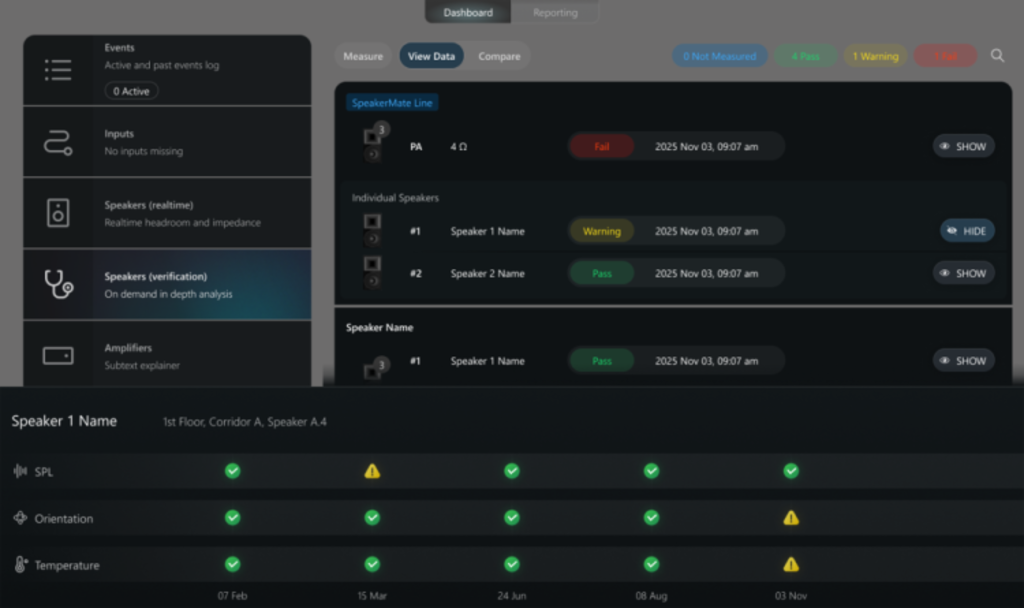
Caption: ArmoniaPlus Speaker Monitoring Interface
One example is NFC tagging via a mobile app, allowing the installer to assign speaker brand and model information before installation. When the system is brought online, ArmoniaPlus can then suggest appropriate presets automatically, reducing the risk of configuration errors. Sensors, data and diagnostics SpeakerMATE is more than an ID tag however, as it also incorporates a temperature sensor, an accelerometer and a microphone, and can interface with an external sensor via a GPI port. Together, these inputs enable a level of monitoring that has previously been unavailable in passive loudspeaker systems.
Temperature and tilt angle can be measured at set periods, while sound pressure level testing can be triggered on demand via the network. This opens up possibilities not only for faultdetection but also for performance verification and preventative maintenance.
The system also captures metadata, through the software interface users can access information such as speaker brand and model, project-specific naming, installation notes (including georeferencing), position within a multi-speaker
line, serial numbers, and records of who performed the tagging and when. This can help installers build up a detailed history of each loudspeaker’s role and condition within the system over time.
For on-site diagnostics, SpeakerMATE includes onboard red and green LEDs to indicate communication status, along with an external LED port for visual identification. In large or complex installations, this can significantly reduce the time spent locating specific speakers during maintenance or troubleshooting.
The benefits of SpeakerMATE are most evident in large, distributed audio systems where visibility has traditionally been limited. Hi-Z lines, in particular, can be difficult to troubleshoot, with faults often requiring time-consuming manual checks.
In shopping centres, granular monitoring of individual speakers enables faster fault localisation and instant alerts, with system status accessible remotely via MyUniverso. Airports can benefit from precise speaker localisation across terminal zones, supporting reliable paging and rapid response to failures. Stadiums and arenas can track speaker history and lifecycle data, simplifying maintenance across complex arrays.
Other specialist applications also stand to gain from the technology. In Dolby Atmos cinemas, SpeakerMATE can help detect misalignment and verify correct positioning, supporting consistent immersive performance. Theme parks and cruise ships, both characterised by vast, segmented audio systems, gain park- or ship-wide visibility with reduced downtime and improved safety.
Even in line array applications, touring or fixed, the technology offers new possibilities. By monitoring cabinet splay angles and frame tilt, it becomes possible to verify that physical deployment matches simulation, and to receive early warnings of potential mechanical issues.
Room to grow
Powersoft views AnyMATE as a foundation rather than a finished product. If we look ahead there is the possibility of licensing the technology to third-party manufacturers to allow wider ecosystem development, provided suitable amplifier firmware is implemented. This could accelerate adoption and encourage new use cases beyond those initially thought of.
Future expansion is also expected in safety-critical applications, particularly in major installations where system reliability and traceability are vital. As regulatory and operational demands increase, having detailed, historical insight into loudspeaker performance and status could provide a significant advantage. For integrators and end users alike, AnyMATE and SpeakerMATE represent a step towards smarter audio systems.
Rather than replacing existing infrastructure, they build intelligence into what is already there by transforming passive loudspeakers from silent endpoints into active participants in the networked AV environment.