Attendees came close to the 100k mark this year, but what was there to see once you were inside ISE 2026? The Inavate team picks out the overriding themes and product highlights during a hectic week at the Fira de Barcelona Gran Via.
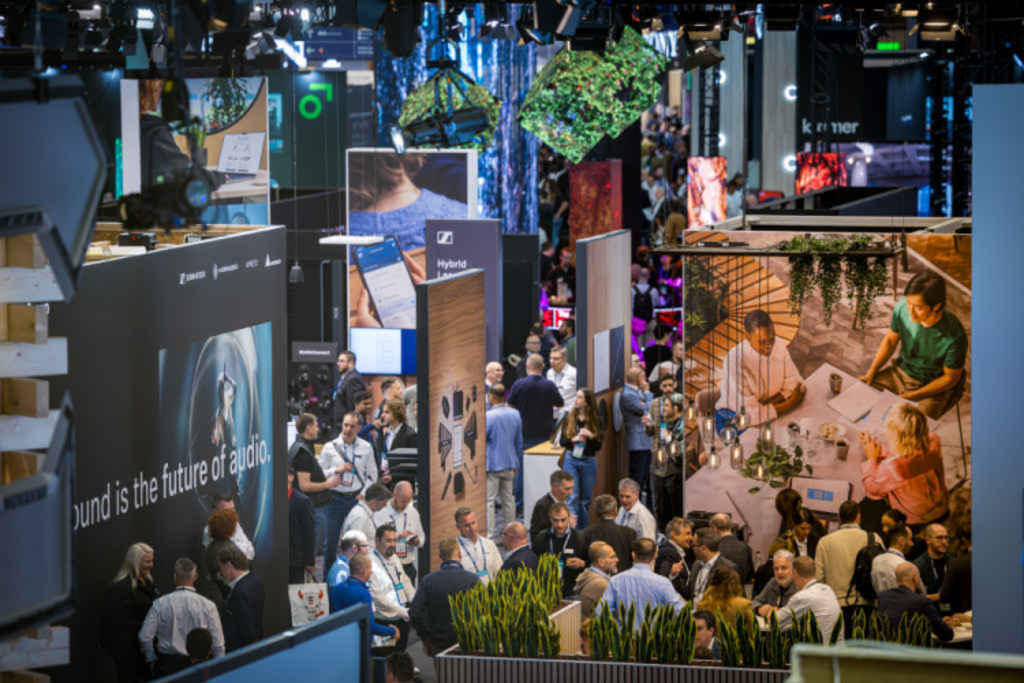
Let’s start with the numbers, shall we? The theme to this year’s ISE show was Push Beyond, and they certainly did that. ISE 2026 broke all records, with 92,170 visitors from around the world and 1,751 exhibitors (323 of those made their debut at ISE this year). This contributed to the largest total show floor space in the event’s history at 101,000 sq m.
The first day at ISE 2026 was up 10% on the opening day last year and Wednesday saw 64,198 visitors onsite, almost equalling the pre-pandemic record attendance of an entire ISE show (64,908 at ISE 2019 in Amsterdam). Overall, total attendance on last year was up another 8%. However, the numbers don’t always tell the full story. What was obvious from the outset was that ISE isn’t a European show anymore, it’s a global one. The numbers of visitors from the Middle East, APAC and North America were there for all to see. A few people have suggested the current political turmoil in the US is causing people, even in North America, to choose ISE over InfoComm until things calm down.
Partnerships
One of the biggest themes to emerge from the show was the importance of partnerships to manufacturers. They have realised they can’t offer everything themselves when it comes to AV, so are choosing a partner of similar quality to offer a best-of-breed package. For example, Sennheiser products were featured on 20 different partner stands at the show, including Barco, who announced its ClickShare Hub room system bundles will feature Sennheiser TeamConnect Bar product certified for Microsoft Teams. It makes perfect sense really. If you don’t have the time or money to create a product outside of your normal expertise, then why not partner with someone who has vast experience, and products ready to go, in that sphere?
IT giants like Google partnering with Neat and Pexip for example highlight not just the continued AV/IT convergence that we have discussed for what feels like an eternity, but the reality that we now work in an industry where the two spheres have no choice but to operate as one coherent ecosystem.
Another theme was the growing y-o-y importance of Microsoft, in particular the Teams Certified logo, it was everywhere you looked on the Crestron booth, which tells you how important that relationship has become to Crestron.
Having that logo is becoming a difference maker between selling a product or getting passed over for a competitor. Talking of Microsoft, its Android-based framework to help manufacturers deliver Teams-certified collaboration hardware, MDEP (Microsoft Device Ecosystem Platform) was also noticeably on the rise at ISE 2026 and was a regular topic of conversations on stands.
Crestron unveiled two touchpanels running on MDEP operating software. What is important is what the shift to MDEP enables. Speaking with Crestron revealed that MDEP is helping them have an easier time with the cybersecurity conversation. In addition, MDEP’s interoperability with Windows (both operating systems are developed by Microsoft) means that discovery and deployment of these touchpanels with a Collab Compute unit in the system for example are easier.
The Shure IntelliMix videobar is also running on MDEP. While other videobars with MDEP exist on the market, Jabra’s offering comes to mind, the fact that Shure chose MDEP to be the operating system for its videobar and first foray into the product vertical suggests that MDEP might just be here to stay.
Ease of use
Another factor at the show was that manufacturers have listened to system integrators and are now clearly targeting simplicity. That is evident in prioritising systems that are easy to install, easy to use for end users, and in systems that are packaged to make them easy to buy. It has been designed to drive adoption but also save integrator’s time, and as such is a true win-win scenario for everyone. One example of this was Jabra’s PanaCast Room Kits. Based around the Jabra PanaCast 55 videobar, to complete a true meeting room system the Room Kits are paired with a PanaCast SpeakerMic and the option of adding one, three or five Huddly PTZ cameras (another partnership), depending on the size of the room, which adds an AI-driven multi-camera system. Again, it’s about making it easy for the integrator by bringing everything into one tidy package.

Elsewhere on the show floor there was also increased mentions of NDI and SMPTE 2110, as the worlds of broadcast and AV become ever closer. Sony acknowledged this by saying it was ready to provide any broadcast system from huge opening ceremonies of global events down to providing the best setup for podcasters, and everything in-between. For a company with such a rich broadcast heritage, it was significant it is now acknowledging the big opportunity for smaller events with more modest budgets, under which a lot of education, retail, transport and corporate projects will naturally fall.
Audio keeps pushing on
d&b audiotechnik was at ISE 2026 to launch the U-Series, a new family of multipurpose point-source loudspeakers, opening a completely new chapter in the product category for the company. Powersoft could make a claim for one the most innovative new technologies at the show with AnyMATE. It offers identification, monitoring and data exchange directly to passive speakers, without requiring additional network cabling or external power.
Broadcast meets AV in the meeting room
One of the best new technologies at the show, which did not achieve the fanfare of those with bigger promotional budgets, was CaptivAIte from Vizrt (see pic below). It brings its broadcast heritage to AV by integrating AR graphics directly into Zoom Rooms, and really elevates what can often be drab video meetings into a far more attractive to watch TV-like spectacle, without the need for lots of broadcast expertise to run it. It’s a product that really comes alive in a live demo if you can get the chance to see it. It would be great to see integration with Microsoft Teams, as it is the dominant video meeting tech right now, and apparently that is coming according to Vizrt. If people really embrace this type of technology it could have a transformative effect on video communication.

Also firmly in that meeting rooms space was the launch of a new videobar from Shure. In what is a crowded market, IntelliMix Bar Pro stands out. The product seems to have hit all the right notes and comes with all the functionality a modern, high-end videobar should have. Shure has partnered with Sony for the camera sensors, and there are four cameras strategically arranged to capture visuals up to a depth of 8.25m. The cameras are also arranged in a manner
to eliminate the ‘bowling alley’ representation of the meeting room. The four-camera array enables up to four participants to be framed simultaneously, increasing equity when several people are contributing at once. Shure’s microphones and speakers handle audio duties.
Compute is required in almost every modern meeting space. It is normally present in the form of a Dell or Lenovo PC. But with Collab Compute, showcased at ISE 2026, Crestron has provided an extremely compelling alternative. Based on a specifically designed chipset with the Intel Core processors, Collab Compute brings more processing power to the table in a half-RU form factor with a slew of ports and connectivity that AV needs. Of particular note is the addition of a USB-C port, which is there to enable 21:9 display support if needed.
Importantly, Collab Compute seems to be a product that is equipped to be ready for future developments. The increased processing power bodes well for the advent of AI, especially if the compute requirements for AI applications get
shifted from the cloud to the edge which is an expected eventuality.
Picking up on the thread of USB-C, Lightware’s Taurus product remains the gold standard for fully featured USB-C connectivity. At ISE 2026, Lightware added a USB-C extension product to its lineup. As more personal devices come equipped with USB-C the demand for power over USB-C continues to grow and Lightware’s extension device is specifically intended to address this demand. It’s not an earth- shatteringly innovative product, but it is one that is going to enable integrators to meet client requirements.
At ISE 2026, Panasonic used its latest round of product announcements to underline a clear strategic direction: reducing complexity in pro-AV while expanding performance and flexibility across display, projection and broadcast workflows. At the centre of the move is the continued evolution of Panasonic Projector & Display Corporation as a standalone business, a structural change that CEO Yousuke Adachi says is already accelerating decision-making and sharpening customer focus. Speaking to Inavate, Adachi said: “That speed of communication is very quick now. This is very much helping our operation and is appreciated by our partners.” That partner-centric thinking is most evident in Panasonic’s latest LED launch: a 55-in dvLED display panel designed to slot into existing LCD workflows.
By integrating the controller directly into the panel and supporting standard VESA mounting, Panasonic is deliberately positioning the product as a familiar upgrade path rather than a specialist LED deployment. A similar philosophy underpins Panasonic’s latest projection announcements. The new PT-HTQ20 projector brings Rec.2020 colour performance to a 1-chip DLP platform, narrowing the gap with 3-chip systems traditionally reserved for premium immersive applications.
A maturing sector
An honest conversation about LED at the show has to be had. ISE 2026 was truly an example of quantity over quality. If you ventured anywhere near Hall 3, then you would find yourself adrift in a sea of LED screens of varying quality. Manufacturers like Absen, LG, Samsung, and INFiLED continue to produce high quality products, but we cannot ignore the ocean of LED manufacturers offering products of shoddy construction and lacklustre content that seemed to dominate the halls through sheer numbers alone. While ISE will, quite rightly speak with pride about its record breaking number of exhibitors, quantity comes at a cost, and that cost appears to be quality.
Pixel pitches in LED are now stable, and no new barriers were broken at ISE. However, a number of manufacturers were showing off transparent LED displays. The most prominent of these was at the LG booth where a four-sided pillar of LED was equipped with a perimeter of transparent LED. To spice things up further, the transparent LED traversed the length of the column providing an example of how complex content interactions can be created by merging traditional LED and transparent LED together.
Unilumin unveiled the U-Natural as a finished product ready to ship to ISE 2026. A prototype was showcased at ISE last year. The LED tiles come with textured finishes, allowing any LED videowall created with the U-Natural tiles to blend into the environment. The U-Natural LED tiles address a major shortcoming of LED videowalls, namely that when the display is not in use you are left with a large, unsightly, black rectangle on your wall. The technology is interesting, but the trade-off for having a textured LED tile comes in the form of reduced performance. Whether or not this trade-off is worth it is subjective and the decision to implement U-Natural would come down to the preferences of the user. With no real advances being made with the LED tile itself, perhaps it is time to start looking at the complete signal chain to see if improvements can eke out better performance.
At ISE 2026, Novastar was showcasing its Infinity processing platform which was based around the TBS A1664 LED chip. Infinity aims to bring PAM (driving current) and PWM (pulse width modulation) hybrid driving technology to the table. The idea is to provide every LED tile with customised power to unlock its full potential.
Designed for scale
Christie’s Sapphire projector made an appearance at ISE 2026 and it is now available in a 40,000 lumens brightness package. The projector uses a hybrid light source using components of both laser phosphor and RGB lighting technologies. The promise is the best of both worlds. A specific application that seems appealing is the use of RGB lighting in rear projection applications, an outcome that is not possible with pure RGB light sources. Christie also claims the hybrid lighting technology enables it to reduce the size and weight of the projector, advancements that are sure to make rental and staging professionals happy. Barco launched three new RGB projectors to its QDX platform, aimed at themed entertainment and high-profile installations. All three models, 25k, 34k and 38k lumens, all cover the Rec.2020 colour gamut.
A spatial shift
Surprisingly, flat panel displays emerged as one of the most exciting product verticals at ISE 2026. The technology was showcased primarily in retail application settings, but astute professionals could possibly take the products and make them do more. First up, an interactive 3D system created with a Sony flat panel display and StarKit by Ameria. Essentially, a lenticular 3D display with gesture control built in due to the presence of cameras, the 3D display solution is designed to give one person the ability to interact with a virtual product. With gestures the virtual product could be viewed, rotated, enlarged, and more.
Over at the Samsung booth, Spatial Signage was capturing the attention of visitors. Essentially a flat panel display with depth of field added and no significant increase in the size of the panel, the setup at Samsung showcased how retail displays could be taken to a new level. Faytech and Looking Glass had partnered up to showcase its Hololuminescent display, which was effectively a competitor to Samsung’s Spatial Signage product. What set the Hololuminescent display apart was the fact that it came with touch capabilities. The applications of these holographic flat panel displays extend beyond retail. As content creation becomes democratised and gen AI becomes better we expect the creation of realistic avatars to become more commonplace. These holographic displays seem to be the perfect canvas for avatars. Experience centres, wayfinding, museums, and attractions could all find uses for this next generation of flat panel display.
ISE 2026 will undoubtedly go down as a success for all concerned. Its real value, many have argued, lies in the networking opportunities gained by having most of the global AV industry in one place at one time. Product innovation is definitely slowing down, and jaw-dropping innovations are becoming a rare animal, but it was heartening to see so many manufacturers looking forward and embracing new technologies and standards (MDEP, Spatial NDI, SMPTE 2110) etc) and embracing a customer-first ethos.