The billion dollar, multi-decade build of the Grand Egyptian Museum in Cairo has created a building
fit for a king. Paul Milligan explores this extraordinary project with the integrator involved.
It couldn’t be more aptly named because everything about the Grand Egyptian Museum is just that. It’s the world's largest archaeological museum, with more than 100,000 artefacts covering 7,000 years of the country's history from the 30 dynasties of ancient Egypt. It is the largest museum in the world dedicated to a single civilisation.
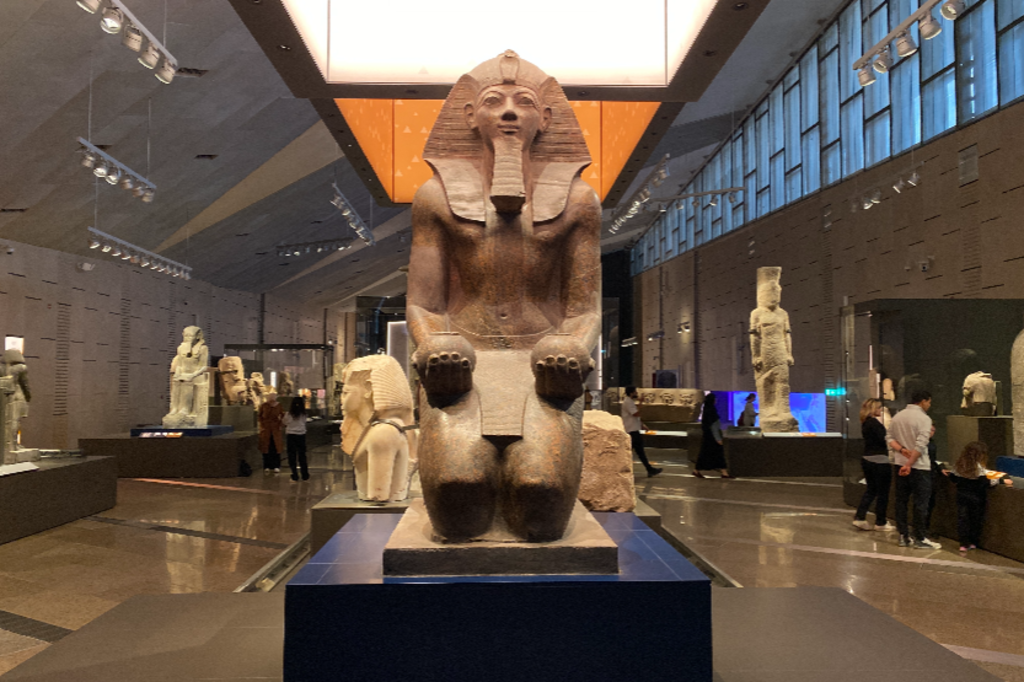
The Grand Egyptian Museum (GEM) cost €1.1bn to build, with an AV budget alone of $12m (€10.2m). The project was financed by the Egyptian government and Japan International Cooperation Agency (JICA). GEM is expected to attract up to 8 million visitors a year on a site covering almost 500,000 sq m. By comparison, The Louvre in Paris is 72,735 sq m in size. It’s a 6km walk for any visitor who wants a complete tour of the GEM site.

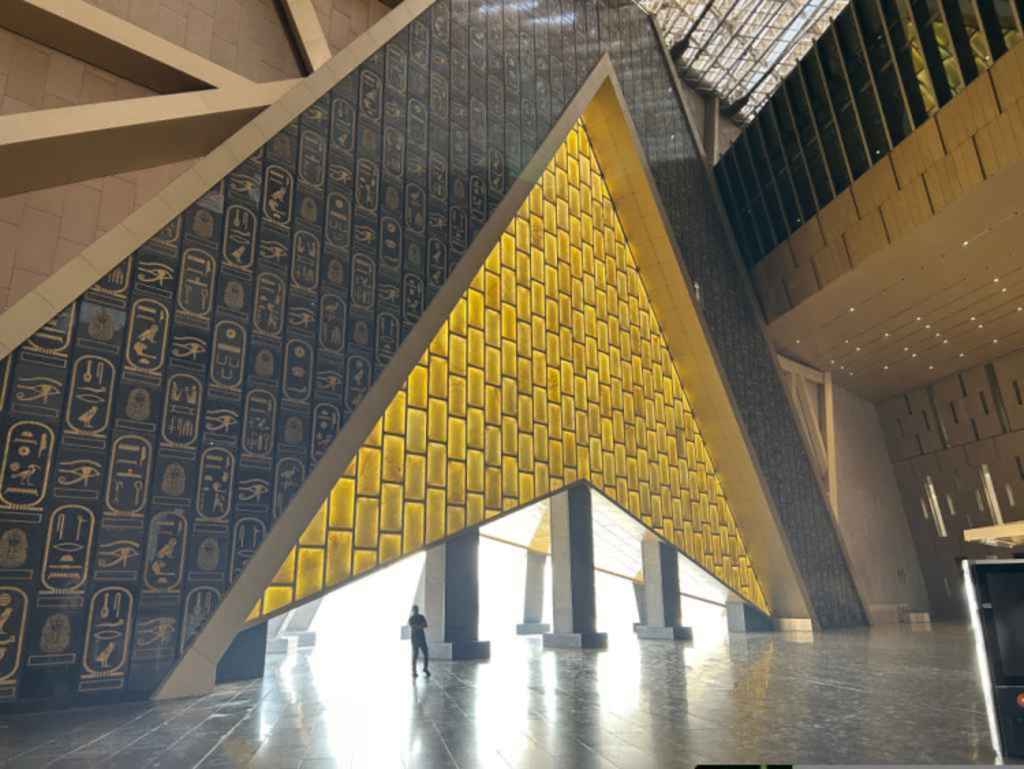
The building is extraordinary looking from the outside, it’s been designed by Heneghan Peng Architects in the shape of a chamfered triangle, echoing the geometry of the pyramids that sit just 1.2 miles away. In keeping with its surroundings, the exterior is covered in hieroglyphs with a pyramid shaped entrance and has been built using sand-coloured concrete.
The museum was built by a joint venture of Egyptian Orascom Construction and the Belgian BESIX Group. The client was the Egyptian Ministry of Tourism Antiquities, Hill International was the project manager, and the project also saw the involvement of design houses Atelier Bruckner from Germany and Haley Sharpe from the UK.
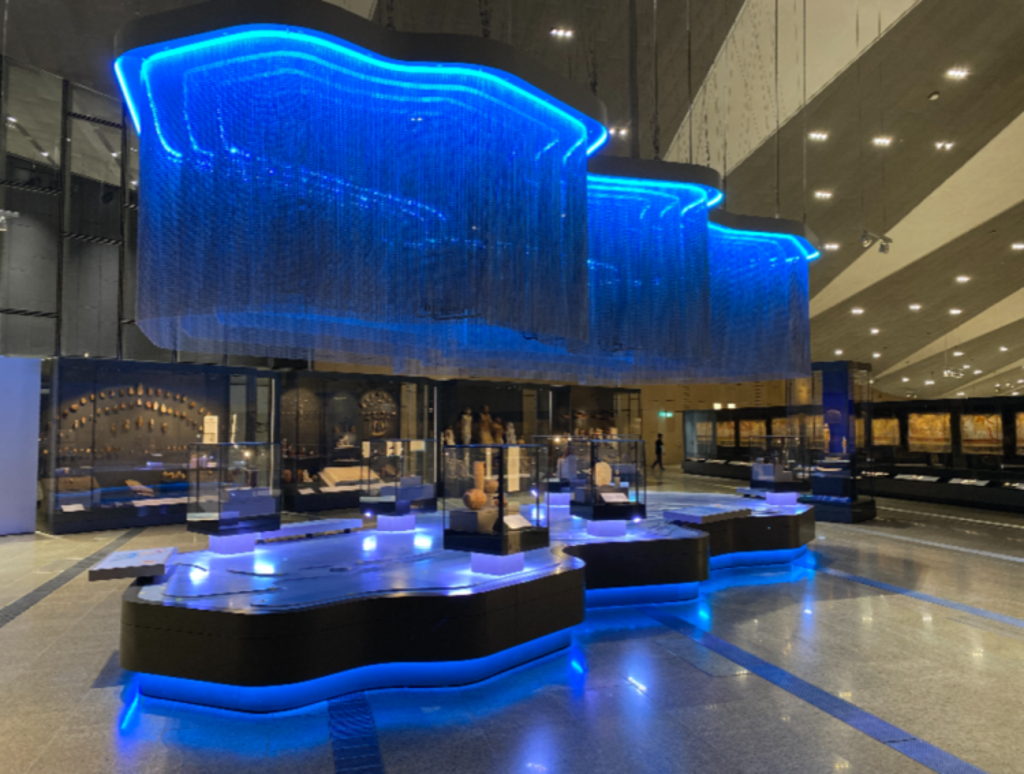
The museum complex includes the main building, a conference centre, a children’s museum, a courtyard, a Nile Valley park, the Khufu Boat Museum and one of the largest conservation and research facilities in the world, featuring 17 specialised laboratories safeguarding Egypt’s vast heritage, connected to the main building via an underground tunnel.
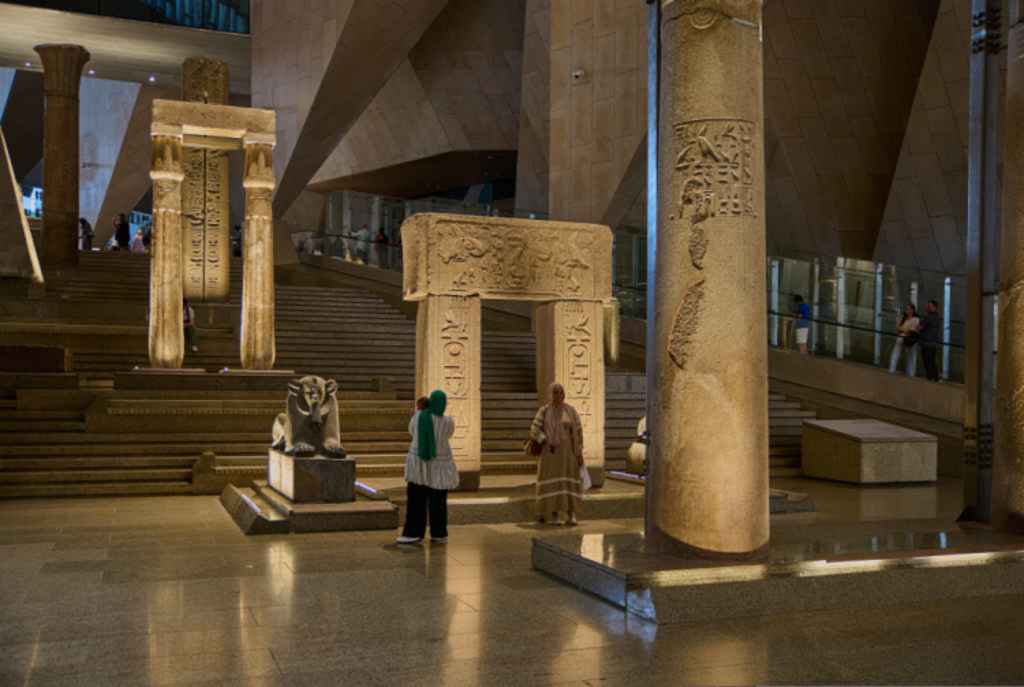
At the heart of the museum lies a six-storey staircase lined with monumental artefacts, which then lead visitors chronologically through Egypt’s history. The journey culminates at the top floor, which features the Tutankhamun gallery, including the boy king’s gold mask, throne and chariots, before opening out to a panoramic view of the pyramids.

Even the construction of the GEM was an epic task. The project was officially launched by President Mubarak in 1992, who wanted a new museum in which to consolidate ancient treasures, in 2002, the foundation stone for the project was laid, in 2005 construction work began, a couple of pauses in the work followed due to political instability, with work resuming in 2014. GEM was fully inaugurated on November 1, 2025.
Tasked with designing and installing all the AV inside was Egyptian Engineering Projects Co - Quality, a system integrator based in Egypt. How did Quality get involved in the project in the first place? “The client knew our capabilities, especially in the museum and heritage vertical, so they approached us for some assistance,” says Quality managing director Mohamed Attia. Quality won the AV tender for the first phase initially but subsequently won tenders for another three contracts as the process continued.
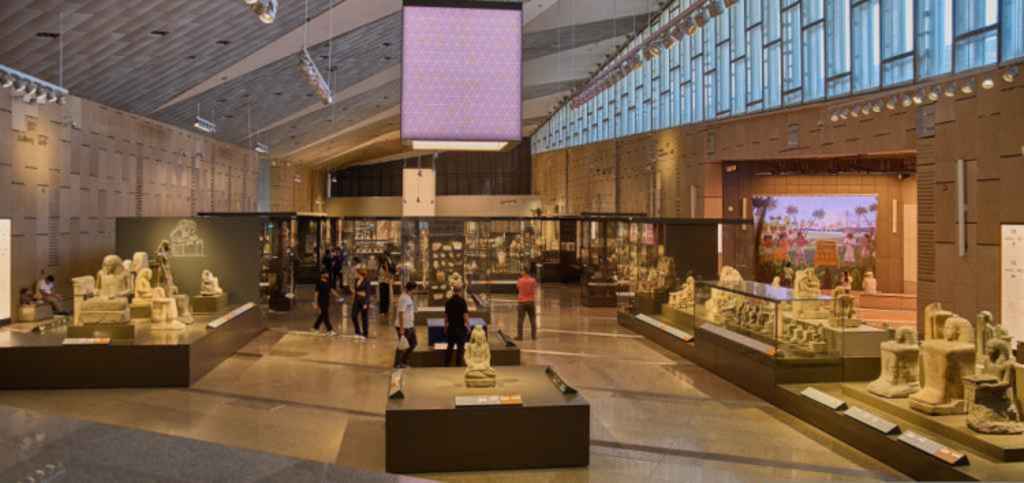
In those first meetings with the client, what did they wanted to achieve with this project? “The main conversations were about the message and the theme and [adhering to] the storyboard. We needed to understand the storyboard very well to be able to give our input. It's easy to just fill in a BoQ, this is not what this museum is about. We had to sit in many meetings with the exhibition designers to interpret their storyboard and put in elements that don’t take anything away from the artifacts but still give the museum experience a lot of interactive add-ons.”
The finished result is a unified digital infrastructure interconnecting more than 120 multimedia exhibits, projection systems, LED walls, touch interfaces, directional audio zones, interactive tables, HoloLens stations, and digital signage displays, all coordinated through network switching and real-time show control. Galleries feature multi-projector mapping, ultra short throw (UST) calibrated systems, panoramic LED configurations, curved LED canvases, and 3D mapped table models.
Other key elements at GEM include a mission critical command and control centre. The overall modular design of the GEM supports any new temporary exhibitions that may come in, any possible expansion plans, and evolving formats with minimal operational disruption.
Due to a clever architectural design, visitors can follow different paths through the GEM, they can travel through different periods covering the same theme - Society, Kingship, or Belief – or go from hall 1 to 12 which will take them chronologically through eras. Upon entering the museum, visitors are greeted by the 3,200-year-old, 83-tonne, 11-metre high statue of King Ramses II, re-located from its previous home in front of Cairo’s main train station.
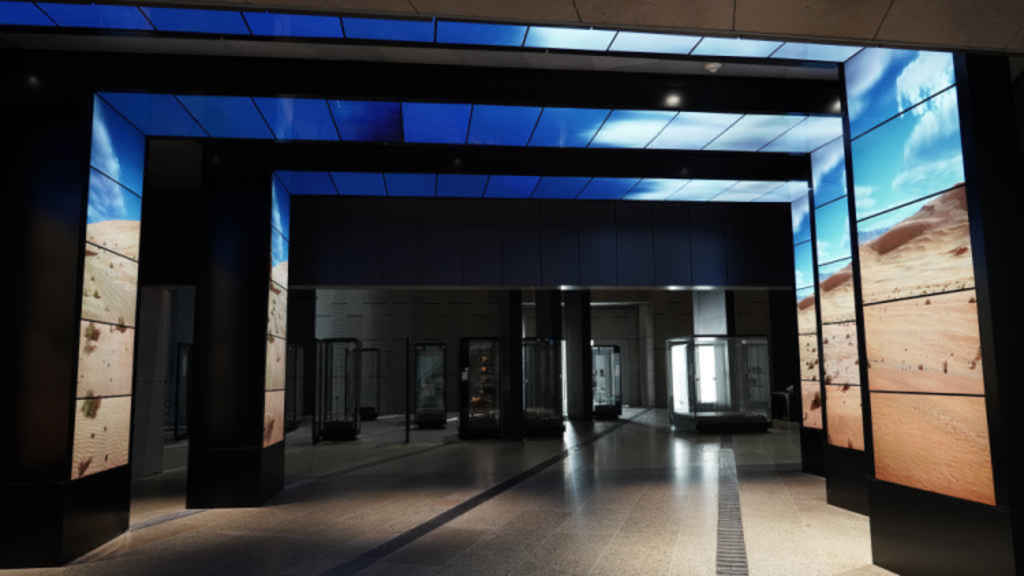
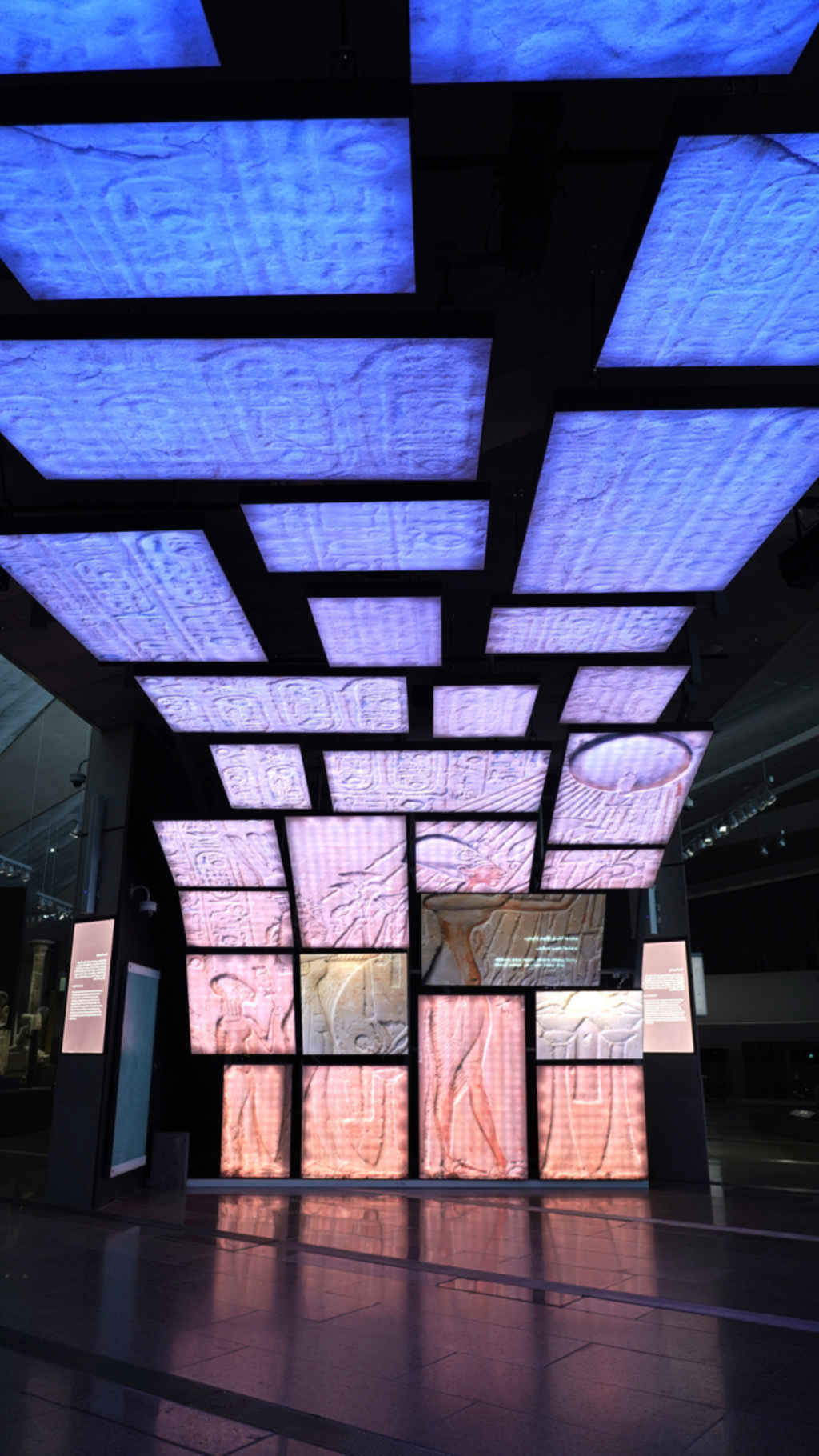
The museum’s most prominent and largest exhibition space is the Tutankhamun Gallery. Installed at the threshold of the Tutankhamun Gallery are three suspended screen ribbons each formed of 21 LG OLED panels. Visitors walk beneath the structure as it plays a film introducing the life and legacy of King Tutankhamun.
The OLED tiles create a floating, sculptural canopy that blends digital art with the physical environment. Three synchronized SureVue media players feed the display ribbons, each connected to the museum’s digital signage server for centralised scheduling, asset management, and unified playback control.
The Valley of the King Discovery exhibit uses an integrated multimedia system that synchronises elo 24-in touchscreens, lighting cues, and digital content to guide visitors through the story of Tutankhamun’s tomb. Networked mini PCs and media players deliver visuals across multiple interactive stations.
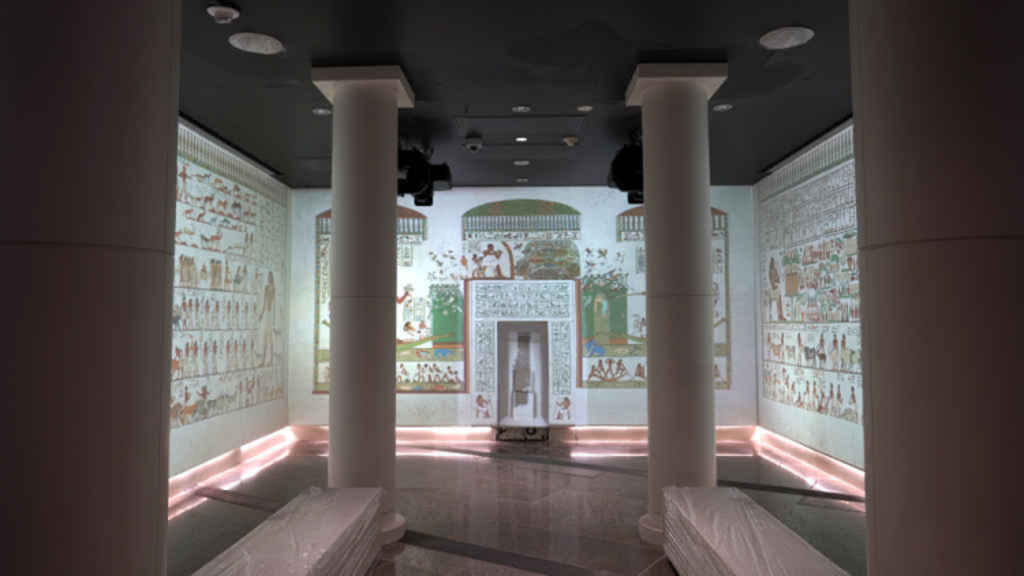
The Tomb Discovery gallery uses projection mapping, synchronised displays, and a central video management platform to recreate the moment of the tombs uncovering. Panasonic 10k laser projectors, smart glass partitions, and networked media controllers work together to guide visitors through the steps of the discovery and reveal the people behind it.
The Cinema Box presents a fully immersive media sequence that puts visitors inside the unfolding story of Tutankhamun’s discovery. Panasonic PT-RZ970 laser projectors, layered narrative audio, and synchronised content playback recreate the atmospheric moment when the tomb was first revealed. UST projection lenses ensure large format images within what is a confined gallery space. Crestron NVX AVoIP provides low latency video delivery from the central media server to the projection system.
BrightSign and HP Coolux ensure centralised control of video content, timed show triggers, and content scheduling. A Bosch digital audio system with ceiling mounted loudspeakers delivers immersive spatial sound tightly synchronised with the film.

Still in the Tutankhamun gallery is an exhibit called His Appearance – Identity. The installation uses a Samsung 46-in videowall paired with Blackbox video extension systems to portray a reconstructed facial model of Tutankhamun. The experience is centrally managed via Crestron NVX. The next exhibit examines the wrapping and characteristics of Tutankhamun's mummy displays on a media table built around a Samsung 46-in videowall delivering a multi- layered mummy visualisation.
The entrance to the main galleries uses Fohhn steerable line array speakers combined with a unified QSC DSP core to deliver immersive sound across the entrance zone. This allows for an atmospheric and dramatic soundscape to be directed exactly where needed, without disturbing adjacent galleries. The system is fully networked over Dante, enabling remote control.
Throughout the 12 galleries, audio is via a mix of Fohhn DLI-130 controllable line source speakers, QSC amps, speakers and DSP. Media delivery is via the Crestron NVX AVoIP platform, and uncompressed 4K media is driven by AV Stumpfl Pixera media servers.

The Map of Early Egypt is a central feature in gallery A07; the map tells the story of Ancient Egypt through the use of five edge-blended Epson 15k laser projectors mapped onto a 3D surface to animate seven key archaeological sites and their corresponding historical periods.
QSC provides spatial sound to accompany each illuminated region, creating an engaging narrative that guides visitors through the development of Ancient Egypt up to the Old Kingdom. Gallery A08 connects the Society and Kingship galleries through the Giza pyramids and the lives of the people that built them.
The digital stream uses a 6.7m x 3.7m Planar LED videowall and a fully integrated AV playback system to present a cinematic introduction to the Age of the Pyramids. Gallery B08, entitled ‘Tombs of Bani Hassan’, gives visitors who have just viewed the Mesehty collection the chance to discover the tomb of another non-royal local ruler.
The Khnumhotep Tomb gallery uses projection mapping and spatial audio to bring the wall scenes of the tomb to life. Six Epson 15K UST laser projectors create animated overlays on the tomb walls. QSC DSP drives a distributed ceiling speaker array to deliver site specific sound cues that guide visitors as they decode the life of Khnumhotep.

Gallery C8.2 take visitors to the land of Punt with the use of a 4.75m x 4.5m Planar LED wall (1.9mm pixel pitch), to provide a sweeping panoramic window into the exotic land of Punt. Steerable Fohhn line array loudspeakers provide directional, immersive audio that surrounds the audience with music, ambient nature sounds, and narrative cues.
Still in Kingship, gallery D09 gives a visual recreation of street life in Alexandria during the Ptolemaic period. Rear-projected Epson laser projectors animate Ptolemaic era figures onto a Prodiffusion film applied to glass, turning each pane into a digital window into ancient Alexandria. A Panphonics directional sound shower delivers focused audio directly to the visitor standing in front of each scene.
The Book of Two Ways in gallery B10 uses synchronised UST Epson 15K projection and QSC spatial audio to illuminate two opposing walls with animated Middle Kingdom coffin texts. Gallery C10 entitled ‘Hymen to the Aten’ uses an Epson projector with short throw optics to create a back projection environment that visualises Akhenaten’s spiritual concept of the Aten.
Another floor within the GEM features four caves, Cave 1 is the ‘Priestess of Hathor’ and provides an exploration of the life and death of inhabitants in Egypt’s first purpose-built community - Deir el-Medina. The space is given an eerie atmosphere via a multi-zone spatial audio system featuring ceiling and surface mount speakers (all QSC). As the visitor continues around the caves, they will enter the Amduat/Hatshepsut Blocks area.
Here a sculptural AV installation surrounds the limestone with custom shaped LED screens that reveal key scenes from Ra’s journey through the underworld. Gold walls rise to frame the original blocks, while a series of Planar CLI 1.9 LED tiles (flat and rhombus-shaped) wrap around the integrated display case to create a storytelling canvas.
Cave 4 is entitled ‘Alexandria Under Water’ and tells the story of Alexandria and underwater archaeology via a looped ‘Sunken Cities’ video. A Planar 1.9mm LED screen delivers visuals complemented by multiple LG displays showing detailed narrative segments. Molitor inductive handsets provide intimate, artifact linked audio moments.

The Children’s Museum features six identical classrooms, all full of technology and a range of exhibits with interactive elements – multitouch displays and motion capture for example - to educate and entertain the next generation of Egyptologists.
While it is difficult to pick out areas in a museum so stacked with such a high level of AV quality, the HoloLens Experience Room enables visitors to experience the GEM collection in a new way. It’s a mixed reality environment for visitors to interact with ancient Egyptian artifacts using Microsoft HoloLens headsets.
The headsets allow participants to view digitally reconstructed objects, explore hidden layers, visualise original colours and shapes, and observe artifacts as they once appeared thousands of years ago. The room is equipped with an NEC videowall, Epson 15k projectors, immersive audio from Extron and Dynacord, controlled theatrical lighting, and a disinfection station for headset hygiene.
It’s easy to assume all the impressive AV is only for the visitors, but a museum this size needs a central hub, and at the GEM that is the impressive command and control centre. Resembling what you would see in a highly secure government or airport environment, the GEM is home to 22 operators (and two supervisors) and provides 24/7 monitoring and coordination of all museum systems including AV, security, safety, digital signage, and building infrastructure.

At the heart of the room is a 3x6 1.8mm NEC LED videowall managed through the eyevis software platform, enabling operators to visualise live camera feeds, system alerts, dashboards, and AV network statuses. To give you another idea of the scale of this whole operation, there are 1,500 CCTV camera in the museum monitored by the command and control centre.
As you can imagine for a project of this size, this project has been a real labour of love for Quality. It’s been involved for nine years, and on-site for seven years. Spaces were finished at different times, so Quality would work on completed spaces and then move onto the next one.
What were the most difficult parts of the project for Quality? “There's no tolerance for mistakes. Everything has to be perfect. Everything has to synchronise with each other,” says Attia. “The most challenging part for us is to give our input for the technology, but for it to not take away the heritage and glory of the artifacts. It was about making a balance between this unbelievable civilisation and technology.”
So how did Quality find that level between offering something new and fun and interactive, but also honouring the ancient artefacts housed inside? “That's the brilliance of the storyboard. It gives you the background so you can use your tools to interpretate the story. Museums can be boring unless you are a researcher or scholar.
The technology was here to keep the visitor experience interesting, and to keep it interactive and to keep challenging your thoughts, challenging what you see and what you don’t see. For example, when we did the video mapping for the Valley of the King map, this is the only way that you can explain the value of the king,” explains Attia.
Quality has worked on every square metre of the GEM says Attia with a wry smile, and it is a fantastic achievement by his company to work on such a prestigious project, for such a length of time, and still produce results of the highest calibre.
The desire to bring so much of the deep history of Egypt under one roof for the first time must have placed an enormous challenge on the shoulders of an Egyptian AV company, and the pressure to deliver will have been enormous. Luckily for all the visitors to come over many years, what Quality has done at GEM will stand the test of time, much like the artefacts packed within its many halls.
KIT LIST
Audio
Behringer HA 400 amplifier
Biamp Tesira Forte DSP
Bosch PLM-8M8 audio signal processor/matrix mixer
Dynacord PCL-1225T amplifiers, CMS 600 3 mixer, DSA 8209 amplifier
Electro-Voice EVID 4.2 T speakers
Extron SI 26T speakers, SI 3 speakers, SF 10C SUB subwoofers, SM 3 ceiling speakers
Fohhn DLI-130 DAN line array speakers
Jocavi acoustic panels
Molitor USO handsets with inductive function
Panphonics SSHP Sound Shower directional speaker, AA 160e amplifier
QSC Core 110F DSP, AD-S6T speakers, AD-C6T-LP ceiling speakers, CX-Q 4K8 amplifiers
Video
AV Stumpfl Pixera media servers
Brightsign XT244 media players
Blackbox video extenders, USB extenders
Coolux software
Draper Profile+ projection screen
DynaScan 55-in outdoor displays
Elo 2494 L touchscreens
Epson EB-L1755 laser projectors
eyevis NPX-4900-Plus videowall controller, Unify wall management software
Extron DTP HDMI 4 K 230 transmitter/receiver
LG 32SM5E 32-in and 98UH5E 98-in displays
NEC E 233 WM monitors, P554 SST 55-in interactive LFD, X554UNV-2 55-in videowall displays, 55EH5C 55-in dual-sided displays, EX341R 34-in curved displays, X551 55-in display, C862 Q86 86-in displays
Panasonic PT RZ 970 projector
Peerless videowall mounts and kiosks
Planar CLI 1.9 and CLI 1.9Flex LED tiles
ProDiffusion rear projection film
Samsung UH46F5 videowall panels, OH55F 55-in outdoor displays
SureVue D1, D4 and D6 media players
Control
Crestron DM-NVX-D30 decoder
IMAGES
credit: shutterstock/Turkey Photo
credit: shutterstock/Colinmthompson
credit: shutterstock/Creativity lover
credit: Grand Egyptian Museum