Trison delivers eyepopping visuals with undersea wonder
at a cutting-edge aquarium. Reece Webb dives in.
Trison has delivered a state-of-the-art visual system for the Aquarium de Barcelona, designed to be shareable on social media while preserving the aquarium’s natural, free-flowing atmosphere.
Built around three themes-digitalisation, sustainability, and modernisation - the project first took shape after the client visited Trison’s stand at Integrated Systems Europe, which featured an LED floor with interactive fish.
“The aquarium needed refurbishment and was looking for ideas around digital transformation,” says Alfonso Alonso Yubero, business development manager at Trison. “We went to the aquarium to understand the space, the client’s journey, and the feeling they wanted visitors to take away.”
Trison was tasked with delivering a turnkey system that integrated visual and audio hardware, playback systems, content creation, and centralised management using a software platform that is accessible via tablets.
Trison delivered approximately 5,400 sq m of LED screens, with 80 displays dotted in and around the aquarium.
Arriving at the aquarium, visitors are welcomed by a 16:9 digital façade bristling with 3D content and synchronised audio, with a ‘hologram’ in the ticketing area to guide guests, while an LED screen at reception provides introductory information for visiting groups.
“The customer was moving from analogue to digital on the façade which was a simple move,” explains Yubero. “We knew that we needed to do something different because the aquarium is in an area where there is a big shopping mall, so we had to inspire and attract people to come in. We used a ‘holographic’ videowall so people can see live animals in the middle of the entrance. This is a very good place to attract people in. It was not only the technology but the content that made the difference. We worked with the client to create an end-to-end solution.
“The most important thing is the platform for the content, and we have a studio that creates in-house content for the screens. We taught the client that you can do a complete content programme for commercial messages, more educational content, as well as promotions or just showing sea life and content about the city. The customer discovered the real benefit of the technology is its flexibility, communicating in a very dynamic way.”
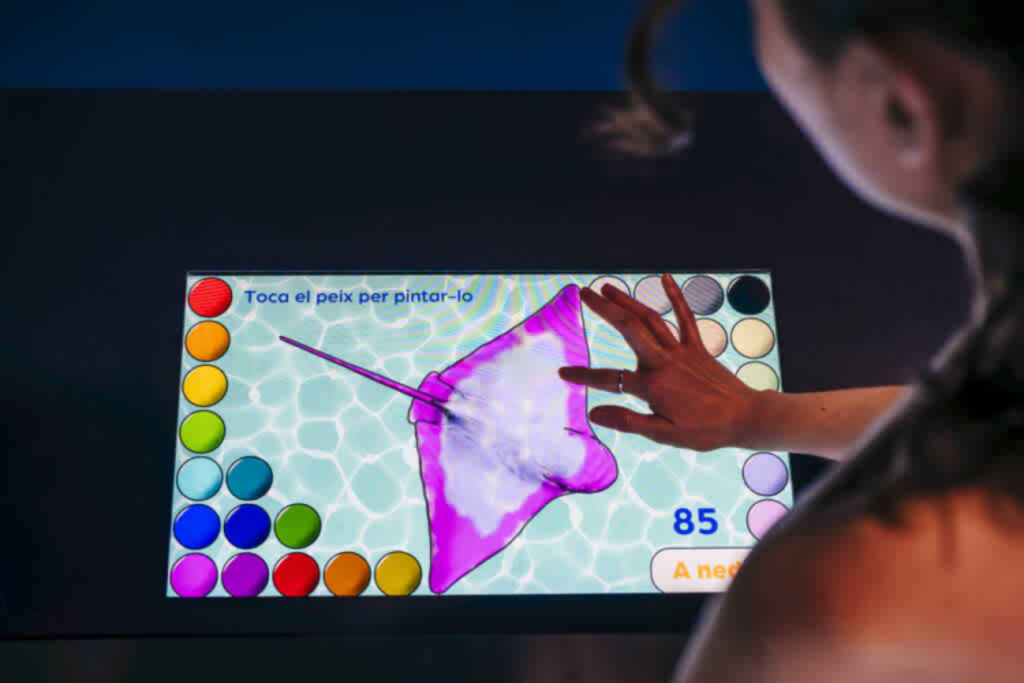
Moving into the main hall, Trison supplied LED screens, including a social media-centric display that is purpose built to be used with social media apps such as Instagram and TikTok.
“The format of the screen is 1:1 for social media”, says Yubero. “This is flexible, you can use it directly with apps like Instagram without making crops. There are lots of school groups that come through, so this welcome area is the right place to put a personalised message to this group. This is where the teachers welcome the schools, sit them down, and they can teach with this screen.”
Pushing on, Trison delivered what it calls a digital sea, which is located as visitors approach a bridge overlooking the Barcelona harbour. The integrator delivered an impressive volume of LED flooring, used in conjunction with mirrors and immersive content to quite literally immerse visitors in an undersea world.
Yubero explains: “The digital sea needed to mix with the harbour completely, as if the water was entering from outside. As you go down, we wanted to give the feeling that you are diving deeper into the sea. We supplied a massive screen, one of the biggest in the world with 300 sq m of LED flooring.
“The key focus was that we did not want the digital to replace the natural, as it would never look the same. As a result, we decided to make some waves as if they are on the beach, and introduce some animals such as whales and dolphins. It’s designed as a digital complement to the aquarium; the main stars are, of course, the sea life.”
Between the next two bridges, a vertical LED screen is designed for further social media interaction. Trison delivered a few different concepts for this space, including a 90-degree screen for a 3D effect, however the client decided to go with a design that allows people to stop there and grab a selfie.
Moving to the aquarium spaces, there is an immersive room where projection is combined with spatial audio and an LED ceiling above the escalators, creating a digital aquarium that takes visitors deeper into the depths than any physical aquarium could realistically go.
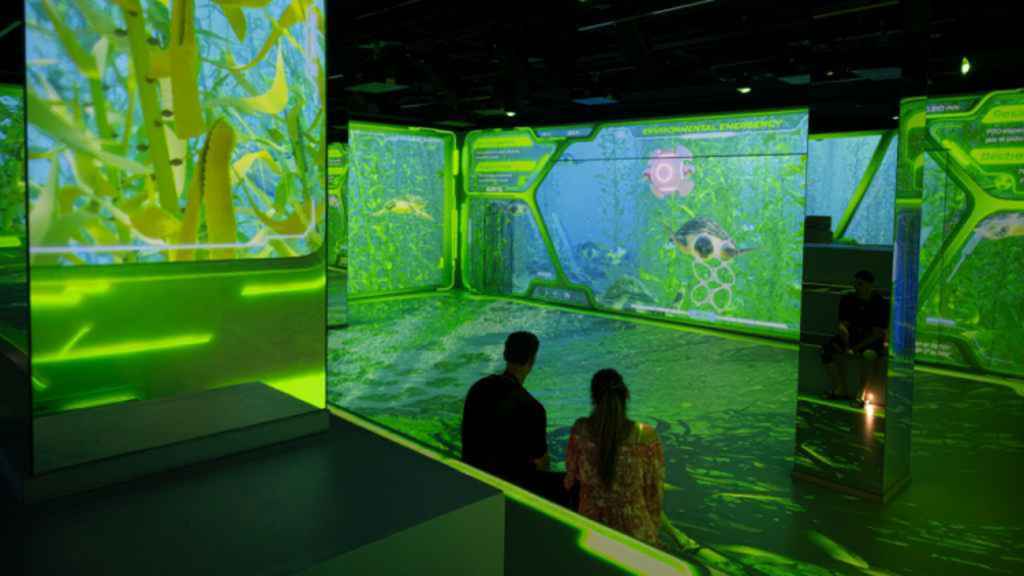
Yubero says: “We work with synchronised content to create a trip, taking you from the surface to 12,000m under the sea. This teaches visitors about how each level of the sea is different. We also show some deep sea life that isn’t present in the aquarium. This concept has been so successful, that the customer has asked for another immersive room, which we are delivering in an aquarium in Lyon.”
Horizontal 75-in monitors were installed throughout the aquarium’s exhibits, positioned along the sides of the tanks to display information about the fish and allow content updates when species change.
“We made another wall effect with Black Magic Glass,” explains Yubero. “It is displayed like a gigantic mirror and shows content of fish from the abyss, fish which are typically considered ugly. We made a digital copy of the fish, not exactly the same, which appears and disappears in the display. The Black Magic Glass is next to some of the tanks and is designed to move people along to the next exhibit.”
Trison supplied an audio system that was minimalistic in nature, reflecting the muffled, undersea soundscape experienced in reality, creating a feeling of natural ambience. The system itself is controlled through touchpanels, which had to be easy to use. Yubero comments: “The customer has a customised control panel so they can change opening hours, turn the system on or off, and prevent unauthorised access.”
The aquarium remained open during the 18-month installation, requiring Trison to work in challenging conditions without disrupting visitor flow. “The logistics proved challenging as some items did not arrive on time and we had to coordinate closely with the client and other contractors. We are used to this, as we see ourselves as part of the team working to deliver the project.”
Ultimately, Trison worked in a collaborative partnership with the customer, focussing on solutions rather than technology. “We helped the customer to optimise their investment, and we went through many technologies that are in different projects. Here, they are all brought together in a place that never closes. It was great to work on a place like this.
“This was a big investment for the aquarium,” says Yubero. “The customer became a consultant, as they could see the potential of the technology, and the collaboration proved valuable for both sides. We learned a lot from the project. Today, we are working on three projects with other aquariums, and our experience on this kind of space was invaluable.”